Agave appraisal guide
Even with the same "Agave titanota," prices range widely—from several thousand to hundreds of thousands of yen. This is because factors such as individual size, compactness, serration prominence, rooting condition, origin (seed-grown or division), and cultivation years directly affect valuation. Here we explain what to examine to understand price differences.
What determines the price
Size and Plant Fullness
HighThe more leaves present and the larger and fuller the overall plant, the higher its evaluation. Even among the same variety, large specimens cultivated over many years are rare.
Compactness (Leaf Density)
HighPlants with tightly spaced leaves and a rosette that forms a compact, "tight" structure are highly valued as evidence of good cultivation skill. Plants with etiolation (excessive stretching) receive lower evaluations.
Serration shape and quantity
HighThe thicker and longer the serrations on the leaf margin, and the more prominently they protrude left and right, the higher the ornamental value is considered. Serration appearance varies by lineage.
Rooting status
MediumPlants with well-developed roots have lower transplant establishment risk after repotting and can be traded with greater confidence compared to unrooted specimens (bare cuttings).
Origin (seedling / division and import / domestic cultivation)
MediumThe origin itself influences price—divisions that inherit parent plant characteristics, superior lineages with stable traits, and plants long-acclimated domestically.
Appraisal points
Observe rosette symmetry
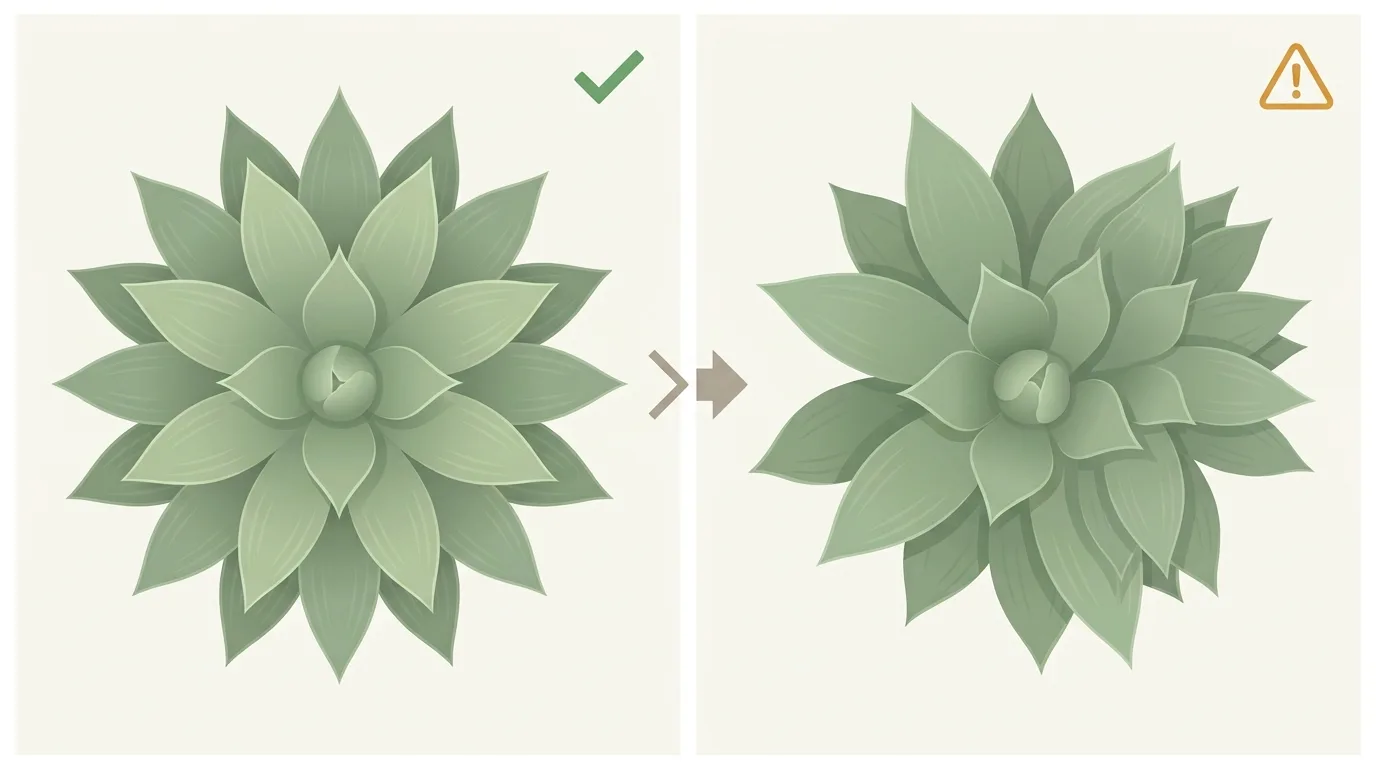
- Good:
- Leaves radiate evenly from the center, forming symmetrically when viewed from above.
- Caution:
- Leaves leaning to one side or the center offset indicate uneven growing conditions.
Observe serration continuity
- Good:
- Serrations follow the leaf margin at uniform intervals with minimal gaps.
- Caution:
- Missing or asymmetrical serrations may indicate shipping damage or poor cultivation.
Check plant base and rooting
- Good:
- The plant base is stable with no wobbling in the soil, and white new roots are visible.
- Caution:
- Bare cuttings that are unstable or have not fully dried cut surfaces require accounting for transplant establishment risk.
Appraisal quiz
When comparing two Titanota specimens, which is generally valued more highly?
Appraisal by breed
General information on judging value; not a guarantee of any individual's price or quality. See the market-price page for actual rates.