Echeveria appraisal
The iconic succulent. Leaves unfold in a rosette pattern resembling a rose bloom, with an exceptionally wide variety of cultivars. Compactness and leaf symmetry are central to appraisal, and variations such as seasonal color changes and variegation further enhance value.

What determines the price
Rosette compactness and symmetry.
HighRosettes with tightly packed leaves forming a compact, highly symmetrical shape are valued. Compact plants without etiolation demonstrate good light and moisture management.
Leaf shape, texture, and pruina (powder).
HighThe leaf shape (roundness and thickness) and condition of surface powder (pruina/bloom) indicate cultivar characteristics. Plants with uniformly intact pruina show evidence of minimal handling.
Seasonal color change and body color expression.
MediumWhether cultivar-specific color expression (red, pink, purple, etc.) is fully developed. The vividness of seasonal color change reflects management conditions.
Variegation and mutation clarity.
HighFor variegated cultivars, the color, form, and clarity of the variegation significantly affect value. For mutant cultivars, stability of the mutation is also important.
Appraisal points
Verify rosette compactness
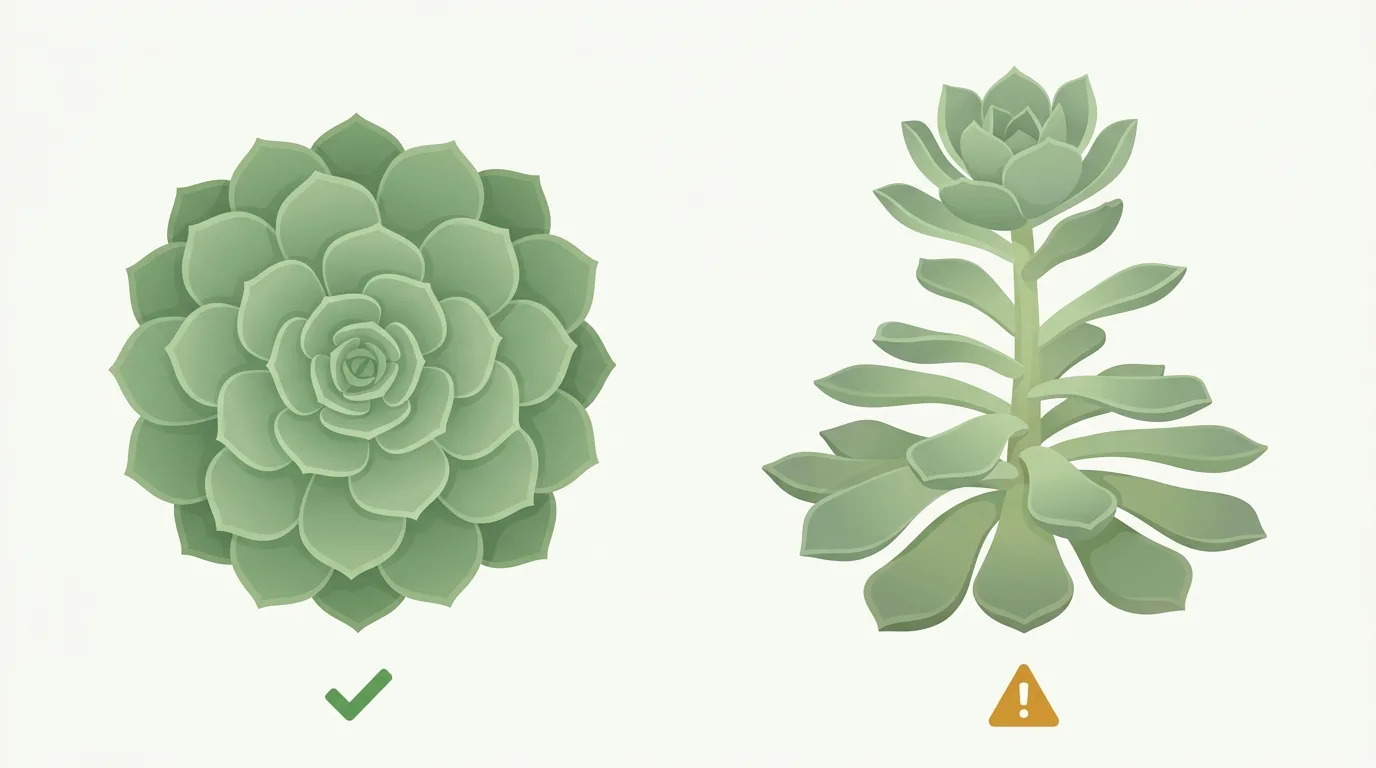
- Good:
- Leaves arranged low and compactly, forming a neat rose-shaped rosette when viewed from above.
- Caution:
- Etiolated plants with wide leaf spacing and upward extension signal poor light management.
Assess the condition of leaf pruina (powder).
- Good:
- Pruina is uniformly distributed on the leaf surface with minimal handling marks.
- Caution:
- Areas where pruina has been removed show diminished appearance and are difficult to restore.
Assess the condition of the base and roots.
- Good:
- The base is firm and healthy roots are evident.
- Caution:
- If the base is soft or shows discoloration, root rot may be present.
Price tiers by grade
Entry-level grade
A healthy small to medium specimen of a common cultivar showing developing compactness.
Intermediate grade
A robust, well-formed specimen with vivid red coloration or distinct variegated markings.
Premium grade
Rare cultivars, prominently mutated forms, or selected specimens with uniform pull-in patterning.
For actual prices, see the market-price page.
Appraisal quiz
What is the correct understanding of pruina (leaf powder) on Echeveria?
Other Succulent appraisals
General information on judging value; not a guarantee of any individual's price or quality. See the market-price page for actual rates.