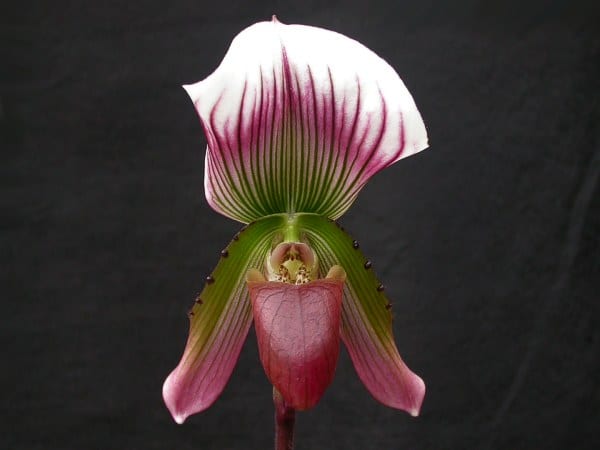
 © Dalton Holland Baptista / CC BY-SA 3.0
卵葉兜蘭
Paphiopedilum callosum is a slipper orchid native to the region stretching from Indochina to the northern Malay Peninsula. Its mottled leaves, patterned in light and dark green, stay attractive year-round, and from spring into early summer it sends up a flower stem covered in fine purple hairs, topped with a single bloom measuring roughly 8 to 11 cm across. The rounded pouch and the broad, upward-fanning dorsal sepal give it a quieter, more sculptural presence than many showier orchids. It calls for some intermediate-level know-how to grow well, but as a perennial that can be propagated by division, it's a plant you can keep growing and multiplying for years. Every Paphiopedilum species is listed in CITES Appendix I, which makes it an Internationally Endangered Species under Japan's Act on Conservation of Endangered Species (種の保存法). Transferring a plant within Japan, whether by sale or gift, requires a registration certificate under that Act, and this applies to plants propagated in Japan too. When buying, always confirm that the plant comes with its registration certificate.
View 卵葉兜蘭 encyclopedia →成交手續費 0%!2026年9月30日前註冊,前 2 株免佣金!
生產者 招募中!
在 GrowerDirect 上架,直接銷售給全國的客戶吧!
GrowerDirect承諾的 6 項透明性重點
出品 蘭花 時,認證 生產者 明示品種、產地、光照需求、栽培難度等資訊,確保購物透明。
- 品種說明
- 實物照片
- 色澤
- 產地說明
- 光照需求
- 難度說明
查看全部142個品種
蘭花分類正在招募認證生產者
生產者正在陸續註冊,即將上架。設定上架通知,不錯過新商品。
「接收上架通知」需免費註冊會員即可設定。當有符合您儲存條件的新商品上架時,我們會以郵件和站內通知提醒您。
卵葉兜蘭的基本資料
- 栽培難度
- 適合中級者
- 壽命
- 多年生植物,可通過分株進行長期栽培(關於壽命的資料較少)
- 體型
- 葉長10~20釐米、花莖12~25釐米、花徑8~11釐米
- 澆水
- 全年施用稀釋的液體肥料
- 光照與放置位置
- 喜歡相當陰暗的陰處。避免直射陽光,在明亮的陰處至半陰處栽培。
- 浇水
- 全年保持一定的澆水頻率,維持高溼度環境。
- 溫度與越冬
- 原產地的平均氣溫約為19~24℃。冬季需在室內溫暖的地方管理。
- 基質與換盆
- 原產地中植株根系生長在厚實的落葉層中。使用具有保水性和透氣性的基質進行盆栽,換盆在花後進行。
- 肥料
- 全年恆定地施用稀釋的液體肥料。
- 病蟲害與注意事項
- 因為這是附錄I中列出的原種,在接收時必須確認物種保護法的登記證。
關於卵葉兜蘭
Paphiopedilum callosum is an intermediate-level slipper orchid from Indochina, prized for mottled leaves and a single 8-11cm bloom on a purple-haired stem. A perennial you can propagate by division over time.
開始照料卵葉兜蘭前需要了解的7件事
1Bright Shade, Not Direct Sun
Paphiopedilum callosum dislikes strong direct sun and prefers soft, filtered light, similar to what passes through a sheer curtain. If you keep it outdoors, choose a spot with dappled shade, such as under a bench, rather than full sun. Leaf scorch can also disturb the mottled leaf pattern, so it's worth being careful about placement.
2Water Before It Dries Out
Water thoroughly once the surface of the potting mix starts to dry, letting water run out through the drainage holes. The plant likes humidity but dislikes sitting in constantly soggy mix, which can lead to root rot, so aim for a balance between the two. Growth slows in winter, so you can space out watering a bit more during that season.
3Choose a Moisture-Retentive, Airy Mix
In the wild, this terrestrial orchid grows along forest streams, rooting into thick layers of leaf litter. Pot it in a mix that holds moisture while still letting air reach the roots, and keep humidity high. Because the mix breaks down over time, plan on refreshing it through periodic repotting.
4Repotting Schedule
Repot as the mix breaks down and the plant grows. The best time is after flowering has finished. Once a plant has filled out, repotting is also a good opportunity to divide it and increase your stock.
5Adjust Care by Season
From spring into early summer, the plant sends up a flower stem covered in fine purple hairs and comes into bloom. Strong direct sun and stagnant humidity in summer, along with cold and dryness in winter, can both weaken the plant, so adjusting its position and airflow with the seasons is key to growing it successfully long term.
6Divide to Keep It Going
As a perennial, Paphiopedilum callosum can be divided once it forms a substantial clump, letting you keep cultivating it across generations over a long period. Divide only once the plant is well established, and make sure each division retains several growths.
7What to Look for in a Plant
When choosing a plant, look for mottled leaves free of significant damage or yellowing, with a firm base where the leaves meet. As an Appendix I species, it must come with a registration certificate under Japan's Act on Conservation of Endangered Species (種の保存法), so always confirm the certificate when acquiring one.
卵葉兜蘭的常見問題
- Q.Is this orchid suitable for beginners?
- A.Paphiopedilum callosum is generally considered an intermediate-level orchid, requiring a bit more attention than some easier houseplants. If you get the hang of watering and placement, it's entirely possible to grow it successfully while building experience. Start by following the basic care guidelines carefully.
- Q.How large does the plant get?
- A.The leaves reach roughly 10 to 20 cm in length, and the flower stem grows to about 12 to 25 cm. A single bloom, around 8 to 11 cm across, opens at the tip of the stem. Since it stays fairly compact in a pot, it's an easy size to manage indoors.
- Q.When and how often does it bloom?
- A.It blooms from spring into early summer, producing a single flower at the tip of a stem covered in fine purple hairs. How often it flowers depends on how well-established the plant is, so building up a healthy, mature plant supports more consistent yearly blooming.
- Q.Does the mottled leaf pattern always look the same?
- A.The leaves show a mottled pattern of light and dark green, but its appearance can shift depending on lighting conditions and the plant's overall condition. Leaf scorch from strong direct sun can disrupt the pattern, so it's worth being mindful of where you place the plant.
- Q.Is it better to grow it indoors or outdoors?
- A.It can be grown either indoors or outdoors, as long as you can keep it out of direct sun. Outdoors, a shaded spot such as under a bench works well; indoors, a bright spot behind a sheer curtain is a good choice. Adjusting for cold and dryness as the seasons change is also important.
卵葉兜蘭栽培的實用工具
在圖鑑中詳細了解卵葉兜蘭
查看卵葉兜蘭的圖鑑條目 →
收錄栽培難度、尺寸、原產地、日照等基礎資料。