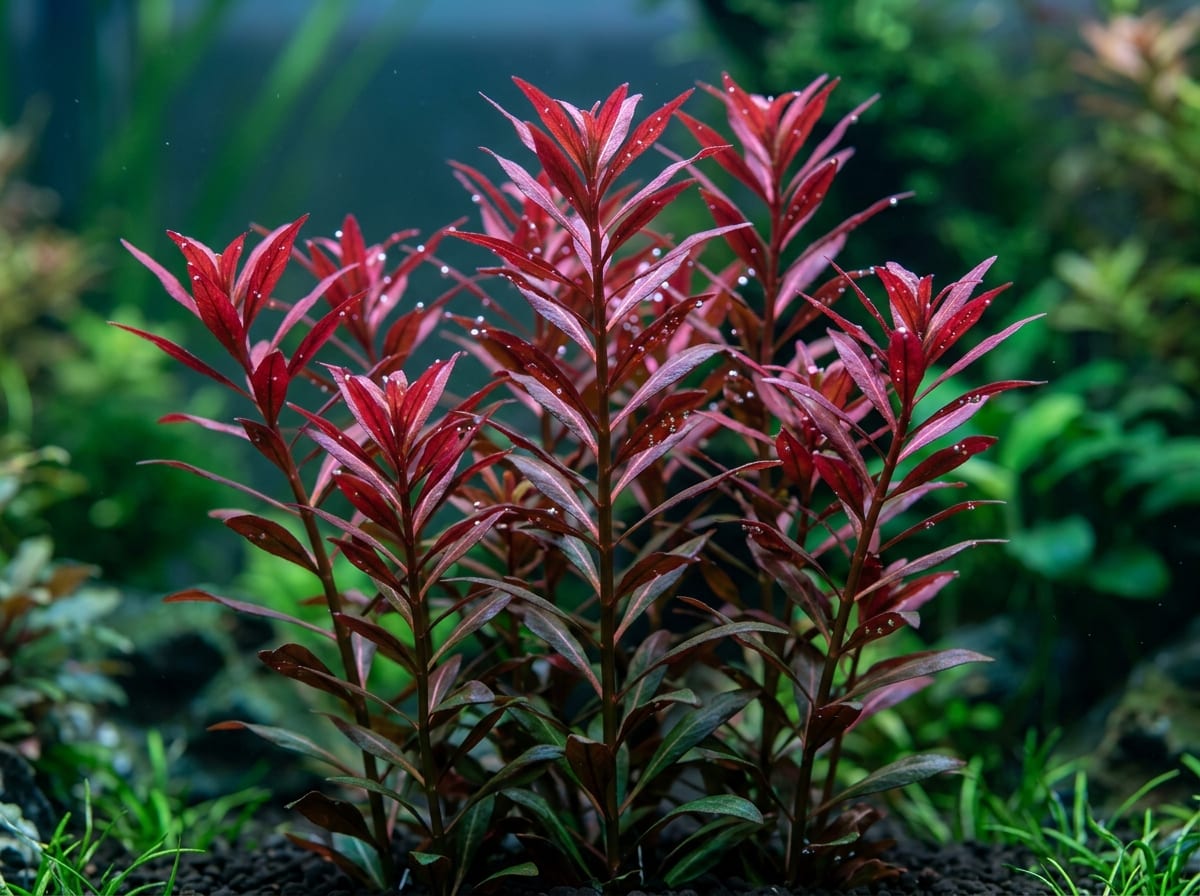
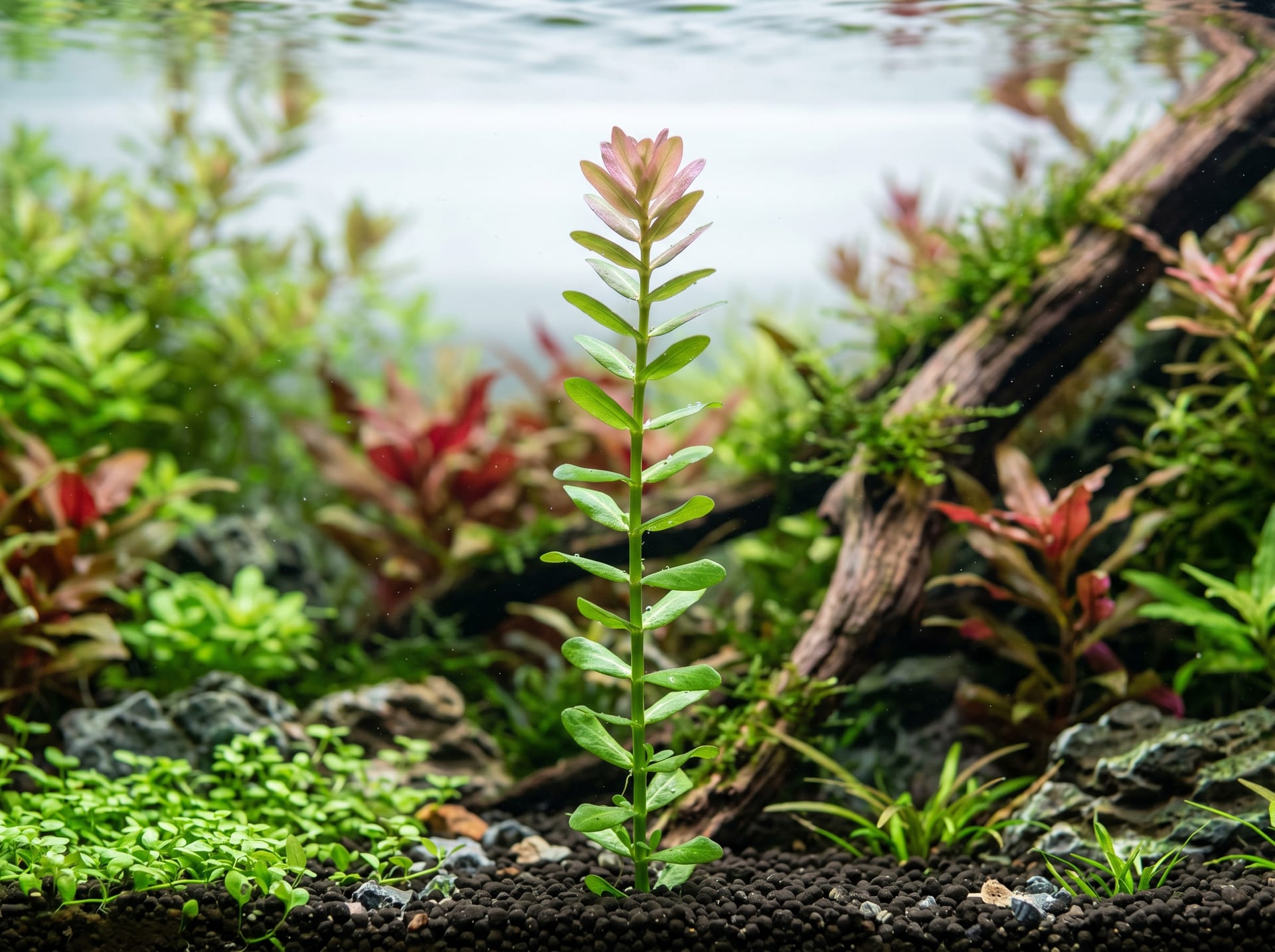
AI-generated image
Ludwigia glandulosa
IntermediateLudwigia glandulosa
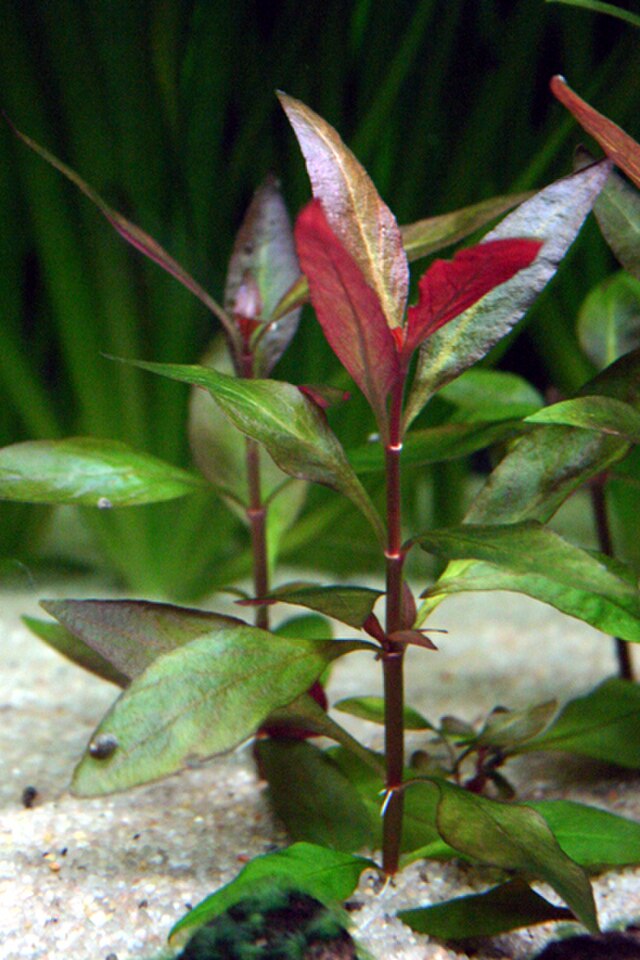
A North American stem plant whose leaves turn vivid wine-red to red-purple under strong light. Submerged stems grow strictly upright with little branching; in insufficient light it turns green and drops its lower leaves.
About
Ludwigia glandulosa is a marsh plant of the evening-primrose family (Onagraceae) found in most south-eastern US states and north to Illinois and Indiana, in wetlands and wet roadside ditches; it is threatened in Indiana and endangered in Maryland. It has been in aquarium cultivation since the late 1980s, and the aquarium population is subsp. glandulosa. It was first introduced wrongly as L. perennis and is still sold as 'perennis', 'peruensis' or L. peruviana, which are other species or made-up names; conversely 'glandulosa' is sometimes misapplied to Ludwigia 'Rubin'. Alternate, lanceolate leaves (one per node) and strictly upright, barely branching submerged stems identify it, and in good light the leaves turn deep wine-red to red-purple. Emersed it forms creeping stems and upright shoots up to about 80 cm, with inconspicuous green, petal-less flowers in summer. Unlike many red plants it keeps its colour without low nitrate. It is sold in Japanese specialist shops.
Source: Wikipedia (CC BY-SA 4.0)
Size of the Ludwigia glandulosa
The Ludwigia glandulosa grows to 15–40 cm tall, 5–12 cm wide submerged.
Temperature & humidity for the Ludwigia glandulosa
The ideal temperature for the Ludwigia glandulosa is 22〜25℃.
Basic Info
Origin
North America (south-eastern United States north to Illinois and Indiana)
Lifespan
Perennial; maintained by cuttings
Size
15–40 cm tall, 5–12 cm wide submerged
Temperature
22〜25℃
Watering & Fertilizer
Needs CO2 and trace elements including iron
Growing Tips
Lighting
Needs strong light; without it the leaves turn green and fall. Even in strong light lower leaves tend to drop.
CO2 & Fertilizer
Needs CO2 (roughly 20–40 mg/L) and ample trace elements including iron; nitrate (5–25 mg/L) and phosphate should be present.
Water Temperature & Quality
Optimum 22–25°C in softish water (KH 2–10°dH, pH 5–7).
Substrate & Attachment
Plant stems individually and spaced; the upright growth suits rows.
Trimming & Propagation
It barely branches underwater, so top it to induce side shoots; the tops can be replanted.
Cautions
As a Ludwigia it needs a species-name certificate on import to Japan; do not confuse it with the specified invasive L. grandiflora. Never release plants into the wild.
Ludwigia glandulosa FAQ
QWhat is the growing difficulty level for Ludwigia glandulosa?
Intermediate. A variety suitable for intermediate growers. Requires some cultivation experience and knowledge of environment management. Pay careful attention to temperature and humidity control.
QWhat is the ideal temperature for Ludwigia glandulosa?
The ideal temperature for Ludwigia glandulosa is 22〜25℃. Avoid sudden temperature changes and maintain a stable environment.
QHow large does Ludwigia glandulosa get?
The mature size of Ludwigia glandulosa is 15–40 cm tall, 5–12 cm wide submerged. This may vary slightly depending on cultivation environment and individual differences.
QHow should I water and fertilize Ludwigia glandulosa?
Ludwigia glandulosa: watering & fertilizer — Needs CO2 and trace elements including iron. Aim for appropriate frequency and amount.
QWhat is the typical price for Ludwigia glandulosa?
The price of Ludwigia glandulosa varies significantly by variety, characteristics, size, and lineage. Please check GrowerDirect's price guide for the latest market information.
Last updated: September 23, 2026
References & Sources
Edited & verified by: GrowerDirect Editorial Team
The classifications, regulations, and growing data on this page are created and verified based on the primary information database below.
Taxonomy & Authority
Regulations & Conservation Status
Not listed in CITES (no match in Species+). Under Japan's Invasive Alien Species Act, imports of Ludwigia plants require a species-name certificate, but growing and selling within Japan are not restricted. The related L. grandiflora is a Specified Invasive Alien Species and a different plant. Never dump aquatic plants into rivers, ponds or ditches.
Sources: Species+ (CITES listing check) / Ministry of the Environment: list of Invasive Alien Species (Invasive Alien Species Act)
Regulations may change. Always verify the latest information with the relevant authorities.
Related Species
Find listings for this species
Related Articles
Ludwigia (Ludwigia Genus Aquatic Plants) Cultivation Techniques — Bringing Out Beautiful Red Coloring Through Cultivation Management
To bring out Ludwigia's red-purple coloring, strong light, CO2 supply, and iron fertilizer are essential. Cultivation techniques for this popular red-toned aquatic plant.
Aquatic Plant Tank Used Soil and Substrate Disposal and Recycling Methods | Correct Disposal Methods and Reuse Tips
Explains the correct disposal methods for used substrate in aquatic plant tanks. Introduces the proper disposal procedures according to local municipal rules and the concept of reuse for short-term usage.
Beginner-Friendly Aquatic Plants Without CO2 Supplementation | Cultivation Conditions and Tank Layout Strategies
You can create a beautiful aquarium without expensive CO2 equipment. This guide explains practical methods for selecting CO2-free aquatic plants that beginners can successfully grow, from cultivation conditions to tank layout strategies.
How to Cultivate Rotala and Bring Out Beautiful Red Color | Lighting, CO2, and Trimming Techniques to Achieve Vibrant Red
This guide explains the Rotala genus, popular in aquatic plant layouts, covering light intensity, CO2, and fertilizer management to bring out red coloration, as well as trimming techniques for maintaining beautiful, dense growth.
🩺 Common diseases
Can't find the plant you're looking for?
Post your wishes for free and growers with matching plants will contact you with introductions.