Beginner-Friendly Aquatic Plants Without CO2 Supplementation | Cultivation Conditions and Tank Layout Strategies
You can create a beautiful aquarium without expensive CO2 equipment. This guide explains practical methods for selecting CO2-free aquatic plants that beginners can successfully grow, from cultivation conditions to tank layout strategies.
Key Takeaways
You can create a beautiful aquarium without expensive CO2 equipment. This guide explains practical methods for selecting CO2-free aquatic plants that beginners can successfully grow, from cultivation conditions to tank layout strategies.
Related Species
Introduction: Growing Beautiful Aquatic Plants in a CO2-Free Tank
Do you think expensive CO2 equipment is essential for growing aquatic plants? In reality, by properly managing light and fertilizer, you can create a beautiful aquarium without CO2 supplementation. This article provides practical guidance for beginners on selecting CO2-free aquatic plants, cultivation conditions, and overall tank layout strategies to maximize your aquatic garden.
Aquatic Plant Species and Characteristics Suitable for CO2-Free Tanks
Growing Anubias Nana
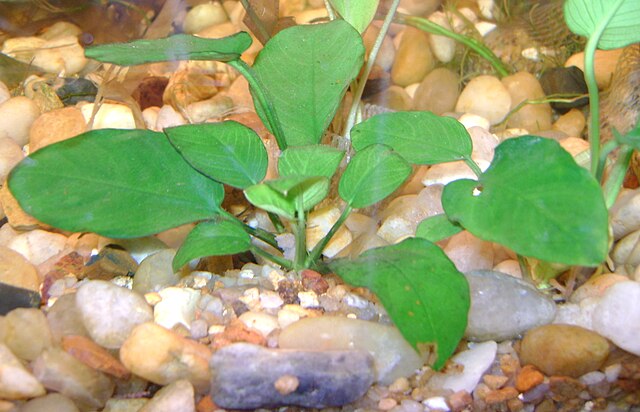
Anubias nana is the "ultimate beginner-friendly aquatic plant" for CO2-free tanks. It thrives even in low-light environments and grows slowly, requiring minimal trimming. By attaching it to driftwood or rocks, you can freely adjust the height and add dimension to your layout.
This plant tolerates a wide temperature range of 15–28°C and requires minimal fertilization. However, burying the rhizome (the area directly above the roots) in substrate causes rot, so attaching it to driftwood is ideal.
Utilizing Hygrophila Polysperma
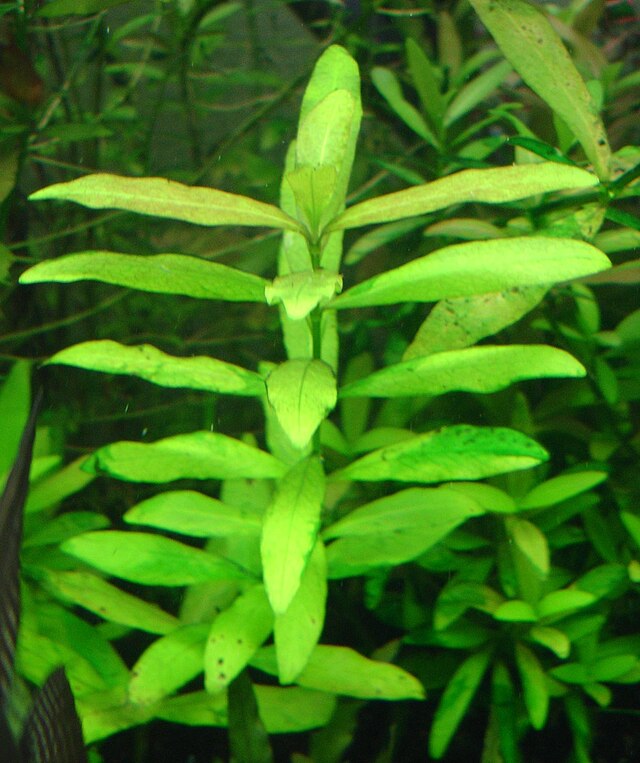
Hygrophila polysperma stands out for its "fast growth rate" in CO2-free environments. It grows under standard fluorescent lighting and can be propagated simply by cutting and replanting, making it one of the best choices for beginners. Its rapid growth helps absorb nitrogen compounds from the water and provides algae suppression benefits.
This species naturally forms dense clusters, making it ideal for creating height in the background. With trimming every 2–3 weeks, you can maintain lush, visually appealing growth.
Light Management in CO2-Free Tanks
Selecting and Configuring LED Lighting
In CO2-free tanks, light intensity is the most critical factor for success. The recommended illumination is 30–40 lux (equivalent to 15–20W for a 60cm tank).
Many beginners mistakenly believe "brighter is always better," but in CO2-deficient environments, excessive light causes algae blooms. A photoperiod of approximately 14 hours daily—from 7 AM to 9 PM—provides balanced cultivation.
Measuring and Adjusting Light Intensity
You can use a smartphone lux meter app to measure surface illumination. As a guideline, 50–100 lux at the 30cm depth is sufficient for CO2-free aquatic plant cultivation.
Adjust lighting seasonally with natural light changes: in summer, turn lights on only in the morning; in winter, run them all day. This flexibility ensures stable growth year-round.
Practical Water Quality and Nutrient Management
Selecting Fertilizers and Application Timing
In CO2-free tanks, regular liquid fertilizer (N-P-K complex) is key to maintaining growth. Adding a proper dose of liquid fertilizer approximately once weekly prevents micronutrient deficiency. A recommended dosage is about 10ml per week for a 100L tank.
Over-fertilization causes algae, so observe plant growth rates and adjust accordingly. Wilting new leaves indicate nutrient deficiency, while pale or curled new leaves signal over-fertilization.
Water Change Frequency and Nutrient Balance
Perform weekly water changes of 20–30% of tank volume to prevent nutrient buildup from fertilization and supply fresh trace elements. Perform water changes more frequently than in CO2-injected tanks to maintain stable water conditions.
If GH (general hardness) is too low (GH ≤ 4), calcium and magnesium absorption decreases. Regularly test GH with a water quality kit and use mineral supplements if needed.
Tank Layout Strategies for CO2-Free Tanks
Foreground, Midground, and Background Height Distribution
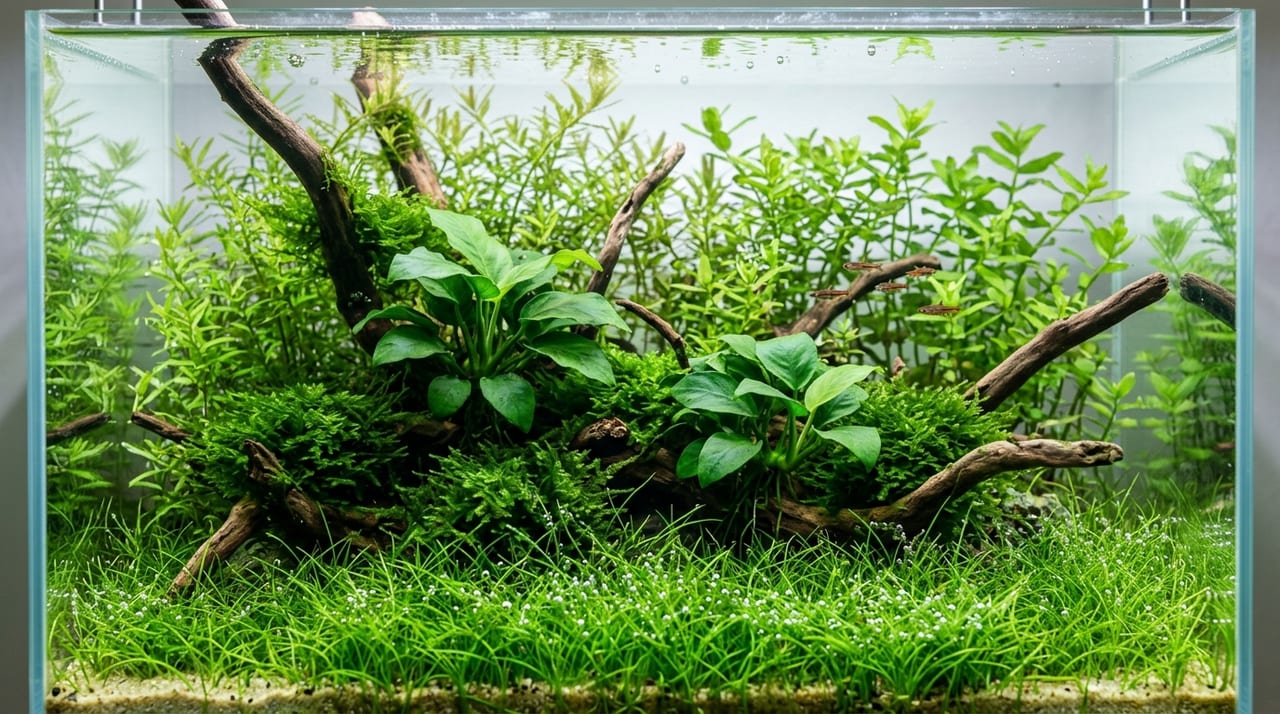
In CO2-free tanks, effective layouts exploit differences in growth rates.
Background (rear section): Place tall species like Hygrophila polysperma to create 30–40cm height.
Midground (center section): Attach Anubias nana to driftwood to create 15–20cm height and add three-dimensional effect.
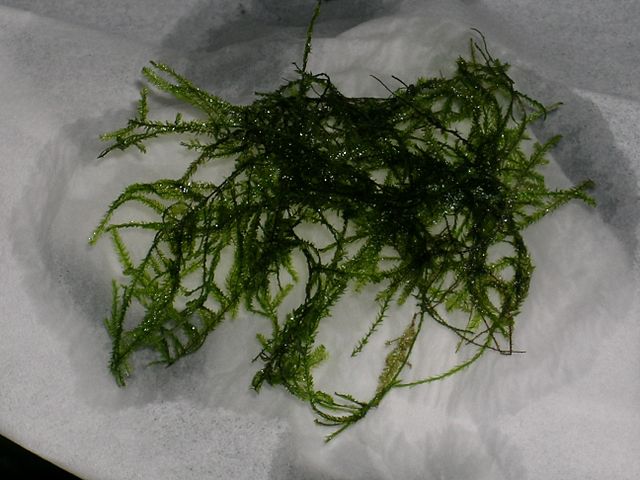
Foreground (front section): Position low-growing plants or mosses (such as Willow moss) at 3–8cm height.
This three-tier arrangement emphasizes tank depth and maximizes spatial efficiency.
Leveraging Driftwood and Rock Layouts
Attaching epiphytic plants like Anubias nana to driftwood creates three-dimensional structures. This approach is especially effective in CO2-free tanks, turning the "slow growth" disadvantage into the "stable layout" advantage.
Choosing high-density driftwood (thoroughly water-saturated and heavy) prevents buoyancy issues during the initial setup phase.
Visual Impact Through Space Utilization
Thinking of plant placement as "colonies" allows you to create rich layouts with limited species. For example, planting 5–10 stems of Hygrophila polysperma as a bundle in the background creates visual volume and achieves excellent aesthetics even without CO2 supplementation.
Growth Rate and Expectations in CO2-Free Tanks
Growth Guidelines for Beginner Aquatic Plants
| Plant Species | Monthly Growth | Trimming Frequency | Recommended Light |
|---|---|---|---|
| Anubias Nana | 2–3cm | Every 2–3 months | 30 lux or more |
| Hygrophila Polysperma | 10–15cm | Every 2–3 weeks | 40 lux or more |
| Willow Moss | 3–5cm | Once monthly | 20 lux or more |
These values are standard for CO2-free environments. If growth is noticeably slow, insufficient light or fertilizer is the cause.
Common Mistakes and Solutions
Mistake 1: Sudden algae bloom after purchase In a new tank, beneficial bacteria have not yet established. During the 2–4 week bacterial colonization period, reduce photoperiod to 8 hours to suppress algae.
Mistake 2: Uniform-height layout Arranging all plants at the same height creates a flat, dimensionless appearance. Intentional height variation is crucial for good design.
Mistake 3: Plant death from over-trimming Even fast-growing species like Hygrophila polysperma suffer if cut by more than 50% at once—photosynthesis drops sharply and recovery takes time. Trim gradually over time.
Seasonal Management for CO2-Free Tanks
In winter (November–February), natural light decreases, so extend LED lighting to 16 hours daily. Conversely, in summer (July–August), prevent oxygen depletion from rising temperatures by improving nighttime air circulation and considering tank cooling systems.
Conclusion
Without CO2 supplementation, you can achieve a beautiful planted aquarium through precise light management, appropriate fertilizer application, and thoughtful layout planning. By applying the beginner-friendly plant species and management techniques explained in this article, you can enjoy serious aquatic plant cultivation while keeping costs low. Discover the depth and potential of CO2-free aquatic plants like Anubias nana and Hygrophila polysperma.