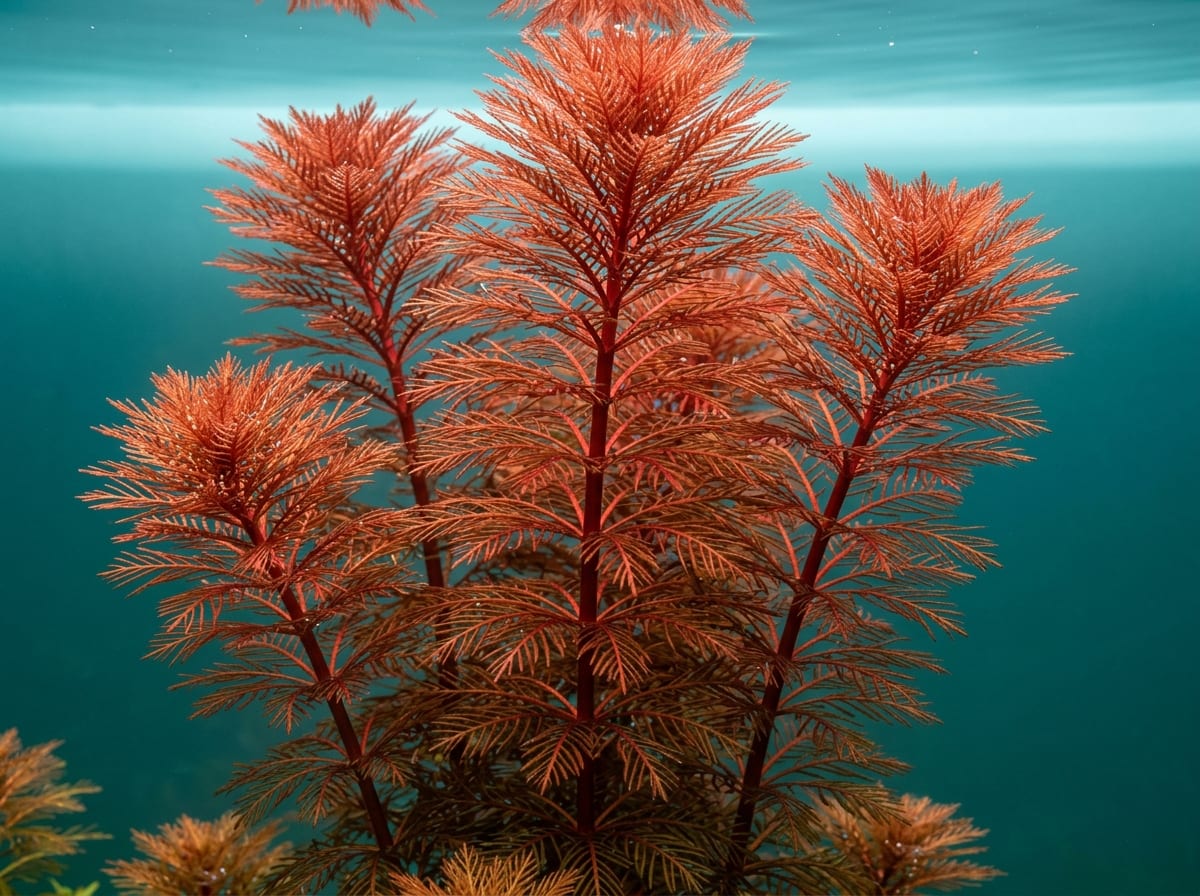
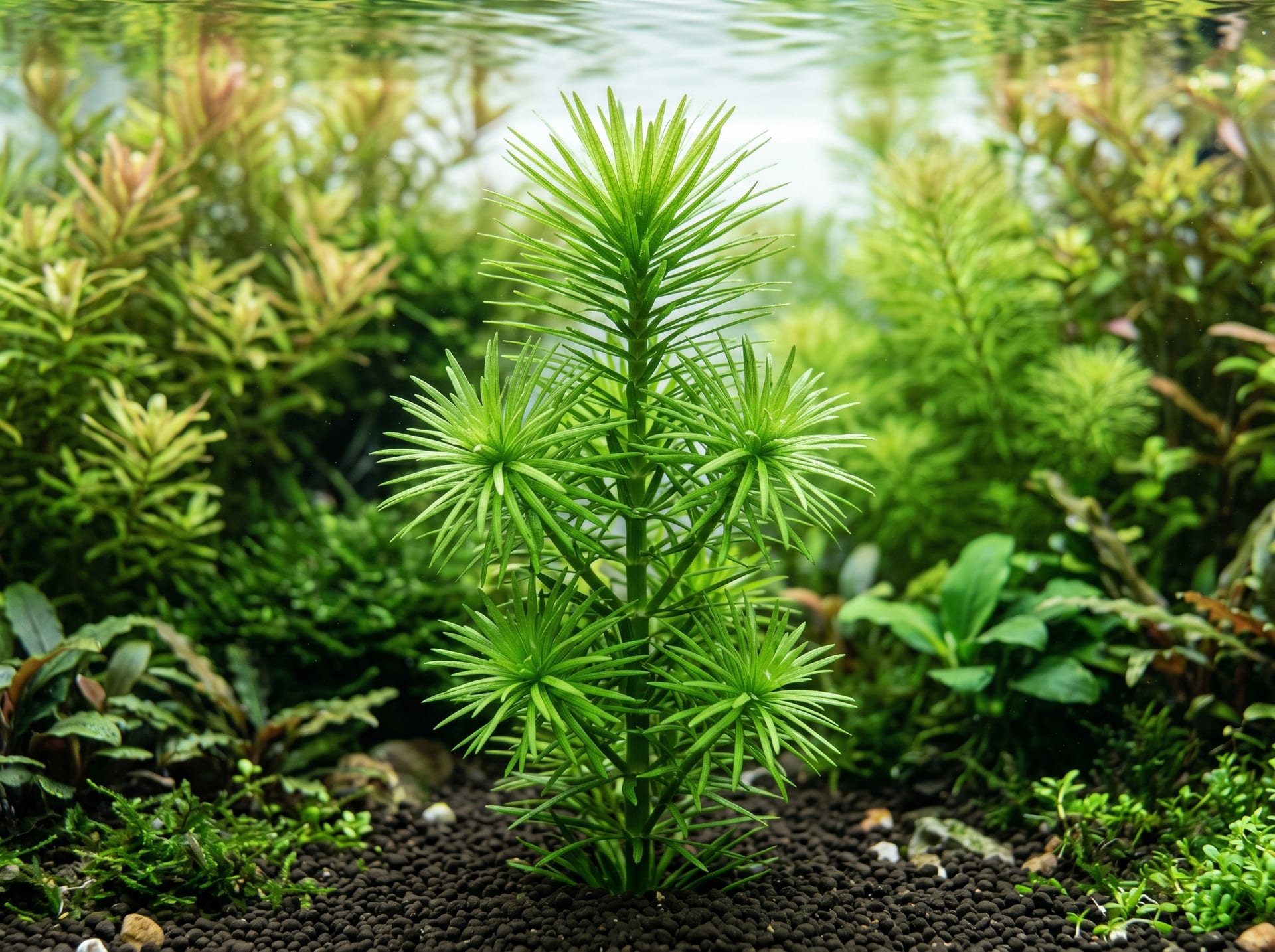
AI-generated image
Red myriophyllum
AdvancedMyriophyllum tuberculatum
An Asian water-milfoil whose finely feathered leaves grow in whorls and turn rusty red in good conditions. For years it was sold under the wrong name Myriophyllum mattogrossense. Strong light, CO2 and trace elements are essential.
About
Red myriophyllum (Myriophyllum tuberculatum, Haloragaceae) grows in slow or still waters in India, Pakistan, China (Guangdong), Malaysia, Indonesia and Australia. For about 20 years it was traded as 'Myriophyllum mattogrossense' until a botanist identified it as M. tuberculatum in 1994. True M. mattogrossense is a green South American water-milfoil and an entirely different plant, yet names such as 'mattogrossense red' still appear, so check the scientific name when buying. Colour and leaves identify it: finely feathered leaves in whorls up to about 10 cm across, the whole plant rusty red when conditions suit it. The related parrot's feather (M. aquaticum) is a Specified Invasive Alien Species whose keeping and transfer are banned, so identify any Myriophyllum by species, not by trade name. It is difficult, needing intense light and CO2. Nitrate and phosphate must never drop to zero, and it needs more iron and trace elements than most stem plants; shortages make stems dark and small, and severe deficiency kills the growing tip. In good conditions it races to the surface and becomes bushy with side shoots. It is sold by specialist shops in Japan.
Size of the Red myriophyllum
The Red myriophyllum grows to Leaf whorls up to about 10 cm across; grows to the surface.
Temperature & humidity for the Red myriophyllum
The ideal temperature for the Red myriophyllum is 18〜24℃.
Basic Info
Origin
South and South-East Asia, southern China, Australia
Lifespan
Perennial; maintained by replanting cuttings
Size
Leaf whorls up to about 10 cm across; grows to the surface
Temperature
18〜24℃
Watering & Fertilizer
Needs CO2 and generous iron and trace elements
Growing Tips
Lighting
Intense light is essential.
CO2 & Fertilizer
CO2 is required. Never let nitrate or phosphate hit zero, and dose extra iron and trace elements; shortages make stems dark and stunted.
Water Temperature & Quality
Optimum 18–24°C in soft (KH 0–8°dKH) water at pH 5–7.
Substrate & Attachment
Plant in the substrate as a red accent in the back- or midground.
Trimming & Propagation
Cut bases resprout slowly, so pull stems and replant the tops; pinched side shoots root readily.
Cautions
The related parrot's feather is a banned Specified Invasive Alien Species; confirm the species name of any Myriophyllum. Never release plants into the wild.
Red myriophyllum FAQ
QWhat is the growing difficulty level for Red myriophyllum?
Advanced. A variety suitable for advanced growers. Requires advanced cultivation techniques and specialized equipment, with careful environmental adjustments needed.
QWhat is the ideal temperature for Red myriophyllum?
The ideal temperature for Red myriophyllum is 18〜24℃. Avoid sudden temperature changes and maintain a stable environment.
QHow large does Red myriophyllum get?
The mature size of Red myriophyllum is Leaf whorls up to about 10 cm across; grows to the surface. This may vary slightly depending on cultivation environment and individual differences.
QHow should I water and fertilize Red myriophyllum?
Red myriophyllum: watering & fertilizer — Needs CO2 and generous iron and trace elements. Aim for appropriate frequency and amount.
QWhat is the typical price for Red myriophyllum?
The price of Red myriophyllum varies significantly by variety, characteristics, size, and lineage. Please check GrowerDirect's price guide for the latest market information.
Last updated: September 23, 2026
References & Sources
Edited & verified by: GrowerDirect Editorial Team
The classifications, regulations, and growing data on this page are created and verified based on the primary information database below.
Taxonomy & Authority
Regulations & Conservation Status
Not listed in CITES (no match in Species+). Imports of any Myriophyllum need a species-name certificate under the Invasive Alien Species Act, but growing and selling within Japan is not restricted. Parrot's feather (M. aquaticum) is a Specified Invasive Alien Species whose keeping, growing and transfer are banned; it is a different species. Never dump aquatic plants into rivers, ponds or ditches, or flush them away with tank water. Drain unwanted plants and trimmings and dispose of them as household waste.
Sources: Species+ (CITES listing check) / Ministry of the Environment: list of Invasive Alien Species (Invasive Alien Species Act) / Ministry of the Environment: alien species list, plants (2nd ed.)
Regulations may change. Always verify the latest information with the relevant authorities.
Related Species
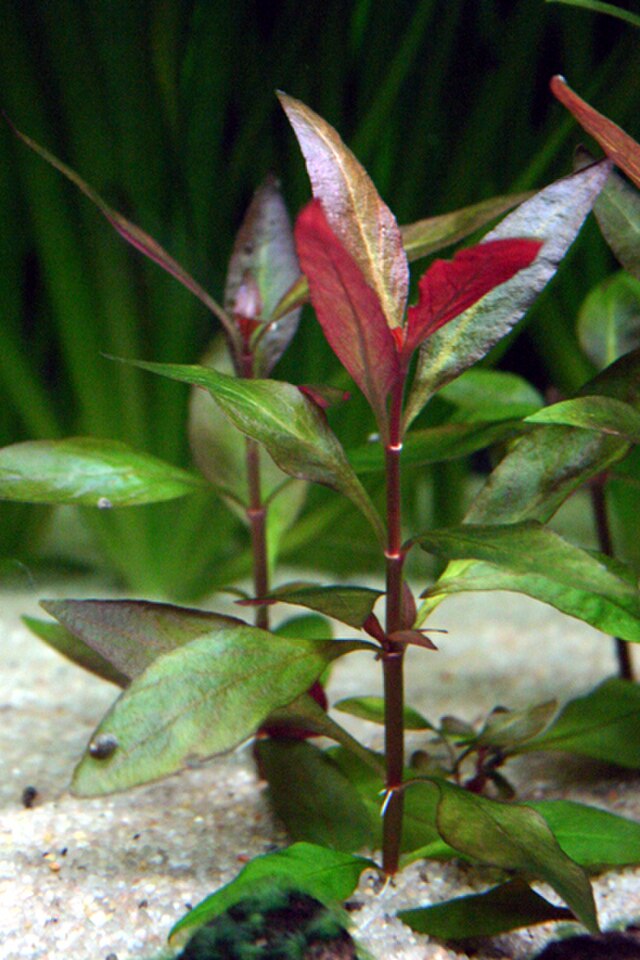
Find listings for this species
Related Articles
Aquatic Plant Tank Used Soil and Substrate Disposal and Recycling Methods | Correct Disposal Methods and Reuse Tips
Explains the correct disposal methods for used substrate in aquatic plant tanks. Introduces the proper disposal procedures according to local municipal rules and the concept of reuse for short-term usage.
Beginner-Friendly Aquatic Plants Without CO2 Supplementation | Cultivation Conditions and Tank Layout Strategies
You can create a beautiful aquarium without expensive CO2 equipment. This guide explains practical methods for selecting CO2-free aquatic plants that beginners can successfully grow, from cultivation conditions to tank layout strategies.
How to Cultivate Rotala and Bring Out Beautiful Red Color | Lighting, CO2, and Trimming Techniques to Achieve Vibrant Red
This guide explains the Rotala genus, popular in aquatic plant layouts, covering light intensity, CO2, and fertilizer management to bring out red coloration, as well as trimming techniques for maintaining beautiful, dense growth.
Rare Attachment-Type Aquatic Plants Beyond Anubias, Bucephalandra, and Willow Moss | The Charm of Distinctive Varieties like Bolbitis
Beyond the standard attachment-type aquatic plants—Anubias, Bucephalandra, and Willow Moss—there are distinctive attachment-type aquatic plants like Bolbitis. This article introduces their charm, cultivation tips, and how to incorporate them into aquascaping layouts.
🩺 Common diseases
Can't find the plant you're looking for?
Post your wishes for free and growers with matching plants will contact you with introductions.