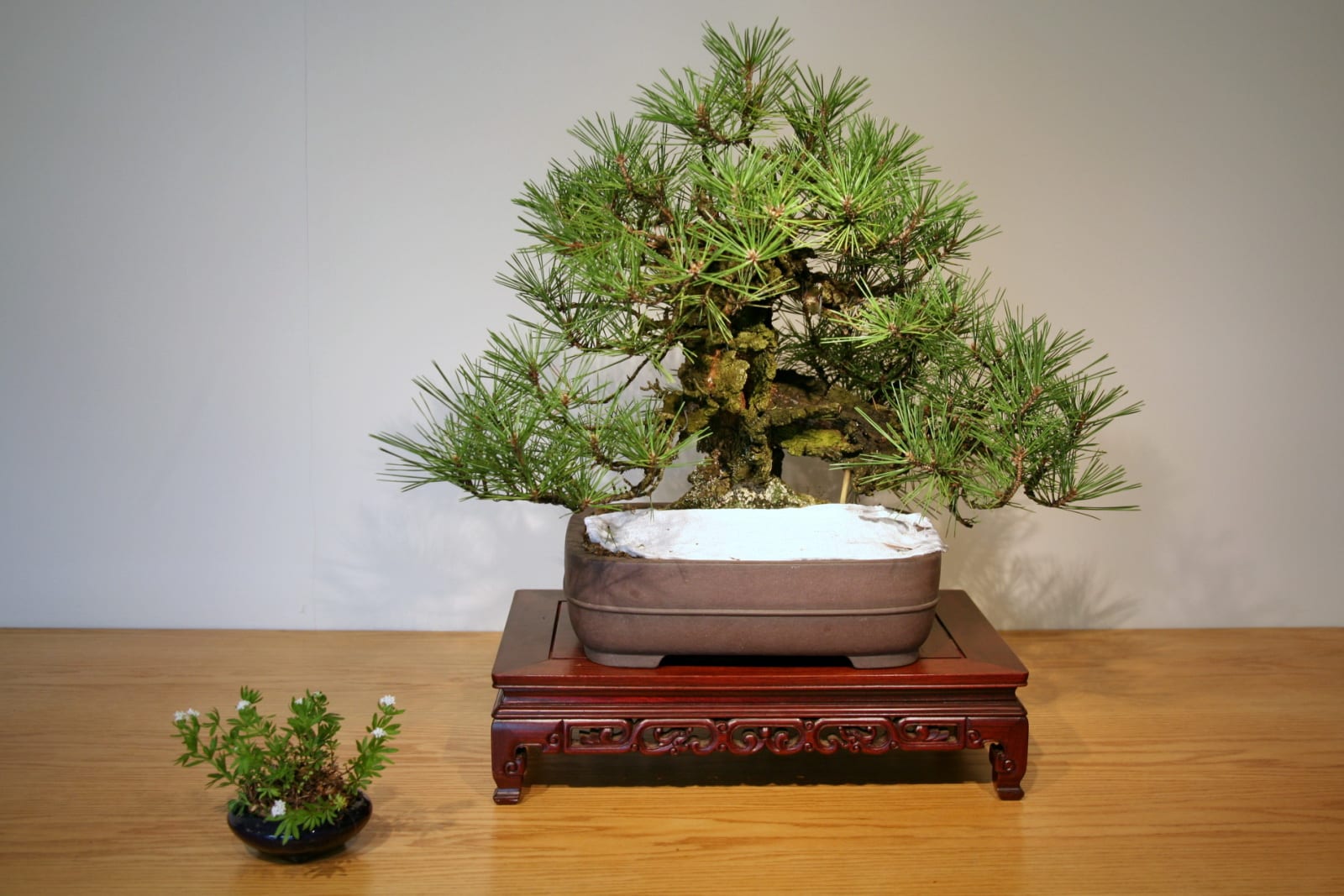
Source: Wikimedia Commons
Nishiki-matsu (cork-bark Japanese black pine)
IntermediatePinus thunbergii 'Nishiki'
A mutation of Japanese black pine found on the Seto Inland Sea coast at Takamatsu, Kagawa. Its trunk and branch bark thickens into cork and splits deeply, giving even young trees the rugged look of a weathered old pine.
About
Nishiki-matsu is a mutation of Japanese black pine (Pinus thunbergii) discovered on the Seto Inland Sea coast at Takamatsu, Kagawa, and is also called 'arakawa-matsu' (rough-bark pine). Its defining trait is a thick corky bark on trunk and branches that splits deeply in a herringbone pattern; the ideal is 'sanmai-gawa', where the bark flares out in three directions like a propeller when seen from above. The needles are the stiff paired needles of black pine, and the new candles are covered in white hairs as in black pine. Wild plants were largely collected out, but grafting was mastered in the mid-Meiji era in what is now Kokubunji, Takamatsu, which is regarded as its home. Today most plants are grafted onto black pine and similar rootstocks, and rooted cuttings are also produced in Kagawa; seedlings do not reliably come true. Around 40 named selections are said to exist, differing in how fast and how hard the bark splits and in needle colour. It should not be confused with sekka goyomatsu, a Japanese white pine that is sometimes also called 'cork bark pine'. The core wood is thinner than it looks and branches snap easily, so heavy wiring is not possible. Its habits are close to black pine, but it prefers a little more water.
Lifespan of the Nishiki-matsu (cork-bark Japanese black pine)
The Nishiki-matsu (cork-bark Japanese black pine) lives Long-lived; bonsai said to be 100 years old exist.
Size of the Nishiki-matsu (cork-bark Japanese black pine)
The Nishiki-matsu (cork-bark Japanese black pine) grows to Usually kept under 3 m in cultivation (bonsai: shohin to medium).
Basic Info
Origin
Japan (black pine mutation found on the Seto Inland Sea coast, Takamatsu)
Lifespan
Long-lived; bonsai said to be 100 years old exist
Size
Usually kept under 3 m in cultivation (bonsai: shohin to medium)
Temperature
-5〜35℃
Watering & Fertilizer
Fertilizer (April–November, except the rainy season and midsummer)
Growing Tips
Light & placement
Outdoors in sun and airflow all year—at least 4–5 hours of sun—turning the pot occasionally
Watering
Likes more water than black pine: 1–2 times daily in spring, 2–3 in summer, every 2–3 days in winter. An evening mist in midsummer also deters mites
Temperature & overwintering
Tolerates heat and cold (black pine: USDA zones 5–8). Protect small or weak plants in winter; branches break under snow
Soil & repotting
Small akadama with 20–30% Kiryu grit. Repot young trees every 2–3 years, finished trees every 3–4
Fertilizer
Solid organic fertilizer monthly April–November, except the rainy season and midsummer
Pruning & styling
Hard candle pinching weakens it; shorten needles with pinching, summer bud-cutting (July) and needle thinning. Wire lightly in dormancy
Pests & cautions
Generally resistant, but weak trees get spider mites and needle cast. Old needles catch in the bark—remove them regularly
Nishiki-matsu (cork-bark Japanese black pine) FAQ
QWhat is the growing difficulty level for Nishiki-matsu (cork-bark Japanese black pine)?
Intermediate. A variety suitable for intermediate growers. Requires some cultivation experience and knowledge of environment management. Pay careful attention to temperature and humidity control.
QWhat is the lifespan of Nishiki-matsu (cork-bark Japanese black pine)?
The average lifespan of Nishiki-matsu (cork-bark Japanese black pine) is Long-lived; bonsai said to be 100 years old exist. With proper cultivation environment and nutrient management, you can keep it healthy for a long time.
QHow large does Nishiki-matsu (cork-bark Japanese black pine) get?
The mature size of Nishiki-matsu (cork-bark Japanese black pine) is Usually kept under 3 m in cultivation (bonsai: shohin to medium). This may vary slightly depending on cultivation environment and individual differences.
QHow should I water and fertilize Nishiki-matsu (cork-bark Japanese black pine)?
Nishiki-matsu (cork-bark Japanese black pine): watering & fertilizer — Fertilizer (April–November, except the rainy season and midsummer). Aim for appropriate frequency and amount.
QWhat is the typical price for Nishiki-matsu (cork-bark Japanese black pine)?
The price of Nishiki-matsu (cork-bark Japanese black pine) varies significantly by variety, characteristics, size, and lineage. Please check GrowerDirect's price guide for the latest market information.
Last updated: September 23, 2026
References & Sources
Edited & verified by: GrowerDirect Editorial Team
The classifications, regulations, and growing data on this page are created and verified based on the primary information database below.
Taxonomy & Authority
Regulations & Conservation Status
Not listed by CITES and not regulated for domestic sale. Not a registered variety under the Plant Variety Protection Act (no Pinus entry for 'Nishiki' in the MAFF database, checked Sept 2026).
Sources: Species+ (CITES listing search) / MAFF Plant Variety Registration Database
Regulations may change. Always verify the latest information with the relevant authorities.
Related Species
Find listings for this species
Related Articles
Bonsai Aged Wood Techniques | Creating Branch Aging Expression and Tree Age Aesthetics
Explains techniques for creating bonsai that appear aged from young stock. Introduces practical methods for expressing tree age aesthetics, from bark texture and branch structure to root development expression and changes over time.
How to Prevent Fertilizer Burn in Bonsai | Determining the Right Fertilizer Amount and Concentration
Why does fertilizer burn occur in bonsai? This explains the mechanism of osmotic pressure, how to identify early symptoms such as browning of leaf tips, why it occurs easily in midsummer and right after repotting, and emergency measures and preventive strategies.
A Guide to Giving Bonsai as Gifts | Appropriate Species and Etiquette for Longevity Celebrations and Business Opening Celebrations
This guide explains how to choose bonsai species and proper etiquette when giving bonsai as gifts for celebrations. It introduces recommended species for different occasions such as longevity celebrations and business opening celebrations, as well as how to choose species while considering management requirements.
Bringing Out the Artistry of Bonsai: Fundamental Techniques in Pruning and Shaping Trees
Master the fundamentals of pruning and shape forming to unveil bonsai artistry. Learn the principles of heavy and light pruning, wiring techniques, how to select bonsai styles and determine the front view, seasonal care schedules, and solutions to common mistakes—all explained step by step.
🩺 Common diseases
Can't find the plant you're looking for?
Post your wishes for free and growers with matching plants will contact you with introductions.