Source: Wikimedia Commons
Arabian Coffee Plant
IntermediateCoffea arabica
An evergreen in the coffee family with glossy, dark green leaves that have wavy margins and prominent veins. Mature plants bear fragrant white flowers and red berries whose seeds are coffee beans.
About
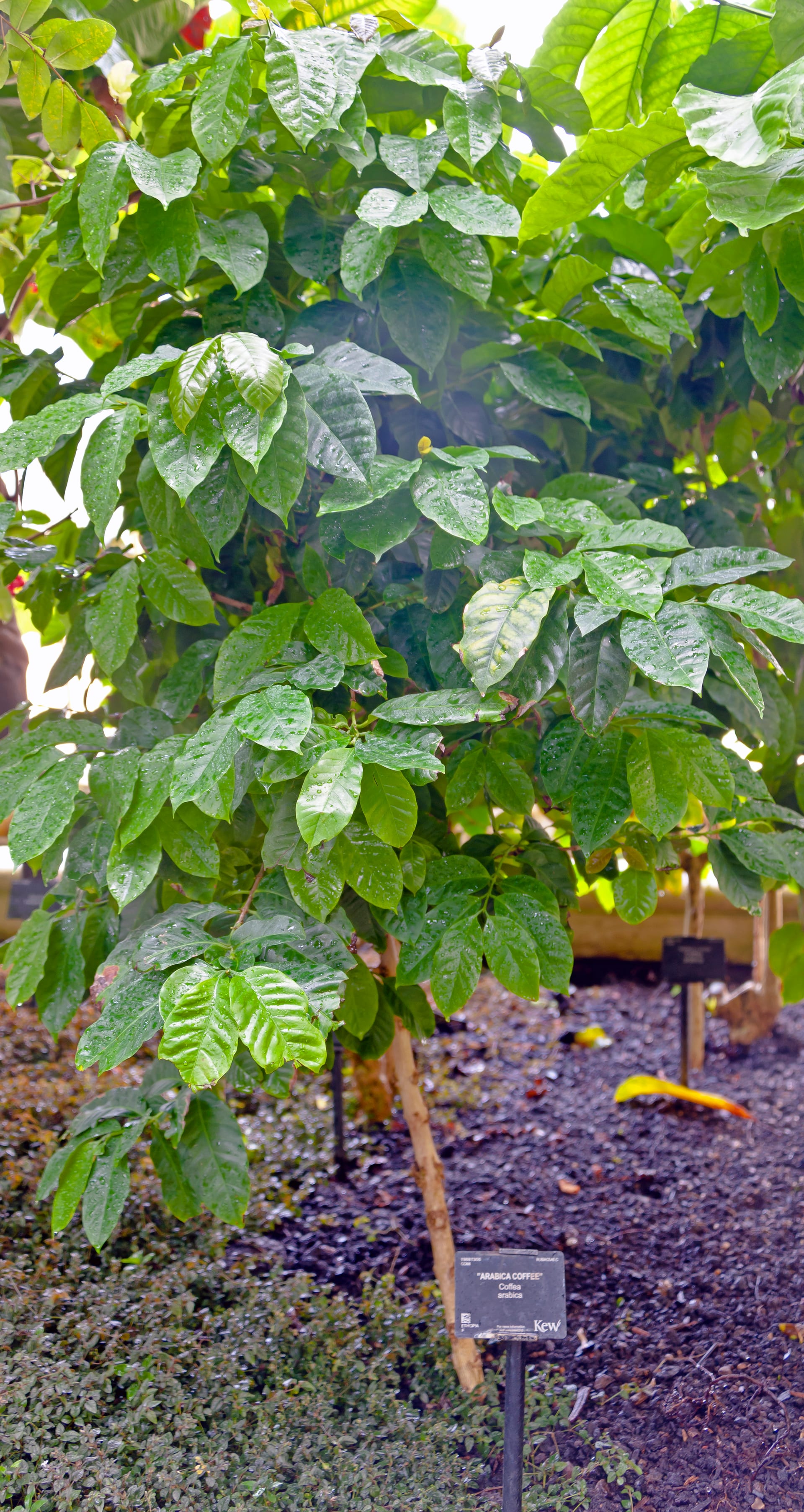
The Arabian coffee plant (Coffea arabica) is an evergreen shrub or small tree in the coffee family (Rubiaceae), native to Ethiopia. The epithet means 'of Arabia', a misnomer reflecting more than 1,000 years of cultivation there rather than a native range. It is now grown throughout the tropics and subtropics for coffee beans, with plantation plants pruned to about 1.8 m for easy harvesting. As a houseplant it is valued for its glossy, elliptic, dark green leaves with wavy margins and prominent veins. Three to four years after planting, it produces star-shaped white flowers in axillary clusters of two to nine in late spring to early summer, with a jasmine-like scent. The berries ripen from green through yellow and light red to deep red, each holding two seeds, the coffee beans. Indoor pot plants usually reach about 1.2-1.8 m. It likes bright light and fairly high humidity, with soil kept moist but not soggy. In Japan it is sold in very large numbers as a houseplant, from small to large pots.
Size of the Arabian Coffee Plant
The Arabian Coffee Plant grows to About 1.2-1.8 m indoors; 1.8-4.5 m tall and wide outdoors in warm climates.
Temperature & humidity for the Arabian Coffee Plant
The ideal temperature for the Arabian Coffee Plant is 21〜27℃.
Being tropical, it dislikes cold and may drop leaves below about 13°C.
Basic Info
Origin
Ethiopia
Lifespan
Perennial evergreen shrub or tree
Size
About 1.2-1.8 m indoors; 1.8-4.5 m tall and wide outdoors in warm climates
Temperature
21〜27℃
Humidity
50〜70%
Watering & Fertilizer
Feed during the growing season
Growing Tips
Light & Placement
Likes bright light; indoors place it by a sunny window. Outdoors, light shade suits it.
Watering
Keep the mix consistently moist but not soggy, using a fast-draining potting mix.
Temperature & Overwintering
Ideal temperatures are about 21-27°C by day and 16-18°C at night. It may drop leaves below about 13°C, so keep it in a warm room in winter.
Soil & Repotting
Use an organically rich, well-drained mix. Repot during the growing season.
Fertiliser
Fertilise during the growing season.
Pests & Cautions
Watch for scale, mealybugs, thrips, caterpillars and mites; mites increase in dry air.
Arabian Coffee Plant FAQ
QWhat is the growing difficulty level for Arabian Coffee Plant?
Intermediate. A variety suitable for intermediate growers. Requires some cultivation experience and knowledge of environment management. Pay careful attention to temperature and humidity control.
QWhat is the ideal temperature for Arabian Coffee Plant?
The ideal temperature for Arabian Coffee Plant is 21〜27℃. Avoid sudden temperature changes and maintain a stable environment.
QHow large does Arabian Coffee Plant get?
The mature size of Arabian Coffee Plant is About 1.2-1.8 m indoors; 1.8-4.5 m tall and wide outdoors in warm climates. This may vary slightly depending on cultivation environment and individual differences.
QHow should I water and fertilize Arabian Coffee Plant?
Arabian Coffee Plant: watering & fertilizer — Feed during the growing season. Aim for appropriate frequency and amount.
QWhat is the typical price for Arabian Coffee Plant?
The price of Arabian Coffee Plant varies significantly by variety, characteristics, size, and lineage. Please check GrowerDirect's price guide for the latest market information.
Last updated: September 23, 2026
References & Sources
Edited & verified by: GrowerDirect Editorial Team
The classifications, regulations, and growing data on this page are created and verified based on the primary information database below.
Taxonomy & Authority
Regulations & Conservation Status
Not listed in the CITES Appendices. Not a designated invasive alien species in Japan, nor a nationally rare species under the Act on Conservation of Endangered Species.
Sources: Species+ (CITES listing check) / Ministry of the Environment: List of Invasive Alien Species
Regulations may change. Always verify the latest information with the relevant authorities.
Related Species
Find listings for this species
Related Articles
Why New Leaves on Foliage Plants Are Smaller — Practical Solutions for Light, Humidity, and Nutrition
We analyze the causes behind stunted growth and smaller new leaves on foliage plants. From light environment and humidity management to fertilization strategy and root health, we explain each factor based on empirical data and introduce methods to restore new leaf size.
Spider Mite and Scale Insect Control: Practical Pest Prevention
Learn to identify spider mites and scale insects on houseplants and recognize damage signs, master practical spider mite control methods, discover effective scale insect elimination techniques, create pest-resistant environments with seasonal management, understand pesticide safety precautions, and discover early detection and prevention strategies.
Root Rot Prevention and Root Zone Regeneration Management in Foliage Plants | Soil Selection, Watering, and Early Diagnosis & Recovery Techniques
Root rot is the greatest threat to foliage plants. This article covers practical knowledge from the mechanisms of root rot development to prevention, early-stage diagnosis and treatment methods, and ensuring long-term plant health through soil and watering management.
Aerial Root Management and Utilization in Houseplants | Cultivation Techniques for Aerial Root-Bearing Plants like Philodendron and Monstera
This guide explains how to understand and manage the characteristics of aerial roots in houseplants. We introduce cultivation techniques that leverage aerial roots, from growth promotion to aesthetic expression.
🩺 Common diseases
Can't find the plant you're looking for?
Post your wishes for free and growers with matching plants will contact you with introductions.