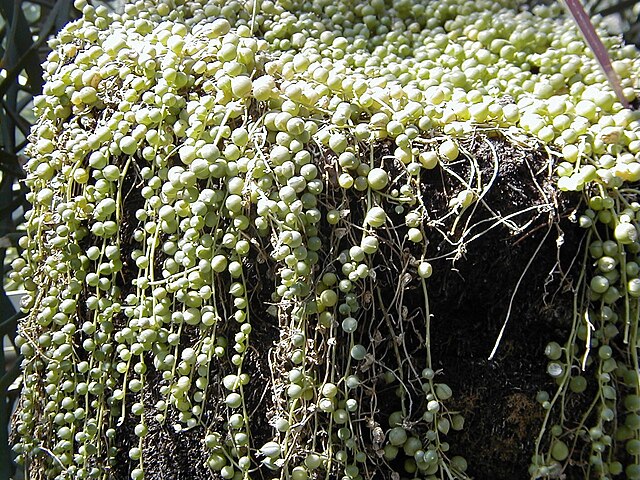
Source: Wikimedia Commons
String of Pearls
IntermediateCurio rowleyanus
A unique succulent with round bead-like leaves strung together. Looks like a pearl necklace when hung.
Overview
Curio rowleyanus (formerly Senecio rowleyanus), the string-of-pearls, is a succulent perennial in the family Asteraceae, native to South Africa. Its trailing stems carry small, spherical, bead-like leaves — an evolutionary adaptation that reduces surface area to minimise water loss in arid conditions. It prefers bright light but should be kept slightly away from intense direct sunlight to prevent scorching. As a succulent, it follows a 'dry then water' regime: allow the soil to dry completely before watering again. Overwatering, particularly in hot humid summers, leads to rapid stem rot. Trailing stems extend 30–100 cm, making it ideally displayed in hanging baskets or trailing from shelves. Its pearl necklace appearance makes it one of the most distinctive and fashionable houseplants available.
Size of the String of Pearls
The String of Pearls grows to Trailing (30-100cm).
Temperature & humidity for the String of Pearls
The ideal temperature for the String of Pearls is 5〜30℃.
Basic Info
Origin
South Africa
Lifespan
Perennial
Size
Trailing (30-100cm)
Temperature
5〜30℃
Humidity
50〜70%
Watering & Fertilizer
Moderate watering
Growing Tips
Light & Placement
Likes bright light, but direct sun causes leaf burn. A bright spot set slightly back from the window is ideal.
Watering
Water only after the soil has dried completely. Like other succulents it prefers dry-side care, and overwatering leads to rot.
Temperature & Overwintering
Grows at 5-30°C and tolerates fairly cool conditions, but never frost. In winter keep it at a bright indoor window.
Soil & Repotting
Use a free-draining succulent mix. The strands reach 30-100 cm, so a hanging pot or one on a high shelf suits it.
Pests & Cautions
Hot, humid summers cause rot from stagnant moisture. Improve airflow and avoid letting water sit on the leaves.
String of Pearls FAQ
QWhat is the growing difficulty level for String of Pearls?
Intermediate. A variety suitable for intermediate growers. Requires some cultivation experience and knowledge of environment management. Pay careful attention to temperature and humidity control.
QWhat is the ideal temperature for String of Pearls?
The ideal temperature for String of Pearls is 5〜30℃. Avoid sudden temperature changes and maintain a stable environment.
QHow large does String of Pearls get?
The mature size of String of Pearls is Trailing (30-100cm). This may vary slightly depending on cultivation environment and individual differences.
QHow should I water and fertilize String of Pearls?
String of Pearls: watering & fertilizer — Moderate watering. Aim for appropriate frequency and amount.
QWhat is the typical price for String of Pearls?
The price of String of Pearls varies significantly by variety, characteristics, size, and lineage. Please check GrowerDirect's price guide for the latest market information.
Last updated: August 31, 2026
Growing Specifications
- USDA Zone
- 9–12
Sources: Missouri Botanical Garden Plant Finder - Curio rowleyanus
References & Sources
Edited & verified by: GrowerDirect Editorial Team
The classifications, regulations, and growing data on this page are created and verified based on the primary information database below.
Taxonomy & Authority
Regulations & Conservation Status
Foliage plant. Confirmed by document review to be non-applicable to CITES Appendix (Flora), designated invasive species, or designated animals (the genus does not appear in the CITES flora section; Dracaena spp. listings in CITES refer to a reptile genus of the same name; the plant Dracaena is not applicable).
Sources: CITES Appendices I/II/III (flora section, grepped via dbca mirror) / CITES Appendices (official) / Ministry of the Environment List of Specified Invasive Alien Species
Regulations may change. Always verify the latest information with the relevant authorities.
Related Species
Find listings for this species
Related Articles
How to Care for Senecio (String of Pearls) | Watering Trailing Succulents and Rejuvenation
Explains watering tips for Senecio succulents such as String of Pearls, Ruby Necklace, and Crescent Necklace, how to address shriveled or burst beads, and rejuvenation techniques through stem propagation.
Optimizing Foliage Plant Leaf Shine | Humidity Management to Achieve Gloss and Plant Health
Environmental management techniques to bring out glossy shine on foliage plant leaves. Techniques to achieve healthy and beautiful leaf expression through optimizing light, humidity, and water quality.
Why New Leaves on Foliage Plants Are Smaller — Practical Solutions for Light, Humidity, and Nutrition
We analyze the causes behind stunted growth and smaller new leaves on foliage plants. From light environment and humidity management to fertilization strategy and root health, we explain each factor based on empirical data and introduce methods to restore new leaf size.
Spider Mite and Scale Insect Control: Practical Pest Prevention
Learn to identify spider mites and scale insects on houseplants and recognize damage signs, master practical spider mite control methods, discover effective scale insect elimination techniques, create pest-resistant environments with seasonal management, understand pesticide safety precautions, and discover early detection and prevention strategies.
🩺 Common diseases
Can't find the plant you're looking for?
Post your wishes for free and growers with matching plants will contact you with introductions.