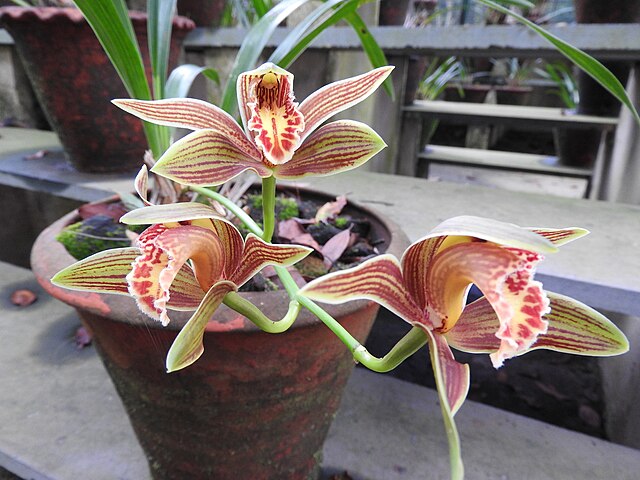
Source: Wikimedia Commons
Cymbidium
IntermediateCymbidium spp.
One of Japan's most popular orchids. Grand flower sprays lasting weeks. Notably cold-hardy. Grow outdoors in direct sun spring-fall; summer heat initiates flower buds.
About
Cymbidium, commonly known as boat orchids, is a genus of evergreen flowering plants in the orchid family Orchidaceae. Orchids in this genus are epiphytic, lithophytic, terrestrial or rarely leafless saprophytic herbs usually with pseudobulbs. There are usually between three and twelve leaves arranged in two ranks on each pseudobulb or shoot and lasting for several years. From one to a large number of flowers are arranged on an unbranched flowering stem arising from the base of the pseudobulb. The sepals and petals are all free from and similar to each other. The labellum is significantly different from the other petals and the sepals and has three lobes. There are about fifty-five species and sixteen further natural hybrids occurring in the wild from tropical and subtropical Asia to Australia. Cymbidiums are well known in horticulture and many cultivars have been developed. The genome of Cymbidium mannii has been sequenced to study epiphytism and crassulacean acid metabolism.
Source: Wikipedia (CC BY-SA 4.0)
Lifespan of the Cymbidium
The Cymbidium lives 20+ years.
Size of the Cymbidium
The Cymbidium grows to 30-80cm (including spike).
Temperature & humidity for the Cymbidium
The ideal temperature for the Cymbidium is 15〜25℃. Ideal humidity is 50〜70%.
Basic Info
Origin
tropical and subtropical Asia to Australia, from the Himalayas and southern China through Japan and Southeast Asia
Lifespan
20+ years
Size
30-80cm (including spike)
Temperature
5〜30℃
Humidity
50〜70%
Watering & Fertilizer
Slow-release every 2 months spring-fall + liquid biweekly
Growing Tips
Light & Placement
From spring to autumn, grow it outdoors in partial shade to full sun to build a strong plant. In winter, keep it by a bright indoor window.
Watering
Water generously in the growing season. In winter indoors, keep it drier and water only after the surface of the medium dries.
Temperature & Overwintering
It tolerates 5-30°C, with 15-25°C ideal. Flower bud formation requires summer heat and an autumn day-night difference of 10°C or more.
Soil & Repotting
Pot in bark, sphagnum moss or a dedicated mix. Old bulbs feed the young ones, so leave them on for 2-3 years.
Fertilizer
From spring to autumn, apply solid fertilizer every 2 months plus liquid feed twice a month. Stop feeding in winter.
Pests & Cautions
Timing the autumn move indoors matters: too early and the flower buds fail to develop. Keep humidity at 50-70%.
Cymbidium FAQ
QWhat is the growing difficulty level for Cymbidium?
Intermediate. A variety suitable for intermediate growers. Requires some cultivation experience and knowledge of environment management. Pay careful attention to temperature and humidity control.
QWhat is the ideal temperature for Cymbidium?
The ideal temperature for Cymbidium is 15〜25℃. Recommended humidity is 50〜70%. Avoid sudden temperature changes and maintain a stable environment.
QWhat is the lifespan of Cymbidium?
The average lifespan of Cymbidium is 20+ years. With proper cultivation environment and nutrient management, you can keep it healthy for a long time.
QHow large does Cymbidium get?
The mature size of Cymbidium is 30-80cm (including spike). This may vary slightly depending on cultivation environment and individual differences.
QHow should I water and fertilize Cymbidium?
Cymbidium: watering & fertilizer — Slow-release every 2 months spring-fall + liquid biweekly. Aim for appropriate frequency and amount.
QWhat is the typical price for Cymbidium?
The price of Cymbidium varies significantly by variety, characteristics, size, and lineage. Please check GrowerDirect's price guide for the latest market information.
Last updated: August 31, 2026
Growing Specifications
- USDA Zone
- 10–12
Sources: Missouri Botanical Garden Plant Finder: Cymbidium (group) (Zone 10 to 12)
References & Sources
Edited & verified by: GrowerDirect Editorial Team
The classifications, regulations, and growing data on this page are created and verified based on the primary information database below.
Taxonomy & Authority
Accepted name: Cymbidium spp. Sw.
Synonyms: Cymbidium spp., Wutongshania, Jensoa, Iridorchis, Cyperorchis, × Cyperocymbidium, Pachyrhizanthe, Arethusantha
Authority databases: GBIF · POWO · RHS orchid hybrid registration (International Orchid Register) · AOS (American Orchid Society)
Nomenclature follows global taxonomic authority databases.
Regulations & Conservation Status
The family Orchidaceae is listed entirely in CITES Appendix II (except for the genera Paphiopedilum and Phragmipedium and certain species, which are in Appendix I). Cultivars and hybrids are subject to family-level regulation; however, artificially propagated specimens may benefit from simplified trading procedures under the Appendices.
Sources: CITES Appendices (Orchidaceae spp. = Appendix II) / CITES Appendix I Orchid Checklist (Kew/UNEP-WCMC 2019)
Regulations may change. Always verify the latest information with the relevant authorities.
Related Species
Find listings for this species
Related Articles
Complete Guide to Growing Cymbidiums | Tips for Blooming Gorgeous Flowers Every Year
Explains how to cultivate Cymbidiums suited to Japan's climate. This is a practical guide for enjoying gorgeous flower spikes every year, from fall outdoor care to flower bud formation through cold treatment and post-bloom care.
Cymbidium Outdoor Cultivation Guide | Enjoying Cold-Hardy Orchids in Your Garden
Explore outdoor cultivation methods for cymbidiums, which are relatively cold-hardy. This guide covers placement selection, summer shading and winter frost protection, autumn low-temperature management for flower bud formation, and division methods for large specimens.
Cymbidium Flower Bud Differentiation and Temperature | The Mechanism of Nighttime Low Temperature Inducing Flower Bud Formation and Winter Management Practices
Explaining the mechanism of nighttime low temperatures required for Cymbidium flower bud differentiation, and practical methods for autumn temperature management and winter care.
Airflow Management Guide for Bulbless Orchids | Understanding the Physiology of Non-Water-Storing Epiphytic Orchids and Their Differences from Dendrobium kingianum
This guide explains the physiology of bulbless epiphytic orchids and key points for airflow management, while comparing water management differences with pseudobulbed Dendrobium kingianum.
Can't find the plant you're looking for?
Post your wishes for free and growers with matching plants will contact you with introductions.