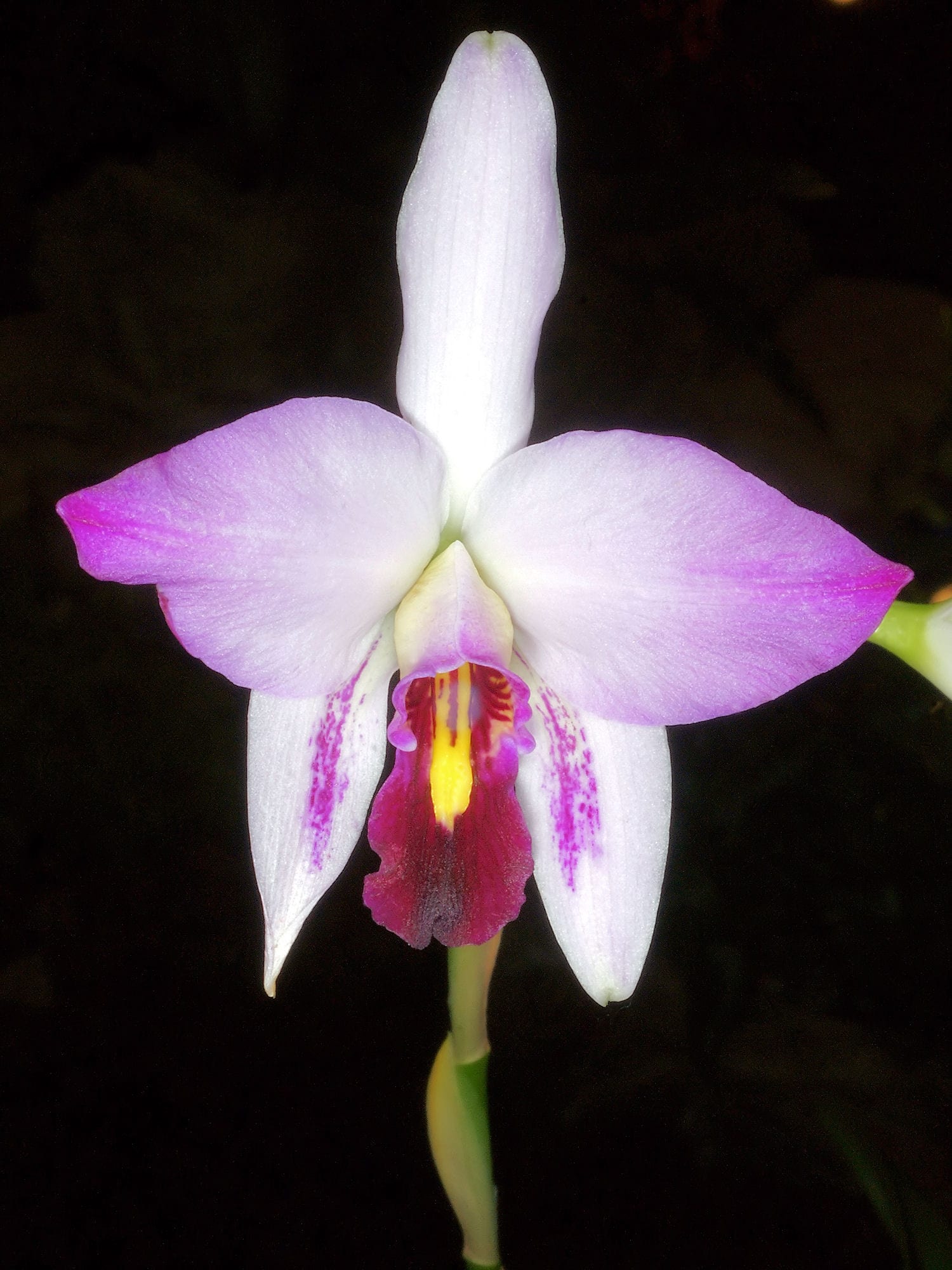
Source: Wikimedia Commons
Two-edged Laelia
BeginnerLaelia anceps
A Mexican Laelia that holds several large flowers with pale lavender petals and a deep crimson lip at the top of stems over 60 cm long. Hardy to drought and cold, it is a tough winter-flowering species.
About
Laelia anceps is an epiphytic orchid whose name, meaning two-edged, describes its flattened pseudobulbs with ridged edges. It grows from Mexico into Central America (Guatemala, Honduras) at 500-1,500 m in oak and pine-oak forest, coffee plantations and pastures, often in full sun. Each flat, ovate pseudobulb bears one, rarely two, thick leathery leaves. From autumn into winter, often around Christmas, it sends up long stems 60-120 cm tall topped by two to six flowers 6-12.5 cm across. They are pale lavender with a deep crimson lip striped yellow and red in the throat, vanilla-scented and long-lasting. It is divided into ssp. anceps of eastern Mexico and ssp. dawsonii of the west, and selected forms such as white alba exist. The key is a dry rest after winter flowering. In Japan, specialist orchid nurseries sell selected plants.
Source: Wikipedia (CC BY-SA 4.0)
Size of the Two-edged Laelia
The Two-edged Laelia grows to Flower stems 60-120 cm; flowers 6-12.5 cm across.
Temperature & humidity for the Two-edged Laelia
Drought-tolerant and very easy, it is reported to do well outdoors down to about 0°C.
Basic Info
Origin
Mexico to Guatemala and Honduras (500-1,500 m)
Lifespan
Perennial that can be kept for many years by division (little data on lifespan)
Size
Flower stems 60-120 cm; flowers 6-12.5 cm across
Temperature
15〜30℃
Humidity
50〜70%
Watering & Fertilizer
Dilute liquid fertilizer in the growing season
Growing Tips
Light & Placement
It often grows in full sun in the wild and likes strong light; shade lightly only in midsummer.
Watering
It tolerates drought, so water after the medium dries well; water sparingly after winter flowering.
Temperature & Overwintering
Fairly cold-tolerant, it is reported to cope outdoors to about 0°C; keep it from frost and freezing.
Soil & Repotting
Pot in a free-draining medium such as bark or mount it; repot in spring as new growth starts.
Dormancy Care
A dry rest after winter flowering improves growth and bloom the next season.
Two-edged Laelia FAQ
QWhat is the growing difficulty level for Two-edged Laelia?
Beginner. A variety suitable for beginners. No special equipment or experience is required—you can grow it without problems by setting up a basic cultivation environment.
QHow large does Two-edged Laelia get?
The mature size of Two-edged Laelia is Flower stems 60-120 cm; flowers 6-12.5 cm across. This may vary slightly depending on cultivation environment and individual differences.
QHow should I water and fertilize Two-edged Laelia?
Two-edged Laelia: watering & fertilizer — Dilute liquid fertilizer in the growing season. Aim for appropriate frequency and amount.
QWhat is the typical price for Two-edged Laelia?
The price of Two-edged Laelia varies significantly by variety, characteristics, size, and lineage. Please check GrowerDirect's price guide for the latest market information.
Last updated: September 23, 2026
References & Sources
Edited & verified by: GrowerDirect Editorial Team
The classifications, regulations, and growing data on this page are created and verified based on the primary information database below.
Taxonomy & Authority
Accepted name: Laelia anceps Lindl.
Synonyms: Amalia anceps (Lindl.) Heynh., Amalias anceps (Lindl.) Hoffmanns., Bletia anceps (Lindl.) Rchb.f., Cattleya anceps (Lindl.) Beer, Laelia anceps f. chilapensis SotoArenas, Laelia anceps subsp. schroederae (Sander) Rolfe
Authority databases: GBIF · GBIF
Nomenclature follows global taxonomic authority databases.
Regulations & Conservation Status
The whole orchid family is listed in CITES Appendix II (checked on Species+). International trade requires permits such as export permits, but no registration is needed to buy, sell or transfer plants within Japan.
Sources: Species+ (CITES) / Ministry of the Environment, Japan: list of Nationally Rare Species
Regulations may change. Always verify the latest information with the relevant authorities.
Related Species
Find listings for this species
Related Articles
Coelogyne Genus Seasonal Care Guide | Withholding Water in the Dry Season and Tips for Regulating the Bloom Cycle
A seasonal guide to Coelogyne, a type of epiphytic orchid, from watering during the growing season to dry-season drought management and tips for regulating the bloom cycle.
Post-Bloom Care: The Annual Cycle from New Growth to Flower Formation
Learn the annual care cycle for orchids from the end of flowering to the next bloom. This guide covers post-flower care including flower stem cutting methods, signs to observe during new shoot development, summer growth period considerations, requirements for flower bud formation, and finishing care from bud emergence through blooming.
A Complete Guide to Enjoying Orchid Exhibitions and Sales Events | Variety Selection and Post-Purchase Care
A guide to enjoying orchid exhibitions and sales events. Covering practical tips on variety selection, how to identify rare species, and post-purchase environmental acclimatization.
Complete Window-Sill Cultivation Guide for Mini Orchids | Techniques for Blooming Fragrant Orchids in Small Spaces and Low-Light Environments
A practical guide to growing miniature orchids on windowsills. Optimize light levels, humidity, and fertilizer management to achieve repeated blooms of fragrant orchids in confined indoor spaces.
Can't find the plant you're looking for?
Post your wishes for free and growers with matching plants will contact you with introductions.