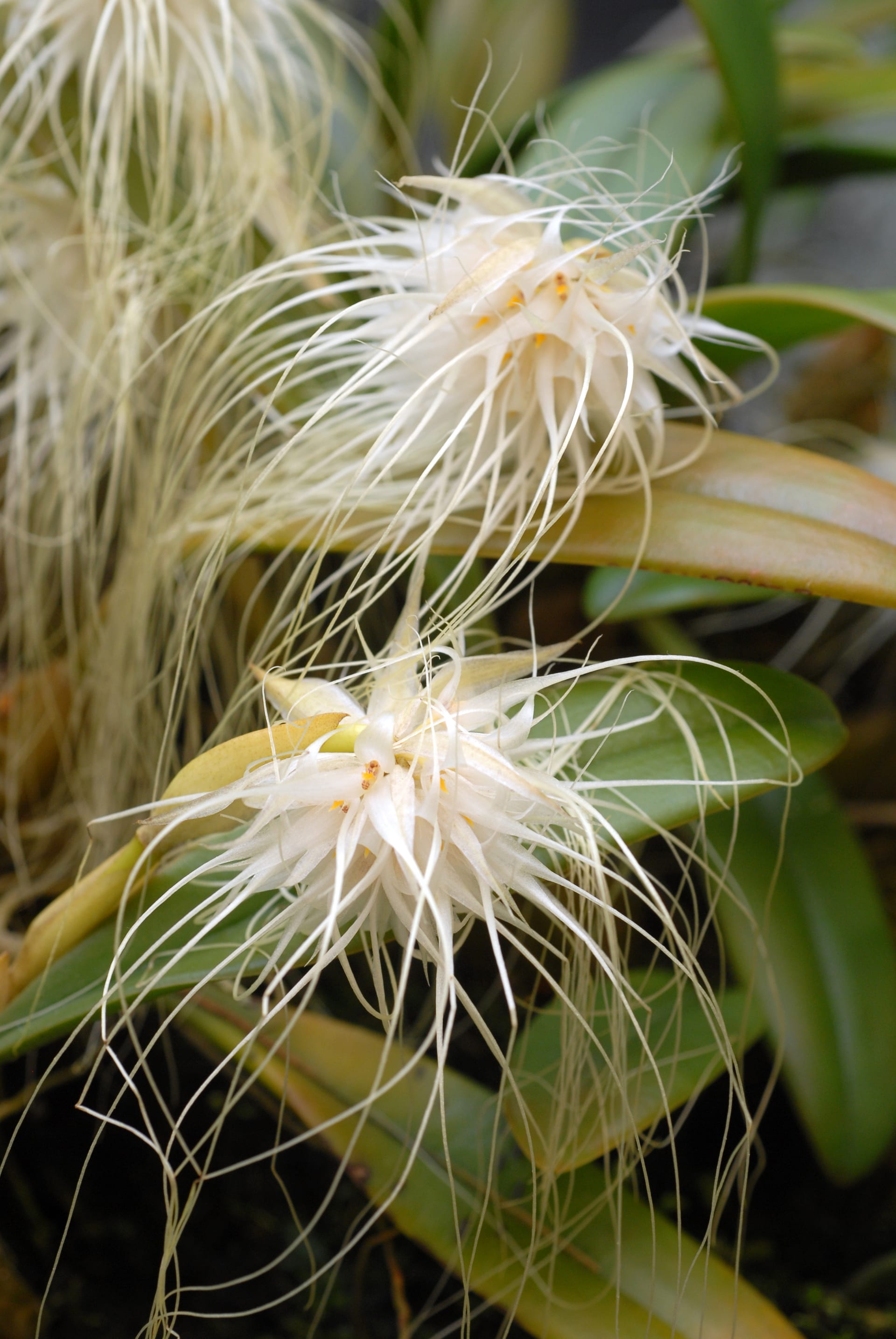
Source: Wikimedia Commons
Medusa's Head Orchid
IntermediateBulbophyllum medusae
A curiosity from South-East Asia whose small white to pale yellow flowers, each with thread-like sepals, gather into a shaggy round tuft named after Medusa. It is a warm, humid-loving epiphyte.
About
Bulbophyllum medusae is an epiphytic orchid that was formerly placed in Cirrhopetalum. It occurs from southern Thailand through the Malay Peninsula to Sumatra and Borneo, growing on trunks and main branches in hot, humid lowland and hill forest. Small pseudobulbs about 2 cm tall sit spaced along a creeping rhizome, each with one leathery leaf about 15-20 cm long. A flower stem from the base of a pseudobulb ends in a dense head of many small flowers. Their lateral sepals are drawn out into long white to pale yellow threads, spotted purple at the base, so the whole head looks like a tassel about 15 cm long. The species name likens this to the snake-haired Medusa. The scent is often described as unpleasant, though some plants have almost none, and individual flowers are fairly short-lived. It needs warmth, moderate shade, regular watering and feeding, and good air movement; baskets or shallow pots that let the rhizome spread make it easier. In Japan it turns up at specialist orchid nurseries and also at houseplant and aquarium shops.
Source: Wikipedia (CC BY-SA 4.0)
Size of the Medusa's Head Orchid
The Medusa's Head Orchid grows to Pseudobulbs about 2 cm; leaves 15-20 cm; flower heads about 15 cm long.
Basic Info
Origin
Southern Thailand, Malay Peninsula, Sumatra and Borneo (lowland and hill forest)
Lifespan
Perennial that keeps spreading along its rhizome (little data on lifespan)
Size
Pseudobulbs about 2 cm; leaves 15-20 cm; flower heads about 15 cm long
Temperature
15〜30℃
Humidity
50〜70%
Watering & Fertilizer
Regular dilute liquid fertilizer while growing
Growing Tips
Light & Placement
It prefers moderate shade; keep it out of direct sun, in light like that through a sheer curtain.
Watering
It dislikes drying out, so water regularly in the growing season without letting the medium dry completely.
Temperature & Overwintering
A warm-growing species that is sensitive to cold; keep it in a warm room in winter.
Soil & Repotting
The rhizome creeps sideways, so use a basket or shallow pot with sphagnum or bark, or mount it.
Pests & Cautions
Ensure good air movement, as the rhizome suffers in stagnant humidity. If the scent bothers you, move it while in flower.
Medusa's Head Orchid FAQ
QWhat is the growing difficulty level for Medusa's Head Orchid?
Intermediate. A variety suitable for intermediate growers. Requires some cultivation experience and knowledge of environment management. Pay careful attention to temperature and humidity control.
QHow large does Medusa's Head Orchid get?
The mature size of Medusa's Head Orchid is Pseudobulbs about 2 cm; leaves 15-20 cm; flower heads about 15 cm long. This may vary slightly depending on cultivation environment and individual differences.
QHow should I water and fertilize Medusa's Head Orchid?
Medusa's Head Orchid: watering & fertilizer — Regular dilute liquid fertilizer while growing. Aim for appropriate frequency and amount.
QWhat is the typical price for Medusa's Head Orchid?
The price of Medusa's Head Orchid varies significantly by variety, characteristics, size, and lineage. Please check GrowerDirect's price guide for the latest market information.
Last updated: September 23, 2026
References & Sources
Edited & verified by: GrowerDirect Editorial Team
The classifications, regulations, and growing data on this page are created and verified based on the primary information database below.
Taxonomy & Authority
Regulations & Conservation Status
The whole orchid family is listed in CITES Appendix II (checked on Species+). International trade requires permits such as export permits, but no registration is needed to buy, sell or transfer plants within Japan.
Sources: Species+ (CITES) / Ministry of the Environment, Japan: list of Nationally Rare Species
Regulations may change. Always verify the latest information with the relevant authorities.
Related Species
Find listings for this species
Related Articles
Coelogyne Genus Seasonal Care Guide | Withholding Water in the Dry Season and Tips for Regulating the Bloom Cycle
A seasonal guide to Coelogyne, a type of epiphytic orchid, from watering during the growing season to dry-season drought management and tips for regulating the bloom cycle.
Post-Bloom Care: The Annual Cycle from New Growth to Flower Formation
Learn the annual care cycle for orchids from the end of flowering to the next bloom. This guide covers post-flower care including flower stem cutting methods, signs to observe during new shoot development, summer growth period considerations, requirements for flower bud formation, and finishing care from bud emergence through blooming.
A Complete Guide to Enjoying Orchid Exhibitions and Sales Events | Variety Selection and Post-Purchase Care
A guide to enjoying orchid exhibitions and sales events. Covering practical tips on variety selection, how to identify rare species, and post-purchase environmental acclimatization.
Complete Window-Sill Cultivation Guide for Mini Orchids | Techniques for Blooming Fragrant Orchids in Small Spaces and Low-Light Environments
A practical guide to growing miniature orchids on windowsills. Optimize light levels, humidity, and fertilizer management to achieve repeated blooms of fragrant orchids in confined indoor spaces.
Can't find the plant you're looking for?
Post your wishes for free and growers with matching plants will contact you with introductions.