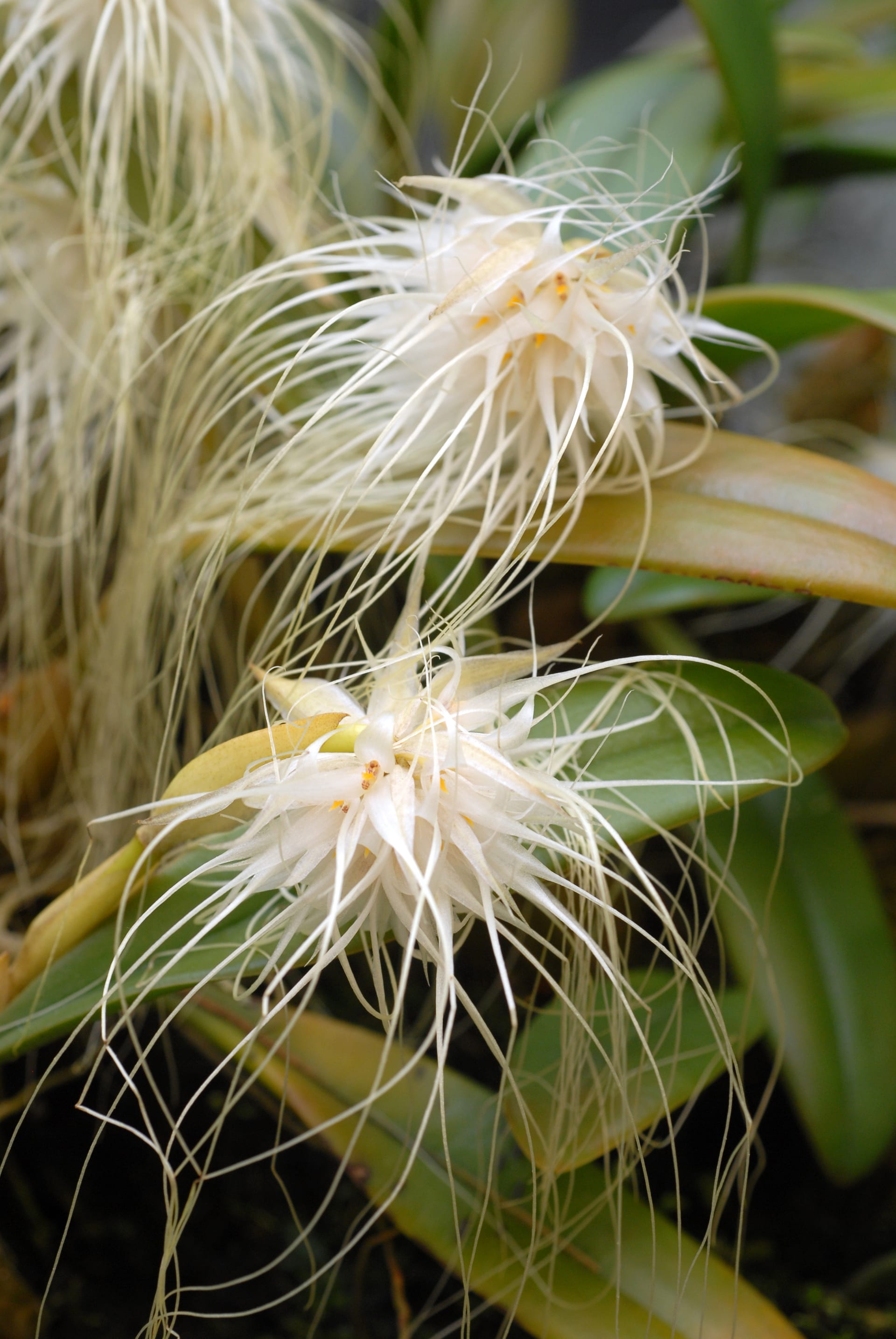
 © Eric Hunt / CC BY-SA 2.5
Medusa's Head Orchid
Bulbophyllum medusae is an epiphytic orchid whose small, white-to-pale-yellow flowers cluster into a round head with long, thread-like sepals that trail outward like wild, windswept hair, a resemblance that inspired its name after the Gorgon of Greek mythology. Its pseudobulbs are compact, only about 2cm tall, while the leaves reach 15 to 20cm and the flower cluster grows to roughly 15cm across. Native to the warm, humid forests of Southeast Asia, it thrives in similarly warm, humid conditions and is generally considered suitable for growers with some prior orchid experience. As a perennial that spreads gradually along a creeping rhizome, it rewards patient care with a strikingly unusual bloom found in few other orchids.
View Medusa's Head Orchid encyclopedia →0% commission on your first sales!Register by September 30, 2026 and your first 2 plants are commission-free!
Grower Wanted!
List your plants on GrowerDirect and sell directly to customers nationwide!
6 Transparency Commitments from GrowerDirect
Growers disclose the following information for Orchids listings, guaranteeing transparency on variety, origin, light requirements, and growing difficulty.
- Variety Disclosed
- Real Photos
- Color Specification
- Origin Disclosed
- Light Requirements
- Difficulty Level Disclosed
Browse all 142 varieties
Light Requirements
Growing Difficulty
Verified growers wanted for Orchids
Growers are signing up now ahead of launch. Subscribe to be notified when new listings go live.
Getting alerts is free with a member account. When new listings match your saved search, we'll notify you by email and in-app.
Browse other categories
Medusa's Head Orchid key facts
- Growing Difficulty
- Intermediate
- Lifespan
- Perennial that keeps spreading along its rhizome (little data on lifespan)
- Size
- Pseudobulbs about 2 cm; leaves 15-20 cm; flower heads about 15 cm long
- Watering
- Regular dilute liquid fertilizer while growing
- Light & Placement
- It prefers moderate shade; keep it out of direct sun, in light like that through a sheer curtain.
- Watering
- It dislikes drying out, so water regularly in the growing season without letting the medium dry completely.
- Temperature & Overwintering
- A warm-growing species that is sensitive to cold; keep it in a warm room in winter.
- Soil & Repotting
- The rhizome creeps sideways, so use a basket or shallow pot with sphagnum or bark, or mount it.
- Pests & Cautions
- Ensure good air movement, as the rhizome suffers in stagnant humidity. If the scent bothers you, move it while in flower.
About Medusa's Head Orchid
Bulbophyllum medusae is an epiphytic orchid from Southeast Asia known for its round clusters of thread-like flowers resembling wild hair. It thrives in warm, humid conditions and suits growers with some orchid experience.
7 things to know before growing Medusa's Head Orchid
1Bright, Indirect Light
Direct sun can scorch the leaves, so a bright spot with filtered light, like behind a sheer curtain, works well. Since this orchid comes from warm, humid parts of Southeast Asia, good air circulation is also important.
2Avoid Over- or Under-Watering
As an epiphyte, constantly soggy media can cause root rot, but this species also dislikes prolonged dryness given its preference for high humidity. Water thoroughly once the surface dries during active growth, and mist regularly to keep humidity up.
3Use a Well-Draining Epiphyte Mix
Bark or sphagnum moss with good airflow and drainage suits this epiphytic orchid best. It can also be mounted on a board or tree-fern fiber instead of potted.
4Repot as the Rhizome Spreads
Although the pseudobulbs stay small at about 2cm, the plant spreads outward as its rhizome grows. Once the rhizome reaches the edge of the pot, move it to a larger pot or fresh mounting material.
5Protect from Cold and Dryness in Winter
Coming from warm, humid Southeast Asia, this orchid should be kept somewhere warm indoors as temperatures drop, while avoiding excessive dryness. Watering can be reduced slightly during its slower growth period.
6Check the Rhizome and Leaves
When choosing a plant, look for firm leaves and healthy, undamaged pseudobulbs and rhizomes. Since it's a perennial that keeps growing along its rhizome for years, root and rhizome health are especially worth checking.
7Enjoy the Unusual Flower Cluster
The flower cluster grows to about 15cm, formed by small flowers with long, thread-like sepals gathered into a round shape. Look closely and you'll see the wild, hair-like form that inspired the plant's mythological name.
Frequently asked questions about Medusa's Head Orchid
- Q.Is this orchid suitable for beginners?
- A.Bulbophyllum medusae is generally considered a plant for intermediate growers, requiring some familiarity with placement, humidity, and watering. Those with prior experience growing epiphytic orchids will find it more approachable.
- Q.How big does this plant get?
- A.The pseudobulbs are compact, at about 2cm, with leaves reaching 15 to 20cm. When in bloom, the flower cluster extends to roughly 15cm.
- Q.Where does the name Medusa's Head Orchid come from?
- A.The name comes from the flower's appearance: small blooms with long, thread-like sepals cluster together in a round shape that resembles the wild, snake-like hair of Medusa from Greek mythology.
- Q.How long can this plant be grown for?
- A.It's a perennial that continues growing along a spreading rhizome over a long period. However, detailed records on its overall lifespan are limited, so an exact figure isn't known.
- Q.How often does it need repotting?
- A.A good guide is to repot once the rhizome reaches the edge of the pot. Growth speed varies by plant, so it helps to check the roots periodically.
Handy Growing Tools for Medusa's Head Orchid
Learn more about Medusa's Head Orchid in the encyclopedia
View Medusa's Head Orchid encyclopedia entry →
Care difficulty, size, origin and light needs — all basics covered.
More in this category
Can't find the plant you're looking for?
Post your wishes for free and growers with matching plants will contact you with introductions.