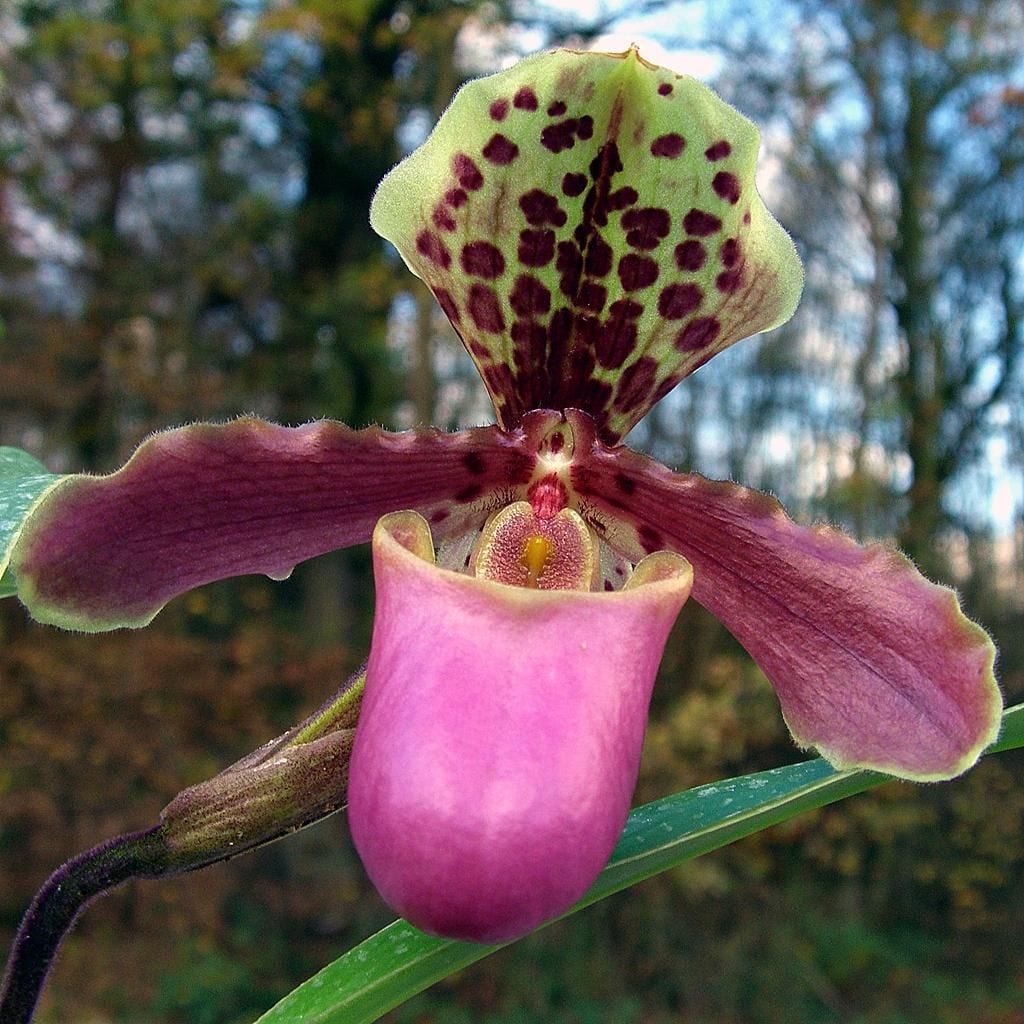
 © Orchi / CC BY-SA 3.0
Henry's Paphiopedilum
Paphiopedilum henryanum is a compact slipper orchid native to limestone cliffs in Guangxi and Yunnan in China and northern Vietnam. Its narrow, glossy dark-green leaves form a neat rosette, and from autumn into winter it sends up a flower stem of roughly 12-15cm topped with a single bloom about 4-6cm across. Rather than bold colors, the appeal lies in the contrast between the tidy foliage and that single, understated flower, making it a favorite among more experienced orchid growers. It calls for intermediate-level care, but rewards patient growers who divide and replant it over the years. Every Paphiopedilum species is listed in CITES Appendix I, which makes it an Internationally Endangered Species under Japan's Act on Conservation of Endangered Species (種の保存法). Transferring a plant within Japan, whether by sale or gift, requires a registration certificate under that Act, and this applies to plants propagated in Japan too. When buying, always confirm that the plant comes with its registration certificate.
View Henry's Paphiopedilum encyclopedia →0% commission on your first sales!Register by September 30, 2026 and your first 2 plants are commission-free!
Grower Wanted!
List your plants on GrowerDirect and sell directly to customers nationwide!
6 Transparency Commitments from GrowerDirect
Growers disclose the following information for Orchids listings, guaranteeing transparency on variety, origin, light requirements, and growing difficulty.
- Variety Disclosed
- Real Photos
- Color Specification
- Origin Disclosed
- Light Requirements
- Difficulty Level Disclosed
Browse all 142 varieties
Light Requirements
Growing Difficulty
Verified growers wanted for Orchids
Growers are signing up now ahead of launch. Subscribe to be notified when new listings go live.
Getting alerts is free with a member account. When new listings match your saved search, we'll notify you by email and in-app.
Browse other categories
Henry's Paphiopedilum key facts
- Growing Difficulty
- Intermediate
- Lifespan
- Perennial that can be kept for many years by division (little data on lifespan)
- Size
- Small; flower stem 12-15 cm, flowers 4-6 cm across
- Watering
- Dilute liquid fertilizer in the growing season
- Light & Placement
- Grow in bright partial shade; strong direct sun can scorch the leaves.
- Watering
- Water as the mix begins to dry, avoiding both waterlogging and hard drying.
- Temperature & Overwintering
- It is an intermediate to warm grower; keep it indoors somewhere warm in winter.
- Soil & Repotting
- In the wild it grows on limestone cliffs. Pot it in a free-draining mix and repot or divide after flowering.
- Fertilizer
- Feed dilute liquid fertilizer regularly in the growing season.
- Pests & Cautions
- As an Appendix I species, always check the registration certificate under the Act on Conservation of Endangered Species when acquiring a plant.
About Henry's Paphiopedilum
Paphiopedilum henryanum is a compact slipper orchid from southern China and northern Vietnam, known for its narrow dark-green leaves and single 4-6cm blooms each autumn and winter. Best suited to intermediate growers.
7 things to know before growing Henry's Paphiopedilum
1Avoid Direct Sun
Coming from limestone cliff habitats, this orchid likes bright conditions but strong midsummer sun can scorch the leaves. A sheer-curtained window or bright, well-ventilated partial shade works best.
2Water When Dry
Water thoroughly once the surface of the mix has dried out, rather than keeping it constantly damp. Make sure water drains freely from the pot, since standing moisture around the base can lead to rot.
3Use Free-Draining Mix
Because it grows on rocky limestone ledges in the wild, this plant prefers a mix that lets its roots dry out between waterings. A bark-and-perlite based compact mix formulated for Paphiopedilum suits it well.
4Repot and Divide After Flowering
Repot once the mix starts to break down, timing it for after flowering has finished. This is also the best moment to divide the plant, producing new offsets with minimal stress.
5Keep Routine Steady in Bloom Season
While the flower stem develops from autumn into winter, avoid major changes to light or watering habits. Keep it away from cold drafts too, since low temperatures at this stage can damage the developing bud.
6Choose Healthy-Leaved Plants
Glossy, deep-green leaves are the sign of a healthy plant. Avoid specimens with dried leaf tips or blackened bases. As an Appendix I species, it must come with a registration certificate under Japan's Act on Conservation of Endangered Species (種の保存法), so always confirm the certificate when acquiring one.
7A Slow, Long-Term Orchid
This is considered an intermediate-level orchid, and flowering may take a while to become reliable until conditions suit it. It's best approached as a plant to grow patiently over years, propagated through repeated divisions.
Frequently asked questions about Henry's Paphiopedilum
- Q.Is this orchid suitable for beginners?
- A.It's generally considered an intermediate-level orchid, though anyone comfortable with basic watering and drainage needs can manage it. Growers with some prior orchid experience will find it approachable.
- Q.How many flowers does it produce?
- A.Each flower stem carries a single bloom. Once the plant is well established, it typically flowers again each autumn through winter.
- Q.How big does it get?
- A.It's a compact Paphiopedilum, with flower stems around 12-15cm and blooms roughly 4-6cm across, making it easy to manage in a pot.
- Q.What causes the leaves to look damaged?
- A.Leaf scorch from direct sun and root rot from poorly draining mix are the most common causes. Reviewing the plant's location and potting mix usually helps.
- Q.When is the best time to divide the plant?
- A.Division is best done together with repotting, after flowering has finished.
Handy Growing Tools for Henry's Paphiopedilum
Learn more about Henry's Paphiopedilum in the encyclopedia
View Henry's Paphiopedilum encyclopedia entry →
Care difficulty, size, origin and light needs — all basics covered.
More in this category
Can't find the plant you're looking for?
Post your wishes for free and growers with matching plants will contact you with introductions.