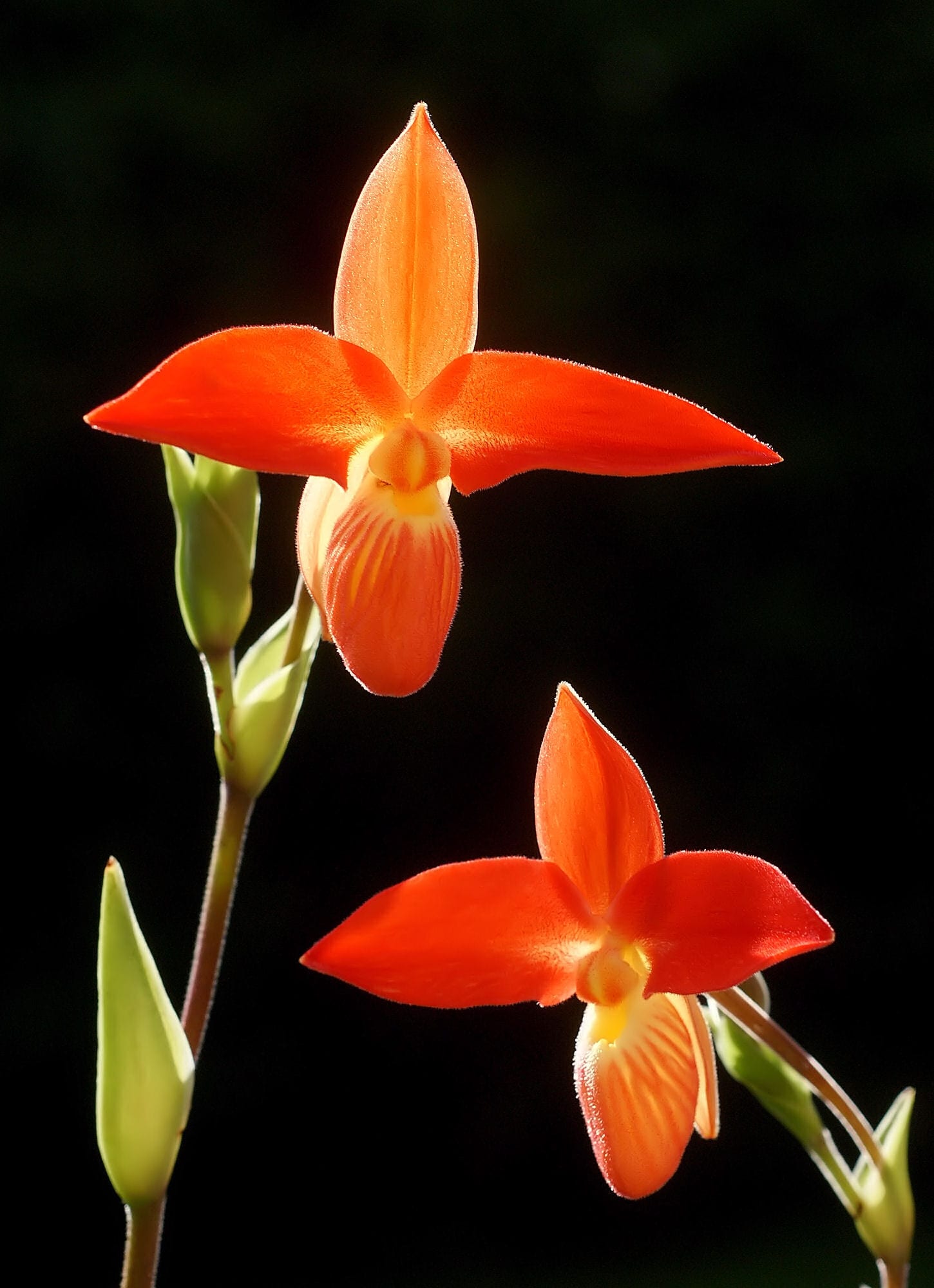
 © Orchi / CC BY-SA 3.0
Besse's Phragmipedium
Phragmipedium besseae is an orchid native to the wet cliffs and rock faces of the eastern Andes in South America, where water constantly flows over its roots. When it was first described in 1981, it drew wide attention for its vivid vermilion-red flowers, a color unknown in the genus until then, and it has since become a prized parent in orchid breeding. As a perennial, it spreads by rhizome and can be grown over many years, adding to its long-term appeal. Despite its compact size, with leaves 13-30cm long, flower stems 30-50cm, and blooms 4-9cm across, keeping the humidity and drainage it needs close to its native habitat calls for real cultivation experience, making it a variety best suited to more advanced growers. Every Phragmipedium species is listed in CITES Appendix I, which makes it an Internationally Endangered Species under Japan's Act on Conservation of Endangered Species (種の保存法). Transferring a plant within Japan, whether by sale or gift, requires a registration certificate under that Act, and this applies to plants propagated in Japan too. When buying, always confirm that the plant comes with its registration certificate.
View Besse's Phragmipedium encyclopedia →0% commission on your first sales!Register by September 30, 2026 and your first 2 plants are commission-free!
Grower Wanted!
List your plants on GrowerDirect and sell directly to customers nationwide!
6 Transparency Commitments from GrowerDirect
Growers disclose the following information for Orchids listings, guaranteeing transparency on variety, origin, light requirements, and growing difficulty.
- Variety Disclosed
- Real Photos
- Color Specification
- Origin Disclosed
- Light Requirements
- Difficulty Level Disclosed
Browse all 142 varieties
Light Requirements
Growing Difficulty
Verified growers wanted for Orchids
Growers are signing up now ahead of launch. Subscribe to be notified when new listings go live.
Getting alerts is free with a member account. When new listings match your saved search, we'll notify you by email and in-app.
Browse other categories
Besse's Phragmipedium key facts
- Growing Difficulty
- Advanced
- Lifespan
- Perennial that spreads by rhizomes and can be kept for many years (little data on lifespan)
- Size
- Small; leaves 13-30 cm, flower stem 30-50 cm, flowers 4-9 cm across
- Watering
- Dilute liquid fertilizer in the growing season
- Light & Placement
- Give bright shade out of direct sun.
- Watering
- It grows on dripping cliffs, so keep the mix from drying out.
- Temperature & Overwintering
- A cool grower from 1,000-1,700 m that dislikes summer heat. Keep it cool and airy in summer and frost-free indoors in winter.
- Soil & Repotting
- It spreads by long rhizomes, so use a shallow, wide pot and a free-draining mix.
- Fertilizer
- Feed dilute liquid fertilizer during growth.
- Pests & Cautions
- All Phragmipedium species are in Appendix I; always check the registration certificate under the Act on Conservation of Endangered Species when acquiring a plant.
About Besse's Phragmipedium
An orchid native to the wet, water-washed cliffs of the Andes, Phragmipedium besseae is known for its vivid vermilion-red flowers, described in 1981, and its rhizome-spreading growth habit — a variety best suited to experienced growers.
7 things to know before growing Besse's Phragmipedium
1Placement & Light
In the wild, this orchid grows on open, sunlit cliffs and rocks where water flows past its roots. Give it bright, filtered light rather than direct sun, along with good air movement around the leaves.
2Watering Tips
Because it grows beside constantly flowing water in the wild, it dislikes drying out and prefers the medium to stay consistently moist. It is also sensitive to mineral buildup, so rainwater or soft water is preferable to hard tap water.
3Choosing Substrate
Choose a mix that balances drainage with moisture retention, such as a blend of bark and sphagnum moss. This keeps the roots consistently damp while still allowing excess water to escape and helping to prevent rot.
4Repotting Timing
Because the medium stays wet at all times, it tends to break down faster than in other orchids. Repotting before it deteriorates, timed to when new roots begin to grow, helps minimize stress on the plant.
5Seasonal Care
Growth can suffer during stretches of extreme heat or cold, so choose a location that avoids both. Maintain humidity year-round while still ensuring enough airflow to prevent the foliage from staying damp and stagnant.
6Choosing a Plant
Since this species spreads by long rhizomes, a plant with multiple new growths already attached tends to establish and expand more readily. Avoid plants with roots that look blackened or feel soft and mushy. As an Appendix I species, it must come with a registration certificate under Japan's Act on Conservation of Endangered Species (種の保存法), so always confirm the certificate when acquiring one.
7Difficulty Level
Keeping humidity, water quality, and airflow consistent makes this a plant generally considered suited to experienced growers. Building experience with other orchids first will make it easier to get a feel for its care.
Frequently asked questions about Besse's Phragmipedium
- Q.Can beginners grow this orchid?
- A.It is generally considered a variety for experienced growers, since it calls for careful management of humidity and water quality. Gaining experience with other orchids first is a good idea before taking it on.
- Q.How large does this orchid grow?
- A.It is a compact, small-growing species with leaves around 13-30cm long, flower stems 30-50cm tall, and blooms roughly 4-9cm across. This makes it manageable to keep in a pot.
- Q.What is distinctive about its flower color?
- A.When it was described in 1981, it became known for its vivid vermilion-red flowers, a color not previously seen in the genus. This striking color is also why it has been so highly valued as a breeding parent.
- Q.How many years can it be grown for?
- A.It is a perennial that spreads by rhizome and can be kept in cultivation over many years. That said, detailed information on its exact lifespan is limited.
- Q.Should the potting medium be kept on the dry side?
- A.No — since it grows naturally where water is constantly flowing, it does not tolerate drying out well. The basic approach is to keep the medium consistently moist.
Handy Growing Tools for Besse's Phragmipedium
Learn more about Besse's Phragmipedium in the encyclopedia
View Besse's Phragmipedium encyclopedia entry →
Care difficulty, size, origin and light needs — all basics covered.
More in this category
Can't find the plant you're looking for?
Post your wishes for free and growers with matching plants will contact you with introductions.