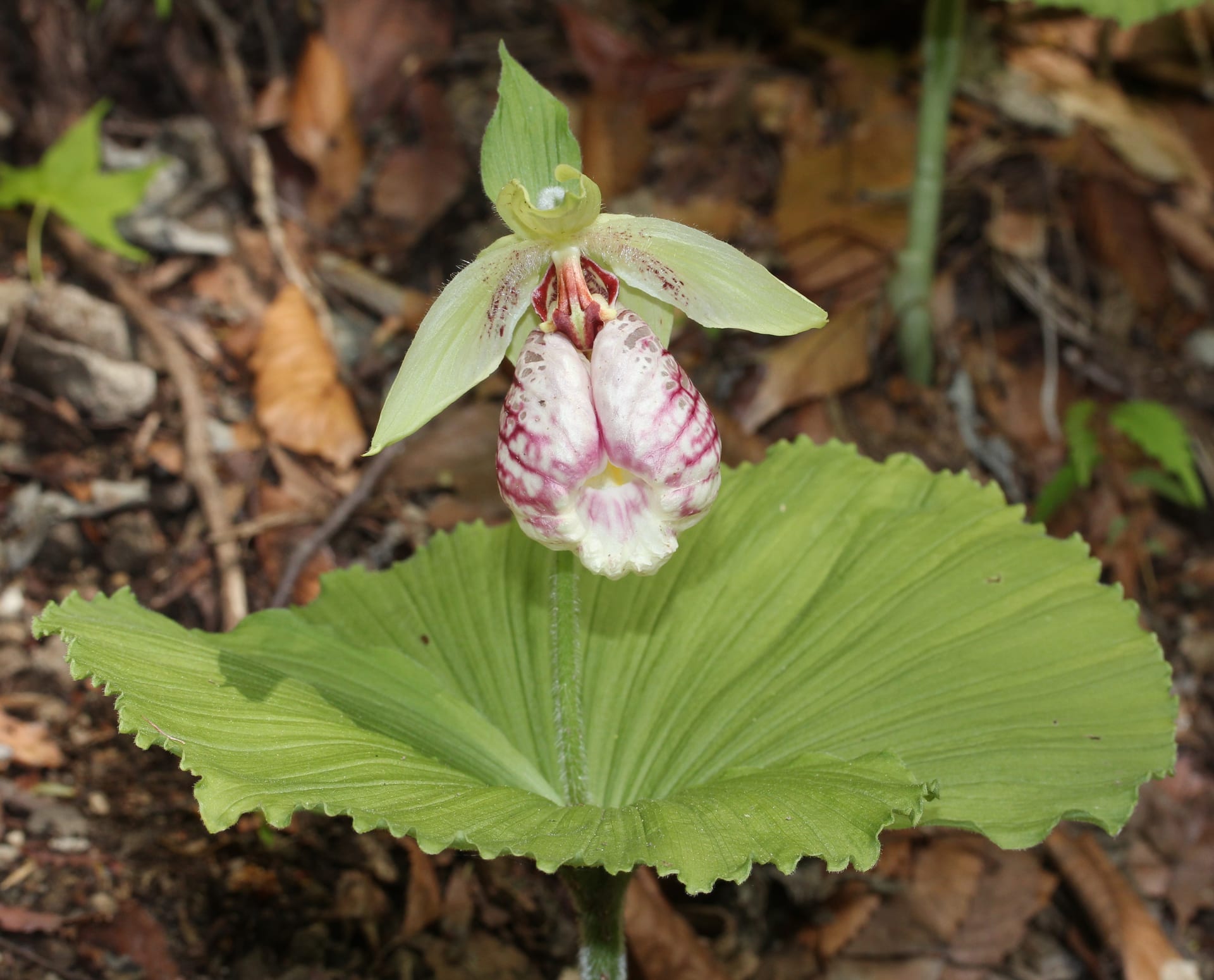
 © Alpsdake / CC BY-SA 4.0
Japanese Cypripedium
Cypripedium japonicum, known as kumagaiso or the Japanese lady's slipper orchid, is one of Japan's most distinctive wild orchids. Two large fan-shaped leaves unfold in a mirrored pair, and a single pouch-shaped flower rises on a stem between them, facing sideways. The white lip is marked with purple-brown mottling, giving the plant a look unlike any other orchid. In the wild, it spreads by rhizomes across the shaded floor of bamboo and cedar forests, forming colonies that bloom together in spring, usually around May. Because it demands cool, moist, partially shaded conditions with sharp drainage close to its native habitat, this orchid is considered a plant for experienced growers. Its slow spread via underground rhizomes is part of its particular charm.
View Japanese Cypripedium encyclopedia →0% commission on your first sales!Register by September 30, 2026 and your first 2 plants are commission-free!
Grower Wanted!
List your plants on GrowerDirect and sell directly to customers nationwide!
6 Transparency Commitments from GrowerDirect
Growers disclose the following information for Orchids listings, guaranteeing transparency on variety, origin, light requirements, and growing difficulty.
- Variety Disclosed
- Real Photos
- Color Specification
- Origin Disclosed
- Light Requirements
- Difficulty Level Disclosed
Browse all 142 varieties
Light Requirements
Growing Difficulty
Verified growers wanted for Orchids
Growers are signing up now ahead of launch. Subscribe to be notified when new listings go live.
Getting alerts is free with a member account. When new listings match your saved search, we'll notify you by email and in-app.
Browse other categories
Japanese Cypripedium key facts
- Growing Difficulty
- Advanced
- Lifespan
- Perennial; spreads by long rhizomes
- Size
- Up to about 40 cm tall; flowers 9-10 cm across
- Watering
- Sparing, dilute liquid fertilizer in the growing season
- Light & Placement
- It grows on the floor of bamboo and cedar woods; give bright shade or dappled light.
- Watering
- It likes moist, humus-rich soil; do not let it dry out in growth, but ensure good drainage to avoid waterlogging.
- Temperature & Overwintering
- It dies back and rests in winter; it tolerates winter cold but should be kept from summer heat and stagnant humidity.
- Soil & Repotting
- Its rhizomes run long, so it is hard to keep in pots and does best planted out where conditions suit, in humus-rich, well-drained soil.
- Dormancy Care
- After the top dies back in autumn it is dormant; do not let the planting site dry out completely.
- Pests & Cautions
- A Japanese native; choose nursery-propagated plants rather than wild-collected ones. Some prefectures restrict collecting wild plants by ordinance. It is listed as Vulnerable on the Ministry of the Environment Red List.
About Japanese Cypripedium
Cypripedium japonicum, Japan's wild lady's slipper orchid, with fan-shaped leaves and a pouch-like bloom. An advanced-level orchid suited to cool, moist, partially shaded growing conditions.
7 things to know before growing Japanese Cypripedium
1Choose Bright Shade
Avoid direct summer sun, which can scorch the leaves, and keep the plant in bright, filtered light similar to a forest floor. In winter, a spot that mirrors its dormant-season habitat under deciduous trees works well.
2Balance Water Carefully
This orchid dislikes both drying out and soggy roots, so water thoroughly once the soil surface has dried. Pay particular attention during the spring-to-early-summer growing season, when it is more prone to water stress.
3Well-Drained Soil Mix
Use a mix that balances drainage with moisture retention, such as hard akadama or kanuma soil combined with leaf mold. It prefers slightly acidic to neutral soil.
4Better in the Ground Than in a Pot
Its rhizomes have long internodes and can exceed 1 meter in total length, so pot culture is difficult and it does best planted in the ground in a suitable site. Plant it in well-draining soil rich in humus. If you want to grow one in a container, the Taiwanese Cypripedium formosanum, which has short rhizomes and suits pots, is an alternative.
5Manage Leaves by Season
After flowering in early summer, the leaves keep photosynthesizing to build up energy, so keep them healthy through autumn. The foliage dies back in winter as the plant goes dormant — avoid letting it dry out completely during this period.
6Pick Healthy Rhizomes
Choose a plant with firm rhizomes and well-developed buds for more reliable growth the following season. Leaves with little damage or discoloration are also a good sign of a healthy plant.
7An Advanced-Level Plant
This is considered one of the more challenging wild orchids to grow, so aim to recreate the cool, moist conditions of its native forest floor. Approach it with patience, thinking in terms of years rather than a single season.
Frequently asked questions about Japanese Cypripedium
- Q.Is this suitable for beginner growers?
- A.Cypripedium japonicum is considered one of the more difficult wild orchids to grow. It suits growers who can provide cool, moist, partially shaded conditions with well-drained soil similar to its native habitat.
- Q.Is it better grown in the ground or in a pot?
- A.Because its rhizomes grow very long, pot culture is difficult and it is best planted in the ground in a suitable spot. Choose a site like a bamboo or cedar forest floor, with bright shade and moist, humus-rich soil. If you want a potted plant, the Taiwanese Cypripedium formosanum, which has short rhizomes, is better suited to containers.
- Q.When does it bloom?
- A.It produces a single sideways-facing, pouch-shaped flower between its fan-shaped leaves in spring, usually around May. The bloom measures roughly 9 to 10 cm across.
- Q.Does the foliage die back in winter?
- A.Yes, as a perennial, its above-ground growth dies back and the plant enters dormancy in winter. The rhizomes remain alive underground, so avoid letting the soil dry out completely even during dormancy.
- Q.How large does it grow?
- A.Plants reach roughly 40 cm in height. Because it spreads via long rhizomes, it gradually forms larger colonies over the years.
Handy Growing Tools for Japanese Cypripedium
Learn more about Japanese Cypripedium in the encyclopedia
View Japanese Cypripedium encyclopedia entry →
Care difficulty, size, origin and light needs — all basics covered.
More in this category
Can't find the plant you're looking for?
Post your wishes for free and growers with matching plants will contact you with introductions.