Source: Wikimedia Commons
Vanilla
IntermediateVanilla planifolia
The vanilla-producing vine orchid, the only commercially important orchid, also enjoyed for its flowers.
About
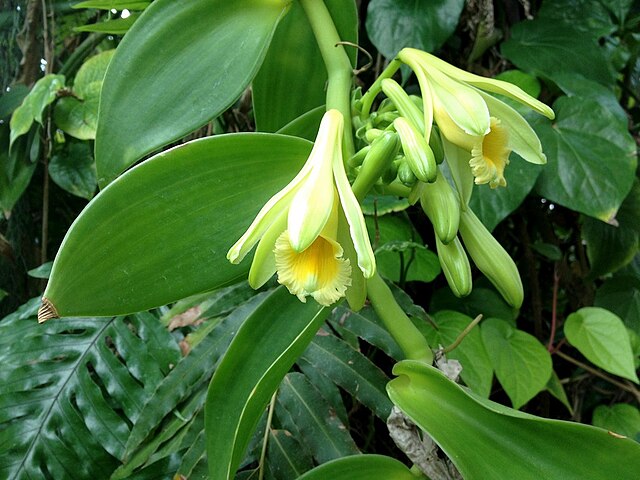
Vanilla is a genus of flowering vines in the orchid family, whose seed pods are the source of vanilla flavoring—one of the world's most widely used food flavorings. Vanilla planifolia, native to Mexico, is the primary commercial species. The vines grow 10–15 m, attaching to trees or supports by adventitious roots. The yellow-green flowers last only a single day and must be hand-pollinated in commercial cultivation; pods take three to five years to develop from planting. Large pots or greenhouse culture with supporting structures are needed. Madagascar, Indonesia, and Tahiti are the principal production regions today.
Source: Wikipedia (CC BY-SA 4.0)
Lifespan of the Vanilla
The Vanilla lives 10+ years.
Temperature & humidity for the Vanilla
The ideal temperature for the Vanilla is 20〜32℃.
Cultivation requires tropical conditions (20–30°C), high humidity, and bright indirect light.
Basic Info
Origin
Mexico (native), now cultivated throughout tropical regions worldwide
Lifespan
10+ years
Size
Vine, several meters
Temperature
20〜32℃
Humidity
50〜70%
Growing Tips
Light & Placement
It likes bright indirect light and should be kept out of strong direct sun. The vines reach several meters, so grow it in a large pot or greenhouse.
Watering
It likes high humidity. The aerial roots from the nodes also take up water, so water so the whole plant never dries out.
Temperature & Overwintering
A tropical plant that wants 20-32°C. During cold periods, keep it somewhere that stays warm, such as a greenhouse.
Soil & Repotting
Plant it in a large pot and provide a stake or trellis for the vines. Let the aerial roots at the nodes attach to the support.
Pruning & Shaping
Being a vine that climbs trees and supports, train the vines onto a stake or trellis to keep the plant tidy.
Vanilla FAQ
QWhat is the growing difficulty level for Vanilla?
Intermediate. A variety suitable for intermediate growers. Requires some cultivation experience and knowledge of environment management. Pay careful attention to temperature and humidity control.
QWhat is the ideal temperature for Vanilla?
The ideal temperature for Vanilla is 20〜32℃. Avoid sudden temperature changes and maintain a stable environment.
QWhat is the lifespan of Vanilla?
The average lifespan of Vanilla is 10+ years. With proper cultivation environment and nutrient management, you can keep it healthy for a long time.
QWhat is the typical price for Vanilla?
The price of Vanilla varies significantly by variety, characteristics, size, and lineage. Please check GrowerDirect's price guide for the latest market information.
Last updated: August 31, 2026
Growing Specifications
- USDA Zone
- 11–12
Sources: Missouri Botanical Garden Plant Finder: Vanilla planifolia (Zone 11 to 12)
References & Sources
Edited & verified by: GrowerDirect Editorial Team
The classifications, regulations, and growing data on this page are created and verified based on the primary information database below.
Primary sources
Taxonomy & Authority
Accepted name: Vanilla planifolia Andrews
Synonyms: Notylia planifolia, Epidendrum rubrum, Vanilla bampsiana, Myrobroma fragrans, Vanilla aromatica var. claviculata, Notylia sativa, Vanilla sylvestris, Vanilla viridiflora
Authority databases: GBIF · POWO · RHS orchid hybrid registration (International Orchid Register) · AOS (American Orchid Society)
Nomenclature follows global taxonomic authority databases.
Regulations & Conservation Status
The family Orchidaceae is listed entirely in CITES Appendix II (except for the genera Paphiopedilum and Phragmipedium and certain species, which are in Appendix I). Cultivars and hybrids are subject to family-level regulation; however, artificially propagated specimens may benefit from simplified trading procedures under the Appendices.
Sources: CITES Appendices (Orchidaceae spp. = Appendix II) / CITES Appendix I Orchid Checklist (Kew/UNEP-WCMC 2019)
Regulations may change. Always verify the latest information with the relevant authorities.
Related Species
Find listings for this species
Related Articles
Airflow Management Guide for Bulbless Orchids | Understanding the Physiology of Non-Water-Storing Epiphytic Orchids and Their Differences from Dendrobium kingianum
This guide explains the physiology of bulbless epiphytic orchids and key points for airflow management, while comparing water management differences with pseudobulbed Dendrobium kingianum.
Orchid Division and Bulb Propagation to New Plant Development | Complete Roadmap from Seedling to Flowering Stock
Orchid division is an important propagation method for bulb-bearing orchids such as Cymbidiums and Dendrobiums. This article provides a detailed explanation of the complete process from division to bulb propagation and new plant development. It covers the full range of successful techniques, from selecting the optimal timing, separating bulbs, planting new plants with initial care management, to the timeline through flowering.
Coelogyne Genus Seasonal Care Guide | Withholding Water in the Dry Season and Tips for Regulating the Bloom Cycle
A seasonal guide to Coelogyne, a type of epiphytic orchid, from watering during the growing season to dry-season drought management and tips for regulating the bloom cycle.
Post-Bloom Care: The Annual Cycle from New Growth to Flower Formation
Learn the annual care cycle for orchids from the end of flowering to the next bloom. This guide covers post-flower care including flower stem cutting methods, signs to observe during new shoot development, summer growth period considerations, requirements for flower bud formation, and finishing care from bud emergence through blooming.
Can't find the plant you're looking for?
Post your wishes for free and growers with matching plants will contact you with introductions.