Complete Guide to Making Cut Roses Last Longer|Floral Foam Utilization and Daily Care Techniques
Techniques for enjoying cut roses 1–2 weeks longer. Detailed explanation of absorbent floral foam, daily water changes, stem treatment methods, and effective ways to use flower preservative.
Key Takeaways
Techniques for enjoying cut roses 1–2 weeks longer. Detailed explanation of absorbent floral foam, daily water changes, stem treatment methods, and effective ways to use flower preservative.
Cut roses are a standard choice for floral gifts because their beauty lasts a long time. However, many people have had the experience of gifted roses wilting within a few days. In fact, by learning the correct care methods, it is possible to significantly extend the freshness of roses. This time, we will provide a detailed explanation of practical techniques for enjoying cut roses to their fullest for as long as possible.
Physiological Characteristics of Cut Roses
Understanding why cut roses wilt is the first step to keeping them fresh longer.
- Blocked xylem vessels: Immediately after cutting, the xylem vessels in the stem of the rose are damaged. Furthermore, as bacteria multiply and block the xylem vessels, the absorption of water and nutrients decreases.
- Sensitivity to ethylene gas: Roses are extremely sensitive to ethylene gas released by plants. When exposed to ethylene gas released by ripe fruit or other flowers, the flower rapidly ages.
- Water loss through transpiration: Since cut roses cannot absorb water from their roots, water is rapidly lost through transpiration from the petals. In particular, the amount of transpiration from areas with many petals and thin thickness is high.
Initial Treatment After Purchase
The initial treatment performed immediately after purchasing roses greatly influences the freshness thereafter.
- Cutting back the stem: Immediately after purchase, cut back approximately 3–5 cm from the bottom of the stem at an angle with a sharp knife as soon as possible. The purpose is to remove blockages in the xylem vessels and maximize the water absorption surface area. Using a knife rather than scissors allows you to cut without crushing the xylem vessels.
- Removal of lower leaves: Remove all leaves within approximately 5 cm from the bottom of the stem. These leaves becoming submerged in water causes bacteria to multiply rapidly, which causes the xylem vessels to become blocked.
- Immersion in cold water: Immerse the cut-back roses in cold water (preferably 4–8°C) for 1–2 hours. At this time, using water with flower preservative added is even more effective.
Utilization of Absorbent Floral Foam (Oasis)
Here, we explain the correct way to use absorbent floral foam, which is the foundation of flower arranging and arrangements.
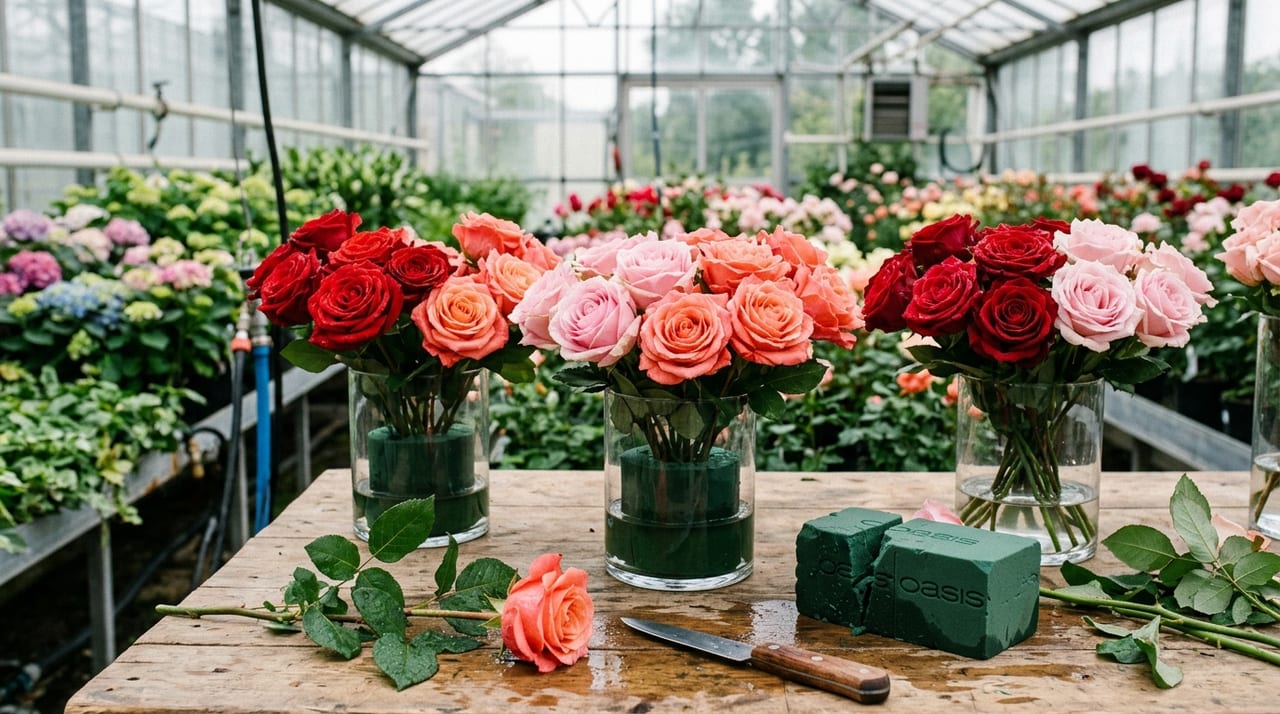
- Selection and preparation of foam: There are two types of absorbent floral foam: one for fresh flowers and one for artificial flowers. For fresh flowers like roses, always choose the fresh flower type. When purchased, it is in a dry state, but needs to be prepared by soaking in water 24 hours before use. To soak, place the foam in a bucket and wait for it to sink naturally. Forcing it to sink traps air and reduces water absorption capacity.
- Inserting stems into foam: With the foam in a sufficiently moist state, insert the rose stems. It is important to insert the stems as vertically as possible, deep into the foam. If inserted too shallow, the stem cannot absorb sufficient water.
- Foam moisture management: Keeping the foam in a constantly moist state is the key to maintaining the freshness of roses. Every day, check the moisture of the foam with your fingers, and if it is dry, add water. The guideline is to pour water until it pools on the surface of the foam.
Daily Care Techniques
Daily management after purchase determines the lifespan of roses.
- Daily water changes (when using floral foam): When using floral foam, it is necessary to add water every day. Even if the water in the vase is not depleted, the foam should always remain moist. If water has decreased, it is recommended to also replace the water in the vase itself.
- Water changes with flower vase: When inserting directly into a vase, it is important to completely change the water every day. Bacteria multiply rapidly in old water. At this time, lightly washing the vase is effective in reducing bacterial adhesion.
- Daily cutting back of stems: By cutting back approximately 1–2 cm from the bottom of the stem daily, you can remove blockages in the xylem vessels and restore water absorption capacity. By performing this treatment every day, the freshness of the roses is noticeably improved.
- Separation from other flowers: It is important not to place roses near other flowers or mature fruit. In particular, apples and bananas release large amounts of ethylene gas, causing roses to rapidly age.
Effective Use of Flower Preservative
When used properly, commercially available rose flower preservatives can significantly extend the lifespan of flowers.
Components and functions of flower preservatives Common flower preservatives contain the following components.
- Sugar: Provides energy for the flower to respire.
- Bactericidal components: Suppress bacterial multiplication and prevent xylem vessel blockage.
- Absorption-promoting substances: Support the flower in absorbing water more efficiently.
Method of use and dosage Mix the flower preservative with water according to the instructions on the package at the prescribed amount. Excessive concentration may damage the flower, so it is important to follow the recommended amount.
Continued use The effect is maximized by adding the flower preservative each time water is changed daily.
Long-Lasting Techniques Through Environmental Management
Environmental conditions where roses are placed also greatly affect their lifespan. Roses last longer in low-temperature environments.
| Environmental factor | Target | Notes |
|---|---|---|
| Temperature management | Ideal temperature is 10–15°C | When room temperature exceeds 20°C, flower aging accelerates. It is important to place in the coolest location possible, avoiding heating and direct sunlight |
| Humidity management | Appropriate humidity (50–70%) | In dry environments, roses wilt rapidly. Humidity can be maintained by using a humidifier or misting water around the flowers |
| Light management | It is recommended to place in a location with soft, indirect light | Direct sunlight or strong lighting accelerates rose aging |
Petal Protection Techniques
Protecting the outer petals is an important technique for protecting the inner beautiful petals.
- Role of outer petals: The outermost petals of a rose (usually 2–3) serve as a protective layer during transport and placement. If these are damaged, the inner petals rapidly age.
- Timing of removal of outer petals: Immediately after arranging, you can expose the inner beautiful petals by gently removing the outer petals. However, if there is no damage, it may be better to keep them for protection.
Summary: Proper care allows freshness to be maintained for over 2 weeks
To keep cut roses fresh longer, all of the following are important: initial treatment immediately after purchase, correct use of absorbent floral foam, careful daily care, and environmental management. By combining these elements, in most cases you can enjoy the beauty of roses for 2–3 weeks, or in some cases even longer. No special tools or expensive flower preservatives are necessary. With basic techniques and a little effort, anyone can enjoy cut roses for as long as possible.