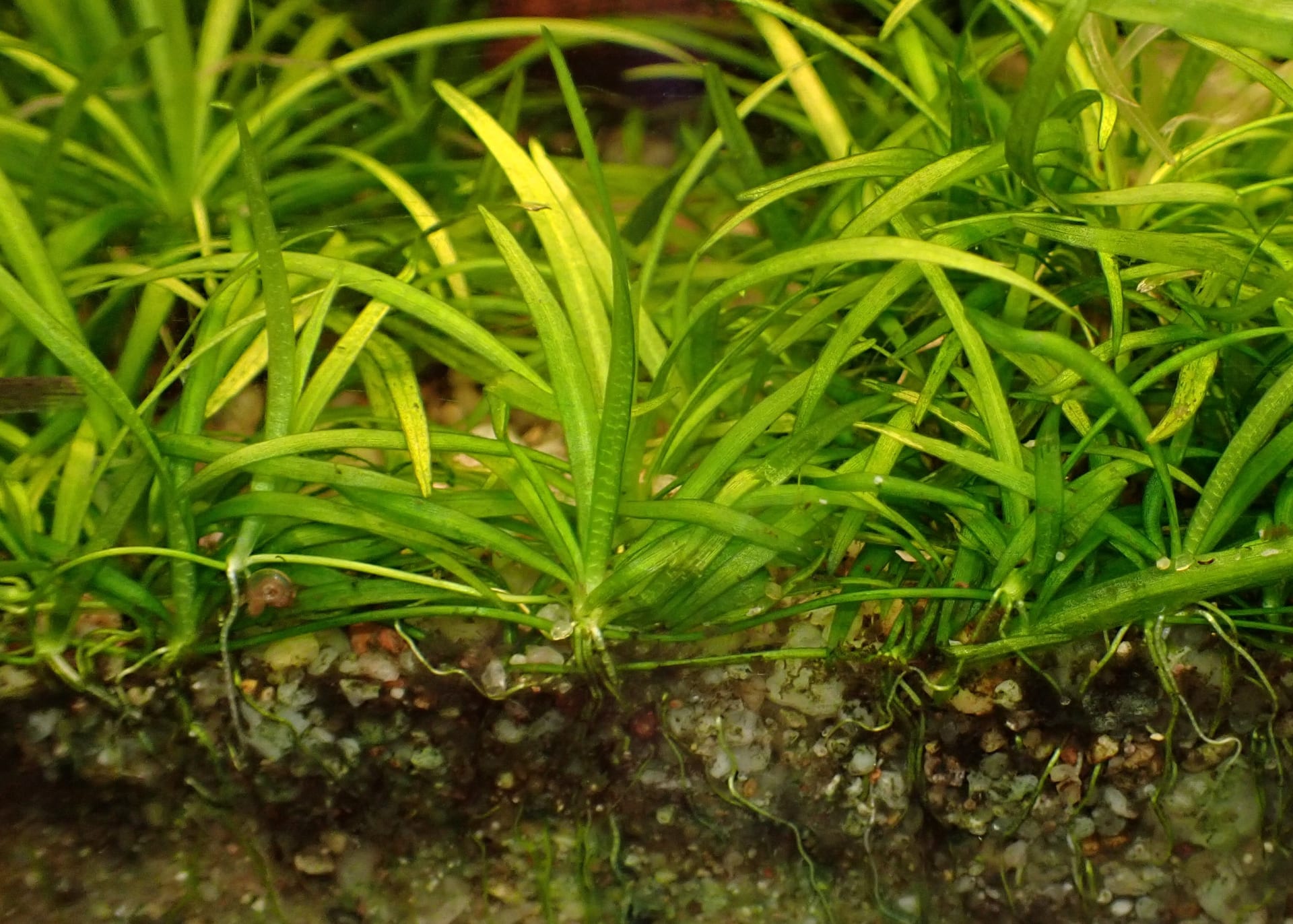
Source: Wikimedia Commons
Pygmy chain sword (Helanthium tenellum)
BeginnerHelanthium tenellum
A small plant with leaves about 1.5 mm wide that spreads by runners into a foreground lawn. Best known by its old name Echinodorus tenellus. It reddens in strong light; a 'Green' form that stays green is also sold.
About
'Echinodorus tenellus' is the old name for Helanthium tenellum, a small runner-forming plant of the Alismataceae now placed in the genus Helanthium. It ranges widely from the eastern United States through southern Mexico and the West Indies to Central and South America. It is the smallest of the runner-forming sword plants and quite variable. The traded form seems to come from tropical America: submerged leaves are very narrow and pointed, 6–10 cm long (sometimes more) and about 1.5 mm wide, widest above the middle about 2 cm below the tip, and mid to olive green or reddish. The 'parvulum' form, probably North American, has somewhat broader light green leaves that are widest below the middle. Tropica's 'Green' is a selection that stays fresh green even under intense light. With good light and a nutritious substrate it forms a lawn 5–10 cm high. It also grows emersed and flowers there. It is a staple foreground plant widely sold in Japan.
Source: Wikipedia (CC BY-SA 4.0)
Size of the Pygmy chain sword (Helanthium tenellum)
The Pygmy chain sword (Helanthium tenellum) grows to 5–10 cm tall as a lawn; leaves about 1.5 mm wide.
Temperature & humidity for the Pygmy chain sword (Helanthium tenellum)
The ideal temperature for the Pygmy chain sword (Helanthium tenellum) is 18〜28℃.
Basic Info
Origin
Eastern North America to Central and South America and the West Indies
Lifespan
Perennial; keeps spreading by runners
Size
5–10 cm tall as a lawn; leaves about 1.5 mm wide
Temperature
18〜28℃
Watering & Fertilizer
Needs a nutritious substrate; CO2 makes it denser
Growing Tips
Lighting
Medium to high light gives a dense lawn; many forms redden in strong light.
CO2 & Fertilizer
CO2 improves growth and density; provide a nutritious substrate.
Water Temperature & Quality
Optimum 18–28°C in softish water (pH 5–7.5, KH 0–14°dH).
Substrate & Attachment
Split into small clumps and plant spaced out in the foreground substrate.
Trimming & Propagation
Spreads by runners bearing plantlets; thin by pulling out excess plantlets.
Cautions
Its runners spread readily, so remove any that invade other foreground plants. Never release plants into the wild.
Pygmy chain sword (Helanthium tenellum) FAQ
QWhat is the growing difficulty level for Pygmy chain sword (Helanthium tenellum)?
Beginner. A variety suitable for beginners. No special equipment or experience is required—you can grow it without problems by setting up a basic cultivation environment.
QWhat is the ideal temperature for Pygmy chain sword (Helanthium tenellum)?
The ideal temperature for Pygmy chain sword (Helanthium tenellum) is 18〜28℃. Avoid sudden temperature changes and maintain a stable environment.
QHow large does Pygmy chain sword (Helanthium tenellum) get?
The mature size of Pygmy chain sword (Helanthium tenellum) is 5–10 cm tall as a lawn; leaves about 1.5 mm wide. This may vary slightly depending on cultivation environment and individual differences.
QHow should I water and fertilize Pygmy chain sword (Helanthium tenellum)?
Pygmy chain sword (Helanthium tenellum): watering & fertilizer — Needs a nutritious substrate; CO2 makes it denser. Aim for appropriate frequency and amount.
QWhat is the typical price for Pygmy chain sword (Helanthium tenellum)?
The price of Pygmy chain sword (Helanthium tenellum) varies significantly by variety, characteristics, size, and lineage. Please check GrowerDirect's price guide for the latest market information.
Last updated: September 23, 2026
References & Sources
Edited & verified by: GrowerDirect Editorial Team
The classifications, regulations, and growing data on this page are created and verified based on the primary information database below.
Taxonomy & Authority
Regulations & Conservation Status
Not listed in CITES (no match in Species+). Not regulated under Japan's Invasive Alien Species Act or Species Conservation Act. Never dump aquatic plants into rivers, ponds or ditches, or flush them away with tank water. Drain unwanted plants and trimmings and dispose of them as household waste.
Sources: Species+ (CITES listing check) / Ministry of the Environment: list of Invasive Alien Species (Invasive Alien Species Act)
Regulations may change. Always verify the latest information with the relevant authorities.
Related Species
Find listings for this species
Related Articles
Complete Guide to Caring for Echinodorus (Amazon Sword Plant) | Managing and Propagating Bold Background Plants
Characteristics and care guide for aquatic Echinodorus (Amazon sword plant). Explanation of substrate nutrient management, propagation methods, and layout applications.
Aquatic Plant Tank Used Soil and Substrate Disposal and Recycling Methods | Correct Disposal Methods and Reuse Tips
Explains the correct disposal methods for used substrate in aquatic plant tanks. Introduces the proper disposal procedures according to local municipal rules and the concept of reuse for short-term usage.
Beginner-Friendly Aquatic Plants Without CO2 Supplementation | Cultivation Conditions and Tank Layout Strategies
You can create a beautiful aquarium without expensive CO2 equipment. This guide explains practical methods for selecting CO2-free aquatic plants that beginners can successfully grow, from cultivation conditions to tank layout strategies.
How to Cultivate Rotala and Bring Out Beautiful Red Color | Lighting, CO2, and Trimming Techniques to Achieve Vibrant Red
This guide explains the Rotala genus, popular in aquatic plant layouts, covering light intensity, CO2, and fertilizer management to bring out red coloration, as well as trimming techniques for maintaining beautiful, dense growth.
🩺 Common diseases
Can't find the plant you're looking for?
Post your wishes for free and growers with matching plants will contact you with introductions.