Source: Wikimedia Commons
Pinguicula Agnata
BeginnerPinguicula agnata
A hardy Mexican butterwort with blue-purple flowers and thick leaves, recommended for beginners.
About
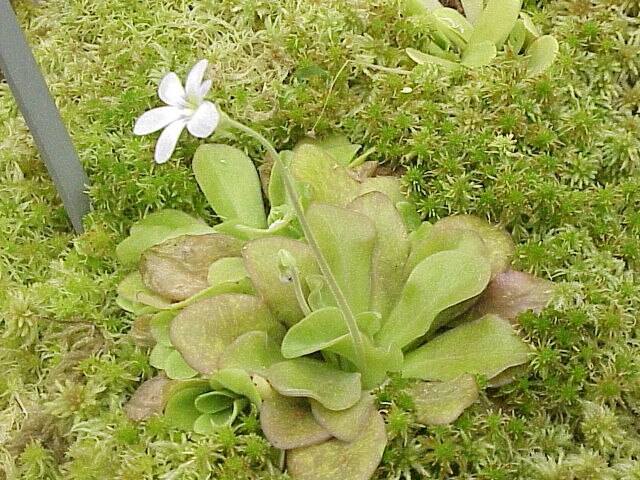
Pinguicula agnata is a Mexican butterwort native to limestone and sandstone outcrops in Hidalgo and Querétaro states, Mexico. It is one of the most vigorous and adaptable species in the genus, universally recommended as a starter Mexican Pinguicula for beginners due to its ease of cultivation and robust growth. The broad, succulent, yellowish-green carnivorous leaves trap insects passively with abundant glandular mucilage throughout the growing season, while the attractive blue-violet flowers are produced repeatedly. A non-carnivorous, compact winter rosette is formed in cooler months. The plant propagates easily from leaf cuttings.
Lifespan of the Pinguicula Agnata
The Pinguicula Agnata lives 5+ years.
Size of the Pinguicula Agnata
The Pinguicula Agnata grows to 5-10cm.
Temperature & humidity for the Pinguicula Agnata
The ideal temperature for the Pinguicula Agnata is 15〜28℃.
Cultivation requires mineral, well-draining media, top watering only when nearly dry, avoidance of waterlogging, bright indirect to weak direct light, and temperatures of 15–28°C.
Basic Info
Origin
Hidalgo and Querétaro states, Mexico, limestone and sandstone rocky outcrops
Lifespan
5+ years
Size
5-10cm
Temperature
15〜28℃
Humidity
60〜90%
Watering & Fertilizer
Insects (auto-capture)
Growing Tips
Light & Placement
Prefers bright indirect light to weak direct sun. It grows well on a bright indoor windowsill and is a sturdy beginner's species.
Watering
Water from above with pure or rain water once the medium dries. Overwatering is fatal; never keep it constantly wet.
Soil & Repotting
Use a sandy, mineral-based, slightly acidic to neutral medium with sharp drainage. Pure sphagnum holds too much water.
Temperature & Overwintering
Grows at 15-28°C. In winter it switches to small succulent dormant leaves, so reduce watering and keep it on the dry side.
Propagation
Vigorous and easily propagated from leaf cuttings. In the growing season, detach a healthy leaf and lay it on moist medium to root.
Pinguicula Agnata FAQ
QWhat is the growing difficulty level for Pinguicula Agnata?
Beginner. A variety suitable for beginners. No special equipment or experience is required—you can grow it without problems by setting up a basic cultivation environment.
QWhat is the ideal temperature for Pinguicula Agnata?
The ideal temperature for Pinguicula Agnata is 15〜28℃. Avoid sudden temperature changes and maintain a stable environment.
QWhat is the lifespan of Pinguicula Agnata?
The average lifespan of Pinguicula Agnata is 5+ years. With proper cultivation environment and nutrient management, you can keep it healthy for a long time.
QHow large does Pinguicula Agnata get?
The mature size of Pinguicula Agnata is 5-10cm. This may vary slightly depending on cultivation environment and individual differences.
QHow should I water and fertilize Pinguicula Agnata?
Pinguicula Agnata: watering & fertilizer — Insects (auto-capture). Aim for appropriate frequency and amount.
QWhat is the typical price for Pinguicula Agnata?
The price of Pinguicula Agnata varies significantly by variety, characteristics, size, and lineage. Please check GrowerDirect's price guide for the latest market information.
Last updated: August 31, 2026
References & Sources
Edited & verified by: GrowerDirect Editorial Team
The classifications, regulations, and growing data on this page are created and verified based on the primary information database below.
Taxonomy & Authority
Accepted name: Pinguicula agnata Casper
Authority databases: GBIF · POWO · ICPS cultivar registration (International Carnivorous Plant Society)
Nomenclature follows global taxonomic authority databases.
Regulations & Conservation Status
This genus is not listed in CITES Appendices (among carnivorous plants, only Nepenthes/Sarracenia/Dionaea are subject to CITES).
Sources: CITES Appendices (carnivorous plants) - ICPS/Barry Rice / CITES & Carnivorous Plant Checklist (RBG Kew)
Regulations may change. Always verify the latest information with the relevant authorities.
Related Species
Find listings for this species
Related Articles
How to Grow Butterwort (Pinguicula) | Beautiful Flowers and the Charm of Sticky Traps
A beginner's guide to growing Butterwort (Pinguicula). Discover cute violet-like flowers, the sticky leaf insect-catching mechanism, differences in cultivation between Mexican and temperate species, and propagation methods.
Carnivorous Plant Dormancy Awakening Guide | Correct Timing for Resuming Feeding, Fertilizing, and Watering
A step-by-step guide to the correct timing for resuming watering, restoring humidity, feeding, and fertilizing as your carnivorous plants emerge from dormancy and enter spring growth.
Why Carnivorous Plant Traps Fail and How to Fix Them | Optimizing Humidity, Nutrition, and Prey-Capture Systems
Investigate why carnivorous plant traps fail to capture insects. From humidity management to nutrient balance, gland secretion function, and dormancy, a detailed scientific approach to restoring trap function.
A Guide to Giving Carnivorous Plants as Gifts | How to Choose Unique Presents and Tips for Long-Term Enjoyment
A guide to selecting carnivorous plants as gifts. Covers how to choose varieties based on the recipient's type, and important care tips to communicate before gifting, such as water quality and dormancy periods.
Can't find the plant you're looking for?
Post your wishes for free and growers with matching plants will contact you with introductions.