Why Carnivorous Plant Traps Fail and How to Fix Them | Optimizing Humidity, Nutrition, and Prey-Capture Systems
Investigate why carnivorous plant traps fail to capture insects. From humidity management to nutrient balance, gland secretion function, and dormancy, a detailed scientific approach to restoring trap function.
Key Takeaways
Investigate why carnivorous plant traps fail to capture insects. From humidity management to nutrient balance, gland secretion function, and dormancy, a detailed scientific approach to restoring trap function.
Related Species
Carnivorous plants have evolved a unique strategy to capture insects and small animals for nutrients, allowing them to survive in nitrogen-poor acidic wetlands and rocky terrain. These "traps" are organs that could be called the plant's lifeline, but as soon as they're brought indoors, the traps often wilt and lose their sticky secretions, or Venus flytraps stop moving with their leaves open. The cause is not singular—it involves multiple interrelated factors: humidity, light, nutrition, temperature, and dormancy. In this article, we'll explain why each factor impairs trap function and provide concrete solutions.
How Carnivorous Plant Traps Capture Insects
Carnivorous plant prey-capture mechanisms fall into four main types.
- Sticky-trap type: Sundews (Drosera) and butterworts (Pinguicula) secrete sticky mucus from glandular hairs to ensnare insects that touch them.
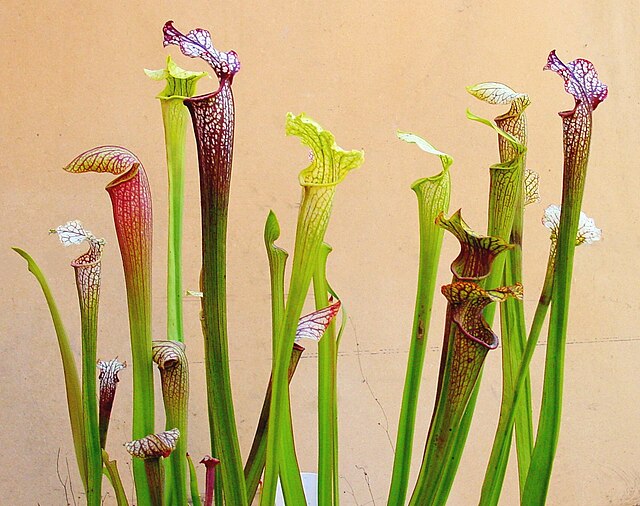
- Pitfall-trap type: Pitcher plants (Nepenthes) and trumpet pitchers (Sarracenia) lure insects into tubular traps where they drown and are digested.
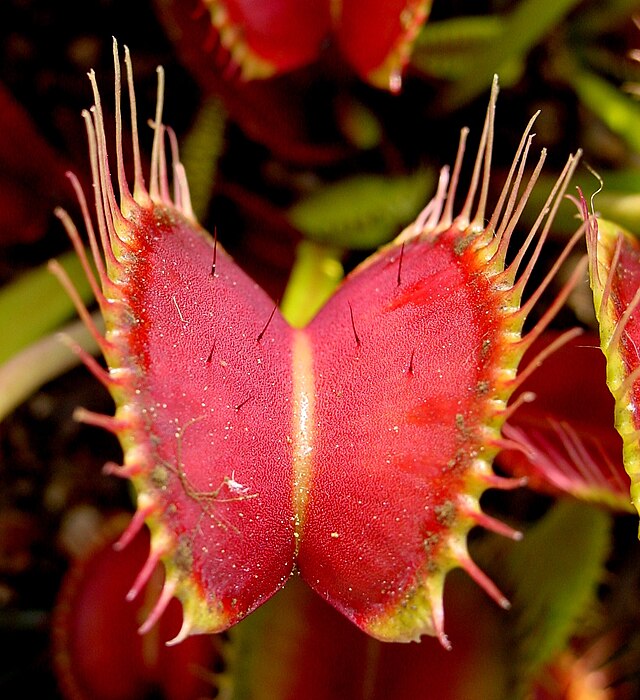
- Snap-trap type: Venus flytraps (Dionaea muscipula) rapidly close their leaves when trigger hairs are repeatedly stimulated.
- Suction-trap type: Bladderworts (Utricularia) instantly vacuum up aquatic microorganisms using suction bladders.
For any of these types to function normally, two conditions must be met: the glands must be active, and the surrounding environment must closely resemble the plant's natural habitat. When these conditions are compromised, sticky secretions dry up, closing speed slows, and liquid fails to accumulate in the traps.
Humidity Deficit: The Primary Factor Behind Trap Failure
Most carnivorous plants grow naturally in misty wetlands, forest margins in highlands, and thin soil layers on rocky outcrops. In their natural habitat, relative humidity typically stays between 70–90% year-round. By contrast, typical indoor environments in Japan drop to 50–60% even in summer, and as low as 30–40% during the heated winter months.
When humidity falls, a cascade of problems begins.
- The sticky secretions from sundew glandular hairs dry out and lose their shine, preventing insects from sticking.
- The inner walls of pitcher plant traps dry out, and the luring fluid evaporates, causing digestive enzymes to concentrate and denature.
- Cells inside Venus flytrap lobes dehydrate and lose elasticity, slowing their closure speed.
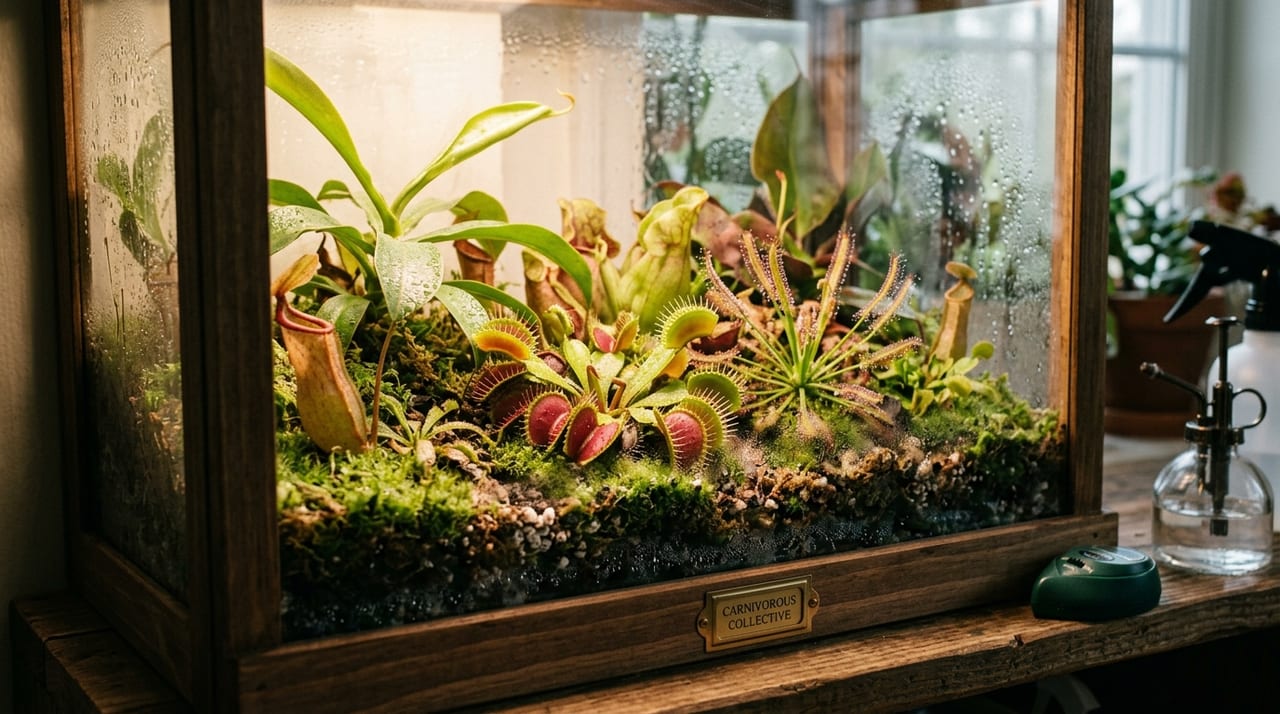
The primary remedy is to establish strict watering from below. Place the pot on a tray and maintain a constant water level of 1–3 cm using distilled water (or soft water). Since tap water minerals like calcium and magnesium can clog the glands, rainwater, distilled water, or reverse-osmosis water is ideal. Additionally, grouping multiple plants of the same species together naturally raises humidity around the tray as water transpires from the foliage. Furthermore, using a terrarium setup with a clear case or acrylic cover helps maintain local humidity levels of 60–80%.
Light Deficiency and Gland Activity
Glands use the products of photosynthesis (sugars) as an energy source to produce sticky secretions and digestive enzymes. Insufficient light reduces photosynthesis, which restricts energy supply to the glands. As a result, both the quantity and viscosity of sticky secretions decrease, and insects fly away without adhering.
Most carnivorous plants need 6–8 hours daily of direct sunlight or strong indirect light. Locations far from windows or in dim areas rarely meet this requirement, and north-facing windows or deep shelves in winter become severely light-limited.
When using LED grow lights, targeting a PPFD of around 200–400 μmol/m²/s maintains gland activity in most carnivorous plants. The distance between the light source and the plant varies by model, but it is safest to increase light intensity gradually while avoiding leaf burn. Venus flytraps particularly favor strong light, and under direct sunlight their trap interiors turn red, enhancing their predatory ability. This red coloration is due to anthocyanin accumulation from UV light and intense illumination, and signals that the plant is adapting to strong light conditions.
Nutrition Management: Excess Fertilizer Degrades Traps
Carnivorous plants are extremely poor at absorbing nutrients through their roots. Using standard garden soil or fertilizer designed for typical plants damages roots with mineral salts and causes death. However, misinterpreting the principle "never fertilize" can lead to overall nutrient starvation, leaving the plant without enough energy to form traps.
Normally, traps capture insects to provide nutrition, but fully indoor plants may not receive any insects. In such cases, during the active growing season (spring through summer) when glands are most active, you can supplement nutrition using these methods:
- Spray diluted liquid fertilizer (standard houseplant fertilizer diluted at least 1000-fold) on the foliage 1–2 times per month.
- Place small pieces of frozen bloodworms or dried daphnia directly in the traps (especially effective for sundews and pitcher plants).
- Feed the Venus flytrap's traps once every 1–2 weeks with very small live insects or dried small arthropods, but only to 1–2 traps at a time (feeding all traps simultaneously will exhaust the plant).
Crucially, never provoke Venus flytrap traps with your finger or a stick to make them snap shut needlessly. Each snap-shut uses considerable ATP, and roughly 10 wasted closures can kill a single trap.
Dormancy Management: Winter Cold Creates Spring Traps
Temperate carnivorous plants (Venus flytraps, trumpet pitchers, many sundews, and others) require a period of cold dormancy in winter. Without this dormancy, the traps that emerge in spring will be smaller, and gland secretion capacity will diminish.
For Venus flytraps, exposing them to temperatures around 5–10°C from November through February satisfies dormancy, allowing them to vigorously develop large traps when they resume growth in March and beyond. Unheated entryways, balconies, or sheds make suitable overwintering locations. During dormancy, significantly reduce watering or lower the water level in the tray, though complete cessation is also an option. However, complete drying will kill the plant, so the soil must remain slightly moist.
Conversely, tropical pitcher plants (Nepenthes) require no dormancy and will continuously develop traps if maintained year-round at 20–30°C with high humidity. Lowland and highland species have different temperature requirements, so it is important to confirm this at the time of purchase. Highland species (such as N. villosa and N. lowii) prefer environments where night temperatures drop to around 15°C, and excessively warm nights tend to produce smaller traps.
Practical Checklist for Restoring Trap Function
If your traps are not functioning, review your environment in this order:
- Check the water quality in your watering tray: If using tap water, switch to rainwater or distilled water.
- Measure humidity: If it drops below 60% near the plant, use a tray, cover, or humidifier.
- Review light intensity: Confirm the plant receives 6+ hours of strong light daily; supplement with a grow light if needed.
- Inspect the growing medium: If using leaf mold, red ball soil, or standard garden soil, repot into a mix of peat moss and pumice (or sand).
- Confirm dormancy: For temperate species, review whether they are exposed to cold in winter.
- Stop unnecessary trap stimulation: Cease unnecessary trigger manipulation and move the plant to a quiet location.
It may take several weeks to a full growth cycle for your carnivorous plant traps to resume capturing insects once conditions are optimized. The fastest path to restoring healthy predatory activity is patience, steady observation, and methodically addressing each condition one by one. Creating an environment that echoes the plant's native habitat is the foundation of everything.