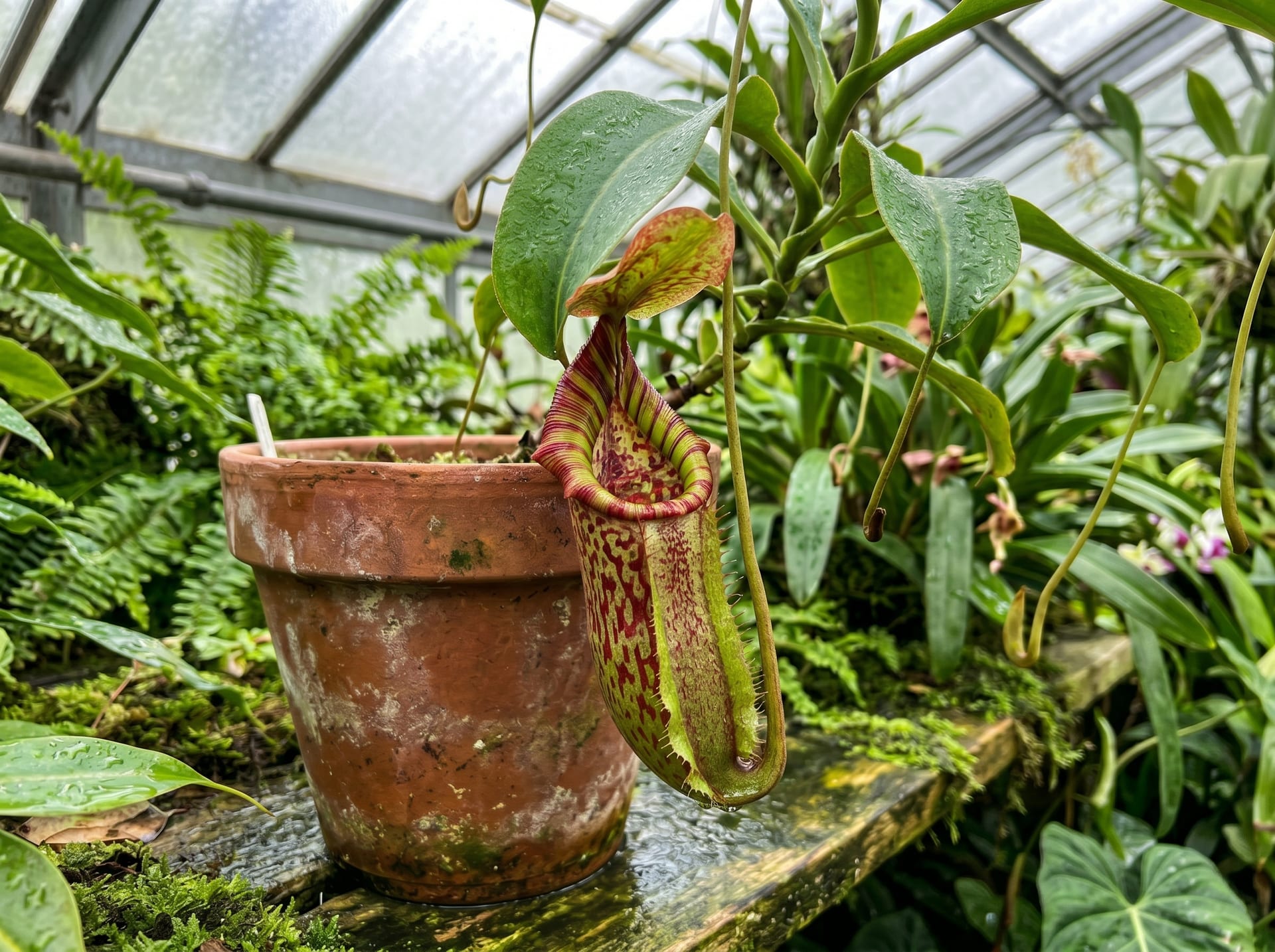
AI-generated image
Nepenthes (Tropical Pitcher Plant)
IntermediateNepenthes spp.
About 170 species of pitcher plants centered in Southeast Asia. Captures insects in lidded pitchers. Highland and lowland species require different growing conditions.
About
Nepenthes, commonly known as tropical pitcher plants, comprise over 170 species distributed primarily across Southeast Asia, with additional species in South Asia, Madagascar, and northern Australia. They inhabit a wide range of nutrient-poor environments, from lowland rainforests and peat swamps to misty highland ridges and ultramafic rock faces. Each plant produces modified leaves that terminate in elaborate, tubular pitchers filled with digestive fluid. Insects and other arthropods are lured by nectar secreted along the peristome, then slip on its waxy surface and drown. Lowland species thrive in consistently warm, humid conditions, while highland species require cool nights and significant diurnal temperature variation. Cultivation typically uses pure sphagnum moss; fertilizer is generally avoided.
Lifespan of the Nepenthes (Tropical Pitcher Plant)
The Nepenthes (Tropical Pitcher Plant) lives 10+ years.
Size of the Nepenthes (Tropical Pitcher Plant)
The Nepenthes (Tropical Pitcher Plant) grows to 20cm to several meters (climbing, varies by species).
Temperature & humidity for the Nepenthes (Tropical Pitcher Plant)
The ideal temperature for the Nepenthes (Tropical Pitcher Plant) is 15〜35℃. Ideal humidity is 70〜90%.
Humidity above 70% is necessary to encourage pitcher formation.
Basic Info
Origin
Southeast Asia (Borneo, Sumatra, Philippines), with species also in South Asia, Madagascar, and northern Australia
Lifespan
10+ years
Size
20cm to several meters (climbing, varies by species)
Temperature
15〜35℃
Humidity
70〜90%
Watering & Fertilizer
Photosynthesis + insects captured and digested in pitchers
Growing Tips
Light & Placement
A rainforest plant best grown in a greenhouse or terrarium where humidity can be kept high. Climbing species grow large, so allow ample space.
Watering
Humidity of 70% or more is ideal; when it is dry, pitchers stop forming. Keep the medium moist and mist to supplement humidity.
Temperature & Overwintering
The range is 15-35°C depending on the species. Lowland species need warm, humid conditions; highland species need cool conditions with a day-night drop.
Soil & Repotting
Sphagnum moss alone is the standard medium. The balance of aeration and water retention matters, so do not pack it too tightly.
Pruning & Shaping
Many species are large climbers, so cut back overgrown vines to keep the plant tidy.
Pests & Cautions
Highland species suffer in summer heat; use air conditioning or misting. Difficulty varies greatly between species.
Nepenthes (Tropical Pitcher Plant) FAQ
QWhat is the growing difficulty level for Nepenthes (Tropical Pitcher Plant)?
Intermediate. A variety suitable for intermediate growers. Requires some cultivation experience and knowledge of environment management. Pay careful attention to temperature and humidity control.
QWhat is the ideal temperature for Nepenthes (Tropical Pitcher Plant)?
The ideal temperature for Nepenthes (Tropical Pitcher Plant) is 15〜35℃. Recommended humidity is 70〜90%. Avoid sudden temperature changes and maintain a stable environment.
QWhat is the lifespan of Nepenthes (Tropical Pitcher Plant)?
The average lifespan of Nepenthes (Tropical Pitcher Plant) is 10+ years. With proper cultivation environment and nutrient management, you can keep it healthy for a long time.
QHow large does Nepenthes (Tropical Pitcher Plant) get?
The mature size of Nepenthes (Tropical Pitcher Plant) is 20cm to several meters (climbing, varies by species). This may vary slightly depending on cultivation environment and individual differences.
QHow should I water and fertilize Nepenthes (Tropical Pitcher Plant)?
Nepenthes (Tropical Pitcher Plant): watering & fertilizer — Photosynthesis + insects captured and digested in pitchers. Aim for appropriate frequency and amount.
QWhat is the typical price for Nepenthes (Tropical Pitcher Plant)?
The price of Nepenthes (Tropical Pitcher Plant) varies significantly by variety, characteristics, size, and lineage. Please check GrowerDirect's price guide for the latest market information.
Last updated: August 31, 2026
References & Sources
Edited & verified by: GrowerDirect Editorial Team
The classifications, regulations, and growing data on this page are created and verified based on the primary information database below.
Taxonomy & Authority
Accepted name: Nepenthes spp.
Authority databases: ICPS cultivar registration (International Carnivorous Plant Society)
Nomenclature follows global taxonomic authority databases.
Regulations & Conservation Status
The genus Nepenthes is listed in CITES Appendix II (N. khasiana and N. rajah are in Appendix I).
Sources: CITES Checklist (Nepenthes)
Regulations may change. Always verify the latest information with the relevant authorities.
Related Species
Find listings for this species
Related Articles
Developing Nepenthes Pitcher Traps Completely: Cultivation Secrets Through Environmental Management and Physiological Approaches
The carnivorous leaves of Nepenthes represent the masterpiece of an insect-trapping mechanism evolved over 200 million years. This article explains how to mature the carnivorous leaves completely and develop healthy plants with actual predatory function through humidity, light, and nutrient management.
Growing Pitcher Plants Without a Greenhouse: How to Get Pitchers to Form Indoors
Explains how to grow carnivorous pitcher plants (Nepenthes) indoors without a greenhouse. Covers reasons why pitchers fail to form and solutions, methods for maintaining humidity, variety selection, and tips for winter care.
Highland Nepenthes Growing Guide | Cool Management for High-Altitude Pitcher Plants
Explains the characteristics of high-altitude nepenthes (highland nepenthes), summer air conditioning management, and methods for controlling humidity and temperature.
How to Grow Nepenthes | Cultivation Techniques to Grow Larger Pitchers
We explain the basic cultivation methods for Nepenthes and the humidity, temperature, and light management techniques to grow beautiful pitchers large.
Can't find the plant you're looking for?
Post your wishes for free and growers with matching plants will contact you with introductions.