Complete Development of Nepenthes Pitcher-Shaped Insectivorous Leaves: Cultivation Secrets Through Environmental Management and Physiological Approach
The insectivorous leaves of Nepenthes are the masterpiece of carnivorous mechanisms that have evolved over 200 million years. This article explains how to fully mature insectivorous leaves and cultivate plants with actual predatory function through humidity, light, and nutrient management.
Key Takeaways
The insectivorous leaves of Nepenthes are the masterpiece of carnivorous mechanisms that have evolved over 200 million years. This article explains how to fully mature insectivorous leaves and cultivate plants with actual predatory function through humidity, light, and nutrient management.
Related Species
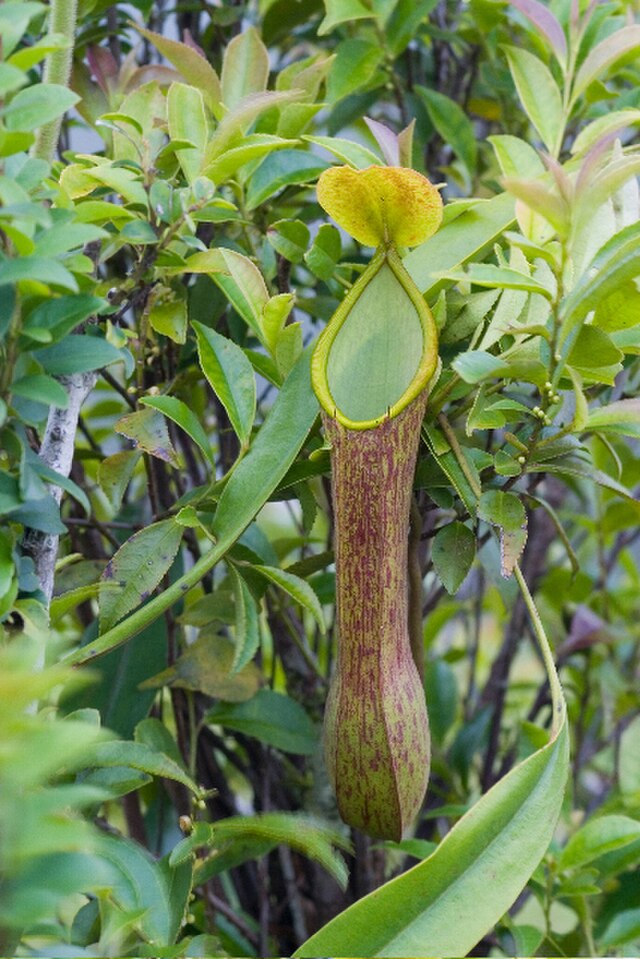
The greatest appeal of Nepenthes (pitcher plant) lies in its unique pitcher-shaped insectivorous leaves. Over approximately 200 million years of evolutionary history, this leaf developed as an organ by which plants created a "mechanism to capture insects"—not merely an eccentric form, but an extremely sophisticated predatory mechanism. However, in cultivation environments, many enthusiasts fail to fully develop these insectivorous leaves, remaining stunted as small tubular deformities. This article conveys environmental management and physiological approaches to fully develop and mature Nepenthes insectivorous leaves.
Nepenthes Insectivorous Leaf Development Mechanism
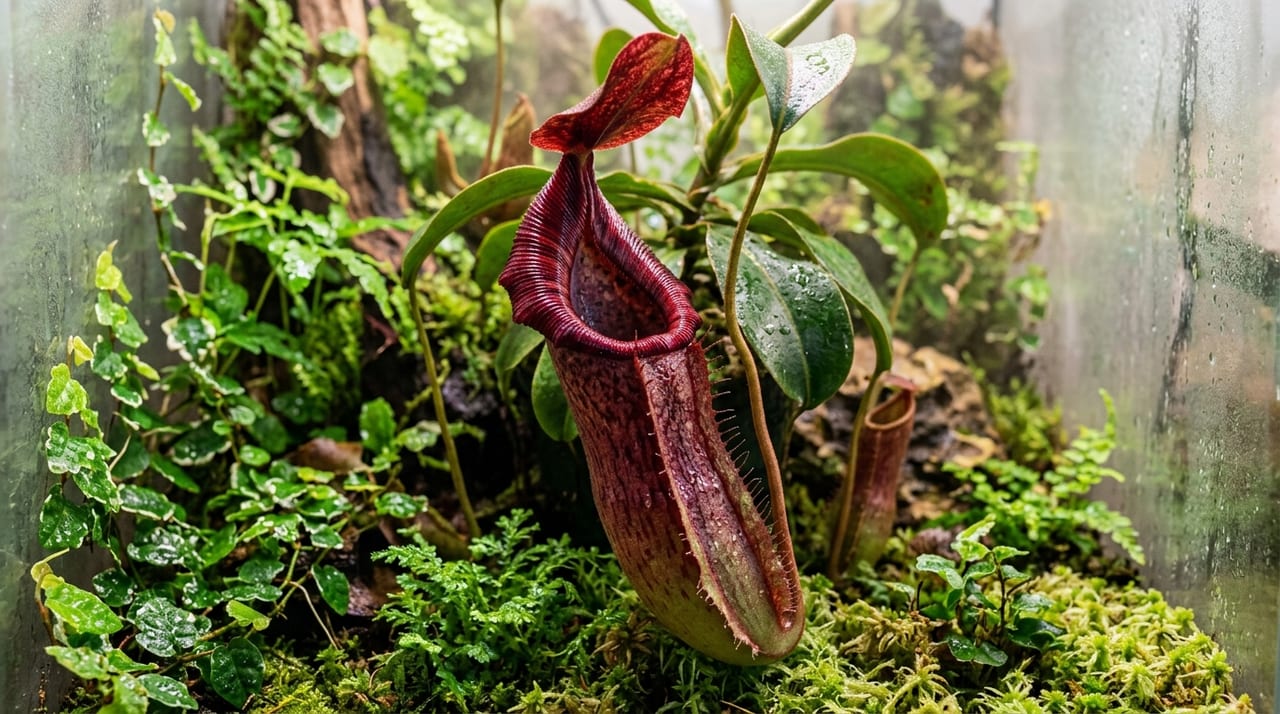
Nepenthes leaves begin with a leaf blade possessing normal veins, partway through transforming into "vine-like veins" (tendril), with the tip swelling and growing into a tubular shape. This tubular structure is not merely a product of chance, but results from a precise combination of genetic programs and environmental signals.
The development of insectivorous leaves is governed primarily by three environmental factors: "humidity," "light," and "nutritional status." First, in low-humidity environments (relative humidity below 50%), Nepenthes does not develop insectivorous leaves. Conversely, when humidity is high (70% or above), the rate of insectivorous leaf development rises dramatically, and the form matures larger. This evolutionarily reflects the wild ecology in rain-rich native habitats (tropical rainforests of Southeast Asia).
Second, the quality and intensity of light are important. Nepenthes is divided into highland and lowland species; highland species (such as Nepenthes alata) develop insectivorous leaves even in relatively low light, while lowland species (such as Nepenthes rafflesiana and Nepenthes gracilis) require strong light. Particularly, the ultraviolet A wavelength range (320–400 nm) is an important signal that promotes insectivorous leaf development. Using LED grow lights with a spectrum containing ultraviolet A significantly improves the rate of insectivorous leaf development and maturity.
Third is nutritional status. Although Nepenthes is a carnivorous plant adapted to low-nutrient environments, conversely, complete absence of nutrients stalls insectivorous leaf development. Particularly, when phosphoric acid or calcium is insufficient, the veins of insectivorous leaves deteriorate and tendril elongation weakens.
Building an Environment for Complete Insectivorous Leaf Development
To fully develop insectivorous leaves, it is essential to construct the following environments in an integrated manner.
First, humidity management. The optimal relative humidity is 70–85%. To achieve this humidity, cultivation with a terrarium, closed planter, or combined humidifier is effective. In particular, daily misting provides temporary humidity increase but dries quickly, so its effectiveness is limited. For continuous humidity maintenance, a combination of bottom watering and ambient humidification is optimal. Pool 3–5 cm of water at the base, place the Nepenthes pot not directly there but via a mesh platform. In this state, high humidity is maintained for 24 hours, promoting insectivorous leaf development.
Next, optimization of light environment. If strong light is insufficient, insectivorous leaves will not develop even if all other conditions are perfect. The recommended light intensity is 1000–1500 µmol/m²/s PAR (photosynthetically active radiation) for lowland species and 500–800 µmol/m²/s for highland species. This is achievable with plant LED light sources (red 650 nm + blue 450 nm + ultraviolet A). Particularly, using a spectrum containing 10–15% ultraviolet A markedly improves the development of insectivorous leaf color and form. A lighting period of 16 hours or more is recommended.
Third is temperature management. Nepenthes generally prefers the temperature range of 20–28°C, but for insectivorous leaf development, "diurnal temperature variation" (day-night temperature difference) is important. With a diurnal variation of 8°C—28°C during the day and 20°C at night—insectivorous leaf development is notably promoted. Conversely, at a constant temperature (for example, constantly 25°C), development stalls. This diurnal variation occurs automatically in natural environments, but in indoor cultivation, air conditioning management may be necessary.
Liquid Management During Insectivorous Leaf Maturation and Promotion of Tendril Elongation
Even after insectivorous leaves begin to develop, 3–6 months are required to mature into a fully tubular form. During this period, nutrient management is important to ensure tendril elongation and swelling of the tube.
Particularly, in the process where the tip of a Nepenthes tendril swells into a tubular form, synthesis of cellulose and pectin accelerates. At this point, calcium is extremely important. In calcium-deficient environments, the tip of the tendril does not swell and remains as a thin rod. The recommended liquid fertilizer is standard foliage plant fertilizer (N:P:K=10:10:10) with added calcium (Ca 50–100 ppm). Applying a 50-fold dilute solution 1–2 times per month maintains tendril flexibility and expansibility, promoting complete tubular growth.
Furthermore, secretion of "digestive liquid" (liquid containing formic acid and protease) secreted on the inner surface of insectivorous leaves is also greatly influenced by nutritional status. In plants given liquid fertilizer properly, the inner surface of the tube takes on a pale red-purple hue, nectar secretion from honey glands becomes active, and the plant develops the function to actually predate on insects.
Appreciation as a Mature Nepenthes
Nepenthes with fully mature insectivorous leaves appear as organisms possessing a "carnivore-like ecosystem" rather than simply a plant. In fact, within the inner surface of the insectivorous leaf, microbial communities equivalent to gut bacteria form and perform digestion and nutrient absorption of captured insects. This microbiome too forms only in environments where humidity and temperature are appropriate.
Standing before the fully matured insectivorous leaves of Nepenthes, one realizes that plants are not merely photosynthetic producers but multifunctional organisms that survive through their own unique strategies.