Source: Wikimedia Commons
Brocchinia reducta
IntermediateBrocchinia reducta
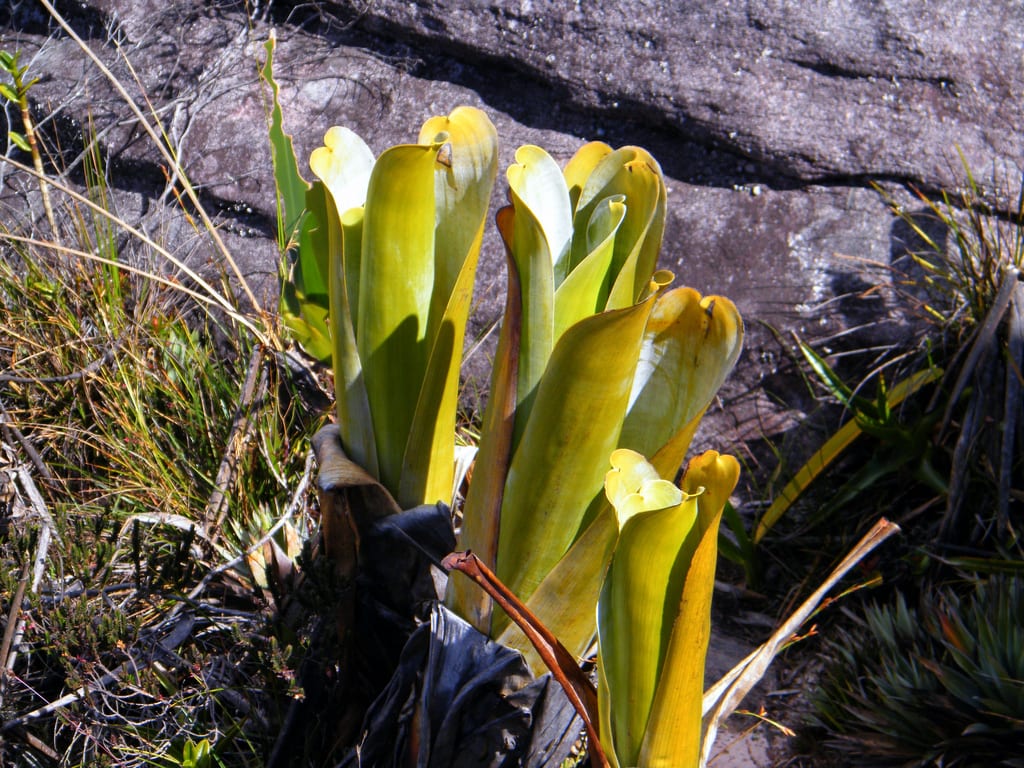
A carnivorous bromeliad from the tepuis of the Guiana Highlands. Its yellow-green leaves overlap into a water-filled tube, and a waxy coating makes insects slip in and drown. Digestive enzyme activity was confirmed in 2005.
About
Brocchinia reducta is a bromeliad (Bromeliaceae) native to southern Venezuela, Guyana, Brazil and Colombia, on nutrient-poor, wet ground, especially on the summits of tepuis (table mountains) in the Guiana Highlands. Its narrow yellow to light green leaves stand stiffly upright and overlap to form a slim, water-holding tube. Leaves are up to about 45 cm long and 5 cm wide, and plants reach 30-50 cm tall including the flower stalk. The leaves are coated with a thick, loose wax that reflects ultraviolet light, attracting insects and then robbing them of footing so they slide into the tube. The water in the tube gives off a sweet scent that draws ants and other insects. It was long thought to rely on bacteria to break down prey, but phosphatase activity was found in its digestive glands in 2005, and it is now regarded as carnivorous. Other organisms live in the tube, and even bladderworts sometimes grow there. The roots are weak and often act mainly as anchors on rock. In cultivation with too little light the leaves turn darker green, the tube loosens and the plant stays shorter. The flowers are small and white. In Japan, plants labelled with locality or clone names are offered by specialist nurseries and at online auctions.
Source: Wikipedia (CC BY-SA 4.0)
Size of the Brocchinia reducta
The Brocchinia reducta grows to Leaves up to about 45 cm long; 30-50 cm tall including the flower stalk.
Basic Info
Origin
Northern South America (southern Venezuela, Guyana, Brazil, Colombia; tepuis of the Guiana Highlands)
Lifespan
Perennial
Size
Leaves up to about 45 cm long; 30-50 cm tall including the flower stalk
Temperature
10〜30℃
Humidity
60〜90%
Watering & Fertilizer
No fertilizer (catches insects in its water-filled tube)
Growing Tips
Light & Placement
Strong light keeps it yellow-green with a tight tube; in low light the leaves turn dark green and splay open, and the tube loses its shape.
Watering
It grows on wet ground, so do not let the mix dry out, and keep the leaf tube filled with water. Use rain water or other water low in dissolved minerals.
Soil & Repotting
Use a nutrient-poor mix. The roots are weak and mostly anchor the plant, so do not over-pot.
Temperature & Overwintering
Little data exists on minimum temperatures. It is a tropical mountain plant, so keep it in a bright, frost-free room in winter.
Fertilizer
Do not fertilize. It feeds on insects that fall into the tube and nutrients dissolved in its water, absorbed through the leaves.
Brocchinia reducta FAQ
QWhat is the growing difficulty level for Brocchinia reducta?
Intermediate. A variety suitable for intermediate growers. Requires some cultivation experience and knowledge of environment management. Pay careful attention to temperature and humidity control.
QHow large does Brocchinia reducta get?
The mature size of Brocchinia reducta is Leaves up to about 45 cm long; 30-50 cm tall including the flower stalk. This may vary slightly depending on cultivation environment and individual differences.
QHow should I water and fertilize Brocchinia reducta?
Brocchinia reducta: watering & fertilizer — No fertilizer (catches insects in its water-filled tube). Aim for appropriate frequency and amount.
QWhat is the typical price for Brocchinia reducta?
The price of Brocchinia reducta varies significantly by variety, characteristics, size, and lineage. Please check GrowerDirect's price guide for the latest market information.
Last updated: September 23, 2026
References & Sources
Edited & verified by: GrowerDirect Editorial Team
The classifications, regulations, and growing data on this page are created and verified based on the primary information database below.
Taxonomy & Authority
Accepted name: Brocchinia reducta Baker
Authority databases: GBIF · GBIF Brocchinia reducta Baker
Nomenclature follows global taxonomic authority databases.
Regulations & Conservation Status
Not listed under CITES; no paperwork is needed to buy or grow it in Japan.
Sources: Species+ (CITES) search: Brocchinia reducta (no listing)
Regulations may change. Always verify the latest information with the relevant authorities.
Related Species
Find listings for this species
Related Articles
Why Carnivorous Plant Traps Fail and How to Fix Them | Optimizing Humidity, Nutrition, and Prey-Capture Systems
Investigate why carnivorous plant traps fail to capture insects. From humidity management to nutrient balance, gland secretion function, and dormancy, a detailed scientific approach to restoring trap function.
A Guide to Giving Carnivorous Plants as Gifts | How to Choose Unique Presents and Tips for Long-Term Enjoyment
A guide to selecting carnivorous plants as gifts. Covers how to choose varieties based on the recipient's type, and important care tips to communicate before gifting, such as water quality and dormancy periods.
Developing Nepenthes Pitcher Traps Completely: Cultivation Secrets Through Environmental Management and Physiological Approaches
The carnivorous leaves of Nepenthes represent the masterpiece of an insect-trapping mechanism evolved over 200 million years. This article explains how to mature the carnivorous leaves completely and develop healthy plants with actual predatory function through humidity, light, and nutrient management.
Outdoor Cultivation and Natural Insect-Capture Guide for Carnivorous Plants | Creating an Environment for Insects and Seasonal Management
Explains how to cultivate carnivorous plants outdoors and enjoy natural insect capture. From environmental setup to seasonal management, introducing strategies for outdoor cultivation.
Can't find the plant you're looking for?
Post your wishes for free and growers with matching plants will contact you with introductions.