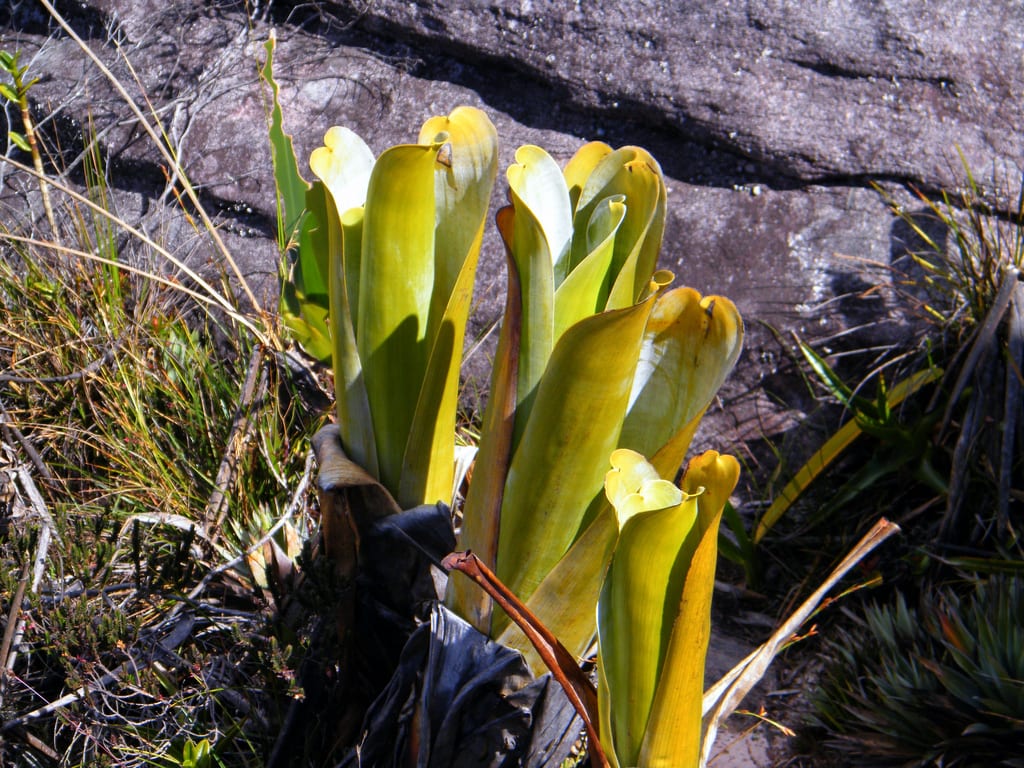
 © Adalberto Jose Perez Lopez / CC BY 2.0
Brocchinia reducta
Brocchinia reducta is a carnivorous bromeliad native to the tepuis (table-top mountains) of South America's Guiana Highlands. Its narrow, yellow-green leaves overlap in tight layers to form a tubular rosette that collects rainwater at its center. The inner leaf surface is coated with a waxy powder that makes insects lose their footing and slide into the water below, where they drown and are captured. A 2005 study confirmed that digestive enzymes are actually active in that pooled water. Rated as suited to intermediate growers, this perennial offers a quieter, more understated presence than many flashier carnivorous plants.
View Brocchinia reducta encyclopedia →0% commission on your first sales!Register by September 30, 2026 and your first 2 plants are commission-free!
Grower Wanted!
List your plants on GrowerDirect and sell directly to customers nationwide!
6 Transparency Commitments from GrowerDirect
Every Grower listing discloses variety, origin, light requirements, and difficulty level for Carnivorous Plants. Complete transparency, guaranteed.
- Variety Disclosed
- Real Photos
- Color Information
- Origin Disclosed
- Light Requirements
- Difficulty Level
Browse all 145 varieties
Light Requirements
Difficulty Level
Verified growers wanted for Carnivorous Plants
Growers are signing up now ahead of launch. Subscribe to be notified when new listings go live.
Getting alerts is free with a member account. When new listings match your saved search, we'll notify you by email and in-app.
Browse other categories
Are you growing carnivorous plants?
Register as a grower and connect with buyers directly.
Apply as a growerBrocchinia reducta key facts
- Growing Difficulty
- Intermediate
- Lifespan
- Perennial
- Size
- Leaves up to about 45 cm long; 30-50 cm tall including the flower stalk
- Watering
- No fertilizer (catches insects in its water-filled tube)
- Light & Placement
- Strong light keeps it yellow-green with a tight tube; in low light the leaves turn dark green and splay open, and the tube loses its shape.
- Watering
- It grows on wet ground, so do not let the mix dry out, and keep the leaf tube filled with water. Use rain water or other water low in dissolved minerals.
- Soil & Repotting
- Use a nutrient-poor mix. The roots are weak and mostly anchor the plant, so do not over-pot.
- Temperature & Overwintering
- Little data exists on minimum temperatures. It is a tropical mountain plant, so keep it in a bright, frost-free room in winter.
- Fertilizer
- Do not fertilize. It feeds on insects that fall into the tube and nutrients dissolved in its water, absorbed through the leaves.
About Brocchinia reducta
Brocchinia reducta is a carnivorous bromeliad from the Guiana Highlands tepuis. Its tubular rosette traps insects in a waxy, water-filled trap. A perennial suited to intermediate growers.
7 things to know before growing Brocchinia reducta
1Give It Strong Light
Grown in strong light, it forms a compact, yellow-green tube. Without enough light, the leaves turn dark green and splay open, the tube loses its shape, and the plant stays short. Keep it in the brightest spot you can.
2Keep the Rosette Filled
The tubular rosette formed by the overlapping leaves is the plant's actual trapping organ, so its center should always hold water. Standing the pot in a shallow water tray helps prevent the growing medium from drying out completely.
3Use a Lean, Airy Mix
In its native habitat this plant grows on nutrient-poor rock, so rich all-purpose potting soil can damage the roots. A mix such as sphagnum moss combined with perlite, offering both moisture retention and airflow, works well.
4Repot Only Every Few Years
Growth is fairly slow, so frequent repotting isn't necessary. Repot when the medium visibly breaks down or once the plant has clearly outgrown its pot, moving it into fresh mix.
5Protect It Indoors in Winter
As a plant native to tropical highlands, prolonged cold can stall its growth or damage it. Move it to a bright spot indoors when temperatures drop, and keep an eye on humidity so it doesn't dry out.
6Check Leaf Color and Rosette Shape
Look for plants with glossy, yellow-green leaves whose outer leaves aren't excessively withered. A tightly formed rosette that still holds its tubular, water-collecting shape tends to establish and grow well afterward.
7A Quiet, Passive Trap
Unlike a Venus flytrap, whose leaves snap shut on prey, this species is a passive trapper: its waxy powder strips insects of their footing, and they fall into the pooled water below. It doesn't need to be fed often — insects that land on it naturally are enough.
Frequently asked questions about Brocchinia reducta
- Q.Do I need to feed it insects by hand?
- A.Generally, no. If it's kept outdoors or near an open window, small insects will land on their own and get caught by the waxy powder on the leaves. Overfeeding it deliberately can actually stress the plant.
- Q.Should I change the water inside the leaves?
- A.You don't need to replace it completely, but top it up as it evaporates so the level stays fairly constant. Swapping out the pooled water every few months helps keep bacteria from building up.
- Q.Does it produce flowers?
- A.Under good growing conditions, it sends up a flower stalk and blooms. Including the flower stalk, the plant reaches about 30 to 50 cm tall, giving it a different look from the leaves alone.
- Q.Can it be grown indoors?
- A.It can, but it still needs as much strong light as possible. In low light the leaves turn dark green and open up, and the tube loses its shape.
- Q.Is this a good plant for beginners?
- A.It's generally considered suited to intermediate growers, requiring some care around placement and keeping the rosette from drying out. Anyone with basic experience growing carnivorous plants should be able to manage it without much trouble.
Handy Growing Tools for Brocchinia reducta
Learn more about Brocchinia reducta in the encyclopedia
View Brocchinia reducta encyclopedia entry →
Care difficulty, size, origin and light needs — all basics covered.
More in this category
Can't find the plant you're looking for?
Post your wishes for free and growers with matching plants will contact you with introductions.