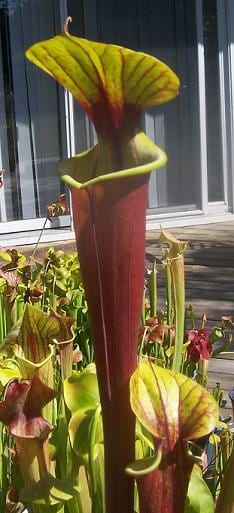
 © Aaron Carlson from Menomonie, WI, USA / CC BY-SA 2.0
Sarracenia flava var. rubricorpora
Sarracenia flava var. rubricorpora is a variant of the yellow pitcher plant, S. flava. Its standout feature is the striking color contrast between the pitcher tube, which turns a vivid red, and the lid, which stays yellow-to-green with visible veining. This red-bodied, bright-lidded look sets it apart from many other Sarracenia. It is known as a rare variant found only in western Florida. Cultivation is considered intermediate-level, but as a perennial it can be maintained for years through division, and its pitchers typically reach around 50cm in height.
View Sarracenia flava var. rubricorpora encyclopedia →0% commission on your first sales!Register by September 30, 2026 and your first 2 plants are commission-free!
Grower Wanted!
List your plants on GrowerDirect and sell directly to customers nationwide!
6 Transparency Commitments from GrowerDirect
Every Grower listing discloses variety, origin, light requirements, and difficulty level for Carnivorous Plants. Complete transparency, guaranteed.
- Variety Disclosed
- Real Photos
- Color Information
- Origin Disclosed
- Light Requirements
- Difficulty Level
Browse all 145 varieties
Light Requirements
Difficulty Level
Verified growers wanted for Carnivorous Plants
Growers are signing up now ahead of launch. Subscribe to be notified when new listings go live.
Getting alerts is free with a member account. When new listings match your saved search, we'll notify you by email and in-app.
Browse other categories
Are you growing carnivorous plants?
Register as a grower and connect with buyers directly.
Apply as a growerSarracenia flava var. rubricorpora key facts
- Growing Difficulty
- Intermediate
- Lifespan
- Perennial (can be kept for many years by division)
- Size
- Pitchers typically about 50 cm (the species can exceed 1 m)
- Watering
- No fertilizer (catches insects)
- Light & Placement
- Grow outdoors in full sun; with too little light the colour is poor and the pitchers are weak.
- Watering
- Keep the pot standing in about 4-6 cm of water at all times and never let it dry out. Use rain water or other water low in dissolved minerals.
- Soil & Repotting
- A 1:1 peat and sand mix is the standard. Divide and repot well-grown plants every 3 or 4 years.
- Temperature & Overwintering
- Let it go dormant in winter. It comes from the Gulf Coast, so protect it from hard freezes and early or late frosts in cold areas, while keeping the winter spot cool rather than warm.
- Fertilizer
- Do not fertilize the soil of mature plants; it can cause rhizome rot. Plenty of sun and access to prey are enough.
- Pests & Cautions
- The varieties of S. flava differ mainly in colour, and intermediate plants and crosses between varieties are common even in the wild. Do not rely on the variety name alone; check the colour of tube and lid on photos or the plant itself.
About Sarracenia flava var. rubricorpora
Sarracenia flava var. rubricorpora is a rare Florida-panhandle variant of the yellow pitcher plant, with red pitchers set against a yellow-green lid. A perennial suited to intermediate growers, maintained long-term by division.
7 things to know before growing Sarracenia flava var. rubricorpora
1Light and Airflow
Like other Sarracenia, this variant prefers a spot with strong light throughout the day. Insufficient light tends to dull the red coloring of the pitchers and the lid's markings, so choose an outdoor spot or a bright windowsill with plenty of light. Good airflow also helps prevent damage from excess humidity around the foliage.
2Keep the Soil Constantly Moist
Because it naturally grows in wetlands, the key is never letting the soil dry out. Standing the pot in a shallow tray of water keeps it consistently moist and is an easy way to manage watering. If you're concerned about minerals in tap water, rainwater or purified water is a safer choice.
3Soil: Balancing Drainage and Moisture
A mix based on sphagnum moss or peat moss, blended with perlite, works well. Avoid ordinary potting soil containing fertilizer, as it can damage the roots — a soil mix formulated for carnivorous plants is the safer choice.
4Division and Repotting
As a perennial, it can be kept going for years by dividing and repotting once the roots become crowded. Early spring, just as dormancy ends, is the best time — work quickly to minimize stress on the roots.
5Let It Go Dormant in Winter
Members of the S. flava group naturally die back above ground and enter dormancy in winter. During this period, water a little less often while still keeping the soil from drying out completely — this die-back is a normal seasonal cycle, not a sign of trouble.
6Choosing a Plant by Its Coloring
Even within this variant, individual plants vary in how deep the red pitcher coloring is and how the veining pattern appears on the lid. When choosing a plant, take a close look at the pitcher color and lid condition to find one that matches your taste.
7The Pitchers Catch Insects on Their Own
The inside of each pitcher is built to lure and digest insects on its own, so there's no need to feed it fertilizer or insects by hand. Watching new pitchers unfurl one after another from spring through summer is one of the pleasures of growing this variant.
Frequently asked questions about Sarracenia flava var. rubricorpora
- Q.How is this different from a typical S. flava?
- A.It's a variant of S. flava distinguished by a pitcher tube that turns red, while the lid stays yellow-to-green with visible veining. That combination creates a striking contrast between the red body and the bright lid.
- Q.Is this a good choice for a first carnivorous plant?
- A.It's generally considered suited to intermediate growers. Being comfortable with the basics of Sarracenia care — plenty of light and never letting the soil dry out — makes it easier to keep successfully.
- Q.Can it be grown indoors only?
- A.Yes, as long as you can provide strong light and good airflow. That said, an outdoor spot or a very bright windowsill tends to bring out richer red coloring in the pitchers and more vivid markings on the lid.
- Q.How large does it grow?
- A.Pitchers typically reach around 50cm in height. Some individuals within the species can exceed 1m, though this varies with growing conditions.
- Q.Does it need special care in winter?
- A.Members of the S. flava group naturally go dormant in winter. The above-ground growth dies back during this period, but that's a normal part of the plant's yearly cycle — just water a bit less and let it rest.
Handy Growing Tools for Sarracenia flava var. rubricorpora
Learn more about Sarracenia flava var. rubricorpora in the encyclopedia
View Sarracenia flava var. rubricorpora encyclopedia entry →
Care difficulty, size, origin and light needs — all basics covered.
More in this category
Can't find the plant you're looking for?
Post your wishes for free and growers with matching plants will contact you with introductions.