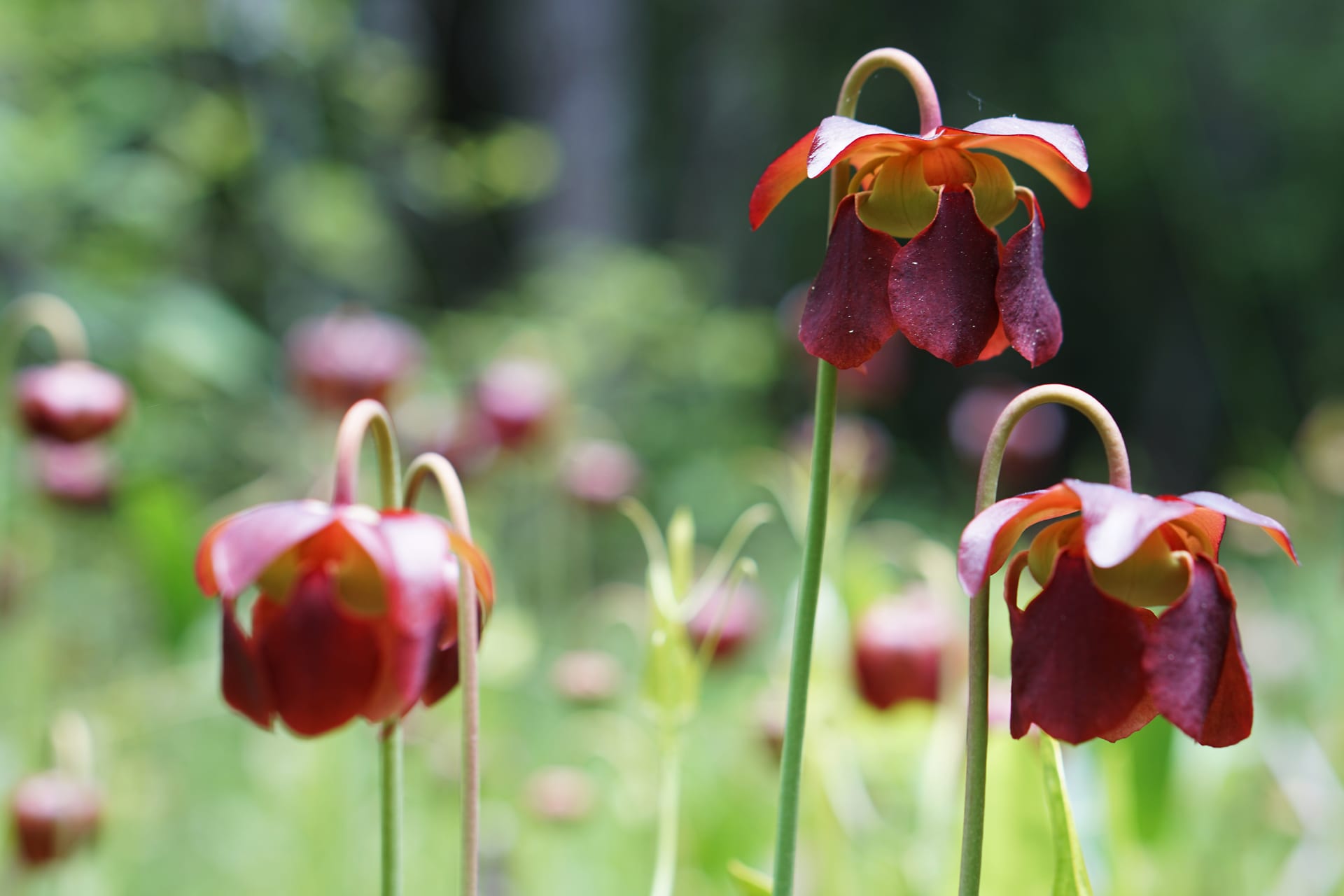
 © U.S. Fish and Wildlife Service Southeast Region / Public domain
Mountain sweet pitcher plant
Sarracenia rubra subsp. jonesii is a pitcher plant found only in a handful of Appalachian Mountain wetlands in the United States. It resembles a larger version of Sarracenia rubra, sending up slim, upright green pitchers marked with red veining, and in season it produces fragrant reddish-purple flowers. It is listed in CITES Appendix I, and in Japan any sale or transfer in principle requires a registration certificate under the Act on Conservation of Endangered Species. Plants propagated in Japan are also subject to registration, so always confirm that a registration certificate comes with the plant when buying. It's generally considered a plant for intermediate growers, and as a perennial it can be kept going for years through division.
View Mountain sweet pitcher plant encyclopedia →0% commission on your first sales!Register by September 30, 2026 and your first 2 plants are commission-free!
Grower Wanted!
List your plants on GrowerDirect and sell directly to customers nationwide!
6 Transparency Commitments from GrowerDirect
Every Grower listing discloses variety, origin, light requirements, and difficulty level for Carnivorous Plants. Complete transparency, guaranteed.
- Variety Disclosed
- Real Photos
- Color Information
- Origin Disclosed
- Light Requirements
- Difficulty Level
Browse all 145 varieties
Light Requirements
Difficulty Level
Verified growers wanted for Carnivorous Plants
Growers are signing up now ahead of launch. Subscribe to be notified when new listings go live.
Getting alerts is free with a member account. When new listings match your saved search, we'll notify you by email and in-app.
Browse other categories
Are you growing carnivorous plants?
Register as a grower and connect with buyers directly.
Apply as a growerMountain sweet pitcher plant key facts
- Growing Difficulty
- Intermediate
- Lifespan
- Perennial (can be kept for many years by division)
- Size
- Pitchers about 43-61 cm tall and 2.8-4.2 cm across the mouth
- Watering
- No fertilizer (catches insects)
- Light & Placement
- Grow outdoors in full sun; with too little light the colour is poor and the pitchers are weak.
- Watering
- Keep the pot standing in about 4-6 cm of water at all times and never let it dry out. Use rain water or other water low in dissolved minerals.
- Soil & Repotting
- A 1:1 peat and sand mix is the standard. Divide and repot well-grown plants every 3 or 4 years.
- Temperature & Overwintering
- A mountain plant that is cold-hardy; fully dormant plants have come through hard frost at -7°C unharmed. Always give it a cold winter dormancy.
- Fertilizer
- Do not fertilize the soil of mature plants; it can cause rhizome rot. Plenty of sun and access to prey are enough.
- Pests & Cautions
- A CITES Appendix I subspecies; selling or giving plants within Japan requires a registration certificate. Do not buy plants without one.
About Mountain sweet pitcher plant
Sarracenia rubra subsp. jonesii is a carnivorous pitcher plant native to Appalachian mountain wetlands, known for slender red-veined pitchers and raspberry-scented red flowers. A perennial suited to intermediate growers.
7 things to know before growing Mountain sweet pitcher plant
1Give It Full Sun
Like other Sarracenias, this plant thrives with as much direct light as possible, whether grown outdoors or on a bright windowsill. Insufficient light tends to mute the red veining on the pitchers and can cause them to grow thin and leggy.
2Keep It in a Water Tray
Because it grows naturally in wetlands, keep the pot standing in a shallow tray of water so the soil stays consistently moist. Letting it dry out, especially during active growth, can weaken the plant.
3Use a Nutrient-Free Mix
Pot it in a mix of sphagnum moss, peat moss, and perlite that contains no added fertilizer. Standard potting soil or fertilized mixes can damage the roots.
4Repot After Dormancy
The best time to repot is right as the plant is waking from dormancy. Lift the root mass with minimal disturbance and move it into fresh mix, choosing a pot roomy enough for its relatively large pitchers to keep spreading.
5Let It Go Dormant in Winter
Coming from a mountain habitat, it's cold-hardy and can overwinter outdoors, and going through a proper dormancy helps it grow well the following year. Cut back on watering somewhat over winter, but avoid letting it dry out completely.
6Enjoy the Spring Bloom
In spring it produces red flowers with a raspberry-like fragrance. Since flowering overlaps with new pitcher growth, cutting the flower stalk early lets the plant put more energy into its pitchers.
7Propagate by Division
As a perennial, it can be maintained indefinitely through division of the clump. When choosing a plant, look for one with clearly defined red veining, minimal damage, and a firm base, which makes it easier to manage going forward.
Frequently asked questions about Mountain sweet pitcher plant
- Q.Is this a good plant for beginners?
- A.Sarracenia rubra subsp. jonesii is generally considered better suited to intermediate growers. Once you understand the basics of carnivorous plant care, such as tray watering and winter dormancy, it's manageable to keep long-term.
- Q.Can it be grown indoors?
- A.It can be grown indoors if you can provide strong light and good air circulation, but it's usually easier to give it adequate sun and a proper winter dormancy outdoors. A balcony or similarly open spot tends to work well.
- Q.Does it die back in winter?
- A.The pitchers above ground do deteriorate in winter, but that's part of entering dormancy rather than the plant dying. As a perennial, the plant itself survives and sends up new pitchers again in spring.
- Q.Do I need to feed it insects?
- A.In the wild it catches insects that fall into its pitchers, and plants kept outdoors or near open windows usually catch enough insects on their own. Manual feeding generally isn't necessary.
- Q.How large does it grow?
- A.Based on reference data, the pitchers reach roughly 43-61cm in height with an opening about 2.8-4.2cm across. As it's propagated by division, a mature clump will show multiple pitchers rising together.
Handy Growing Tools for Mountain sweet pitcher plant
Learn more about Mountain sweet pitcher plant in the encyclopedia
View Mountain sweet pitcher plant encyclopedia entry →
Care difficulty, size, origin and light needs — all basics covered.
More in this category
Can't find the plant you're looking for?
Post your wishes for free and growers with matching plants will contact you with introductions.