Source: Wikimedia Commons
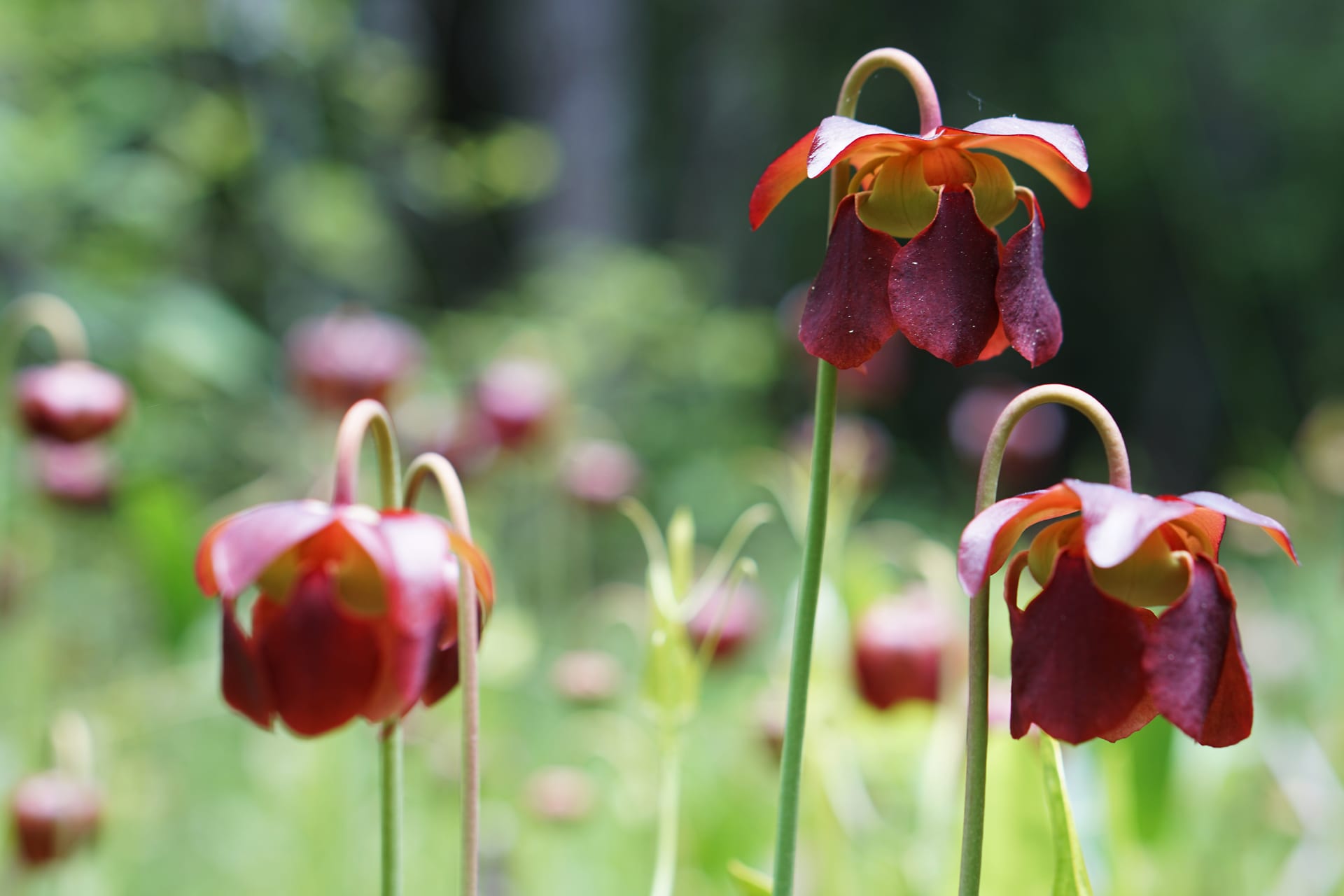
Mountain sweet pitcher plant
IntermediateSarracenia rubra ssp. jonesii
A pitcher plant surviving only in bogs of the Appalachian Mountains. It raises slender green pitchers veined in maroon, like a larger S. rubra, and bears red, raspberry-scented flowers. It is a CITES Appendix I subspecies.
About
Sarracenia rubra subsp. jonesii, the mountain sweet pitcher plant, grows only in the mountains on the border of North and South Carolina, USA. It was described as the species S. jonesii in 1929 and has since been treated as a form or subspecies of S. rubra; botanists still disagree on its rank (GBIF accepts S. jonesii, while CITES lists it as a subspecies of S. rubra). The pitchers are slender green tubes with maroon veins, larger than those of S. rubra: about 43-61 cm tall and 2.8-4.2 cm across the mouth (S. rubra is 26-45 cm). The tube is said to swell slightly in its upper third and narrow just below the mouth, though this varies with growing conditions. The maroon flowers are fragrant and appear from April to June. It grows in seepage bogs and 'cataract bogs', where water sheets over sloping granite, and only about ten sites are known. Changes in water flow and poaching have reduced it, and it is listed as Endangered under the US Endangered Species Act. An all-green form lacking red pigment has reportedly been lost from the wild to poachers. It is occasionally offered in Japan by specialist nurseries and at auctions, but as an Appendix I plant it needs a registration certificate to be transferred.
Source: Wikipedia (CC BY-SA 4.0)
Size of the Mountain sweet pitcher plant
The Mountain sweet pitcher plant grows to Pitchers about 43-61 cm tall and 2.8-4.2 cm across the mouth.
Basic Info
Origin
Mountains of North and South Carolina, USA (southern Appalachians)
Lifespan
Perennial (can be kept for many years by division)
Size
Pitchers about 43-61 cm tall and 2.8-4.2 cm across the mouth
Temperature
10〜30℃
Humidity
60〜90%
Watering & Fertilizer
No fertilizer (catches insects)
Growing Tips
Light & Placement
Grow outdoors in full sun; with too little light the colour is poor and the pitchers are weak.
Watering
Keep the pot standing in about 4-6 cm of water at all times and never let it dry out. Use rain water or other water low in dissolved minerals.
Soil & Repotting
A 1:1 peat and sand mix is the standard. Divide and repot well-grown plants every 3 or 4 years.
Temperature & Overwintering
A mountain plant that is cold-hardy; fully dormant plants have come through hard frost at -7°C unharmed. Always give it a cold winter dormancy.
Fertilizer
Do not fertilize the soil of mature plants; it can cause rhizome rot. Plenty of sun and access to prey are enough.
Pests & Cautions
A CITES Appendix I subspecies; selling or giving plants within Japan requires a registration certificate. Do not buy plants without one.
Mountain sweet pitcher plant FAQ
QWhat is the growing difficulty level for Mountain sweet pitcher plant?
Intermediate. A variety suitable for intermediate growers. Requires some cultivation experience and knowledge of environment management. Pay careful attention to temperature and humidity control.
QHow large does Mountain sweet pitcher plant get?
The mature size of Mountain sweet pitcher plant is Pitchers about 43-61 cm tall and 2.8-4.2 cm across the mouth. This may vary slightly depending on cultivation environment and individual differences.
QHow should I water and fertilize Mountain sweet pitcher plant?
Mountain sweet pitcher plant: watering & fertilizer — No fertilizer (catches insects). Aim for appropriate frequency and amount.
QWhat is the typical price for Mountain sweet pitcher plant?
The price of Mountain sweet pitcher plant varies significantly by variety, characteristics, size, and lineage. Please check GrowerDirect's price guide for the latest market information.
Last updated: September 23, 2026
References & Sources
Edited & verified by: GrowerDirect Editorial Team
The classifications, regulations, and growing data on this page are created and verified based on the primary information database below.
Taxonomy & Authority
Accepted name: Sarracenia rubra ssp. jonesii (Wherry) Wherry
Synonyms: Sarracenia jonesii Wherry
Authority databases: GBIF · GBIF Sarracenia rubra subsp. jonesii (Wherry) Wherry(Backbone では Sarracenia jonesii のシノニム) · GBIF Sarracenia jonesii Wherry
Nomenclature follows global taxonomic authority databases.
Regulations & Conservation Status
Listed in CITES Appendix I, so international commercial trade is prohibited in principle. Within Japan, transferring a plant (selling or giving it away) in principle requires a registration certificate under the Act on Conservation of Endangered Species, and plants propagated in Japan also have to be registered. Always check that a registration certificate comes with the plant.
Sources: Species+ (CITES) Sarracenia rubra subsp. jonesii / Species+ (CITES) Sarracenia rubra
Regulations may change. Always verify the latest information with the relevant authorities.
Related Species
Find listings for this species
Related Articles
Complete Sarracenia Growing Guide | Variety Selection, Outdoor Cultivation, and Winter Dormancy
A complete guide to cultivating Sarracenia, a carnivorous plant native to North America. Learn the characteristics of major species and varieties, the advantages and environmental needs for outdoor cultivation in sunny locations, selection of soil and containers, watering and standing-water management techniques, winter dormancy care, and practical tips for growing healthy, thriving plants in Japan's climate.
Sarracenia Outdoor Cultivation Guide | Cold Hardiness and Year-Round Management
This guide explains the benefits of outdoor Sarracenia cultivation, cold hardiness, annual management schedules, and care for soil, watering, and light.
Sarracenia Trap Function and Diverse Morphology
A detailed explanation of the unique trap mechanisms of Sarracenia carnivorous plants and the varied morphology that differs by species.
How to Cultivate Sarracenia (Pitcher Plant) | Humidity Control and Maintaining Tubular Carnivorous Leaves
Methods for maintaining healthy tubular carnivorous leaves in Sarracenia. Detailed explanation of replicating native habitat conditions, optimal parameters for light, humidity, and growing media, seasonal management (the necessity of winter dormancy), and pest and disease management. A professional cultivation guide for experienced growers.
Can't find the plant you're looking for?
Post your wishes for free and growers with matching plants will contact you with introductions.