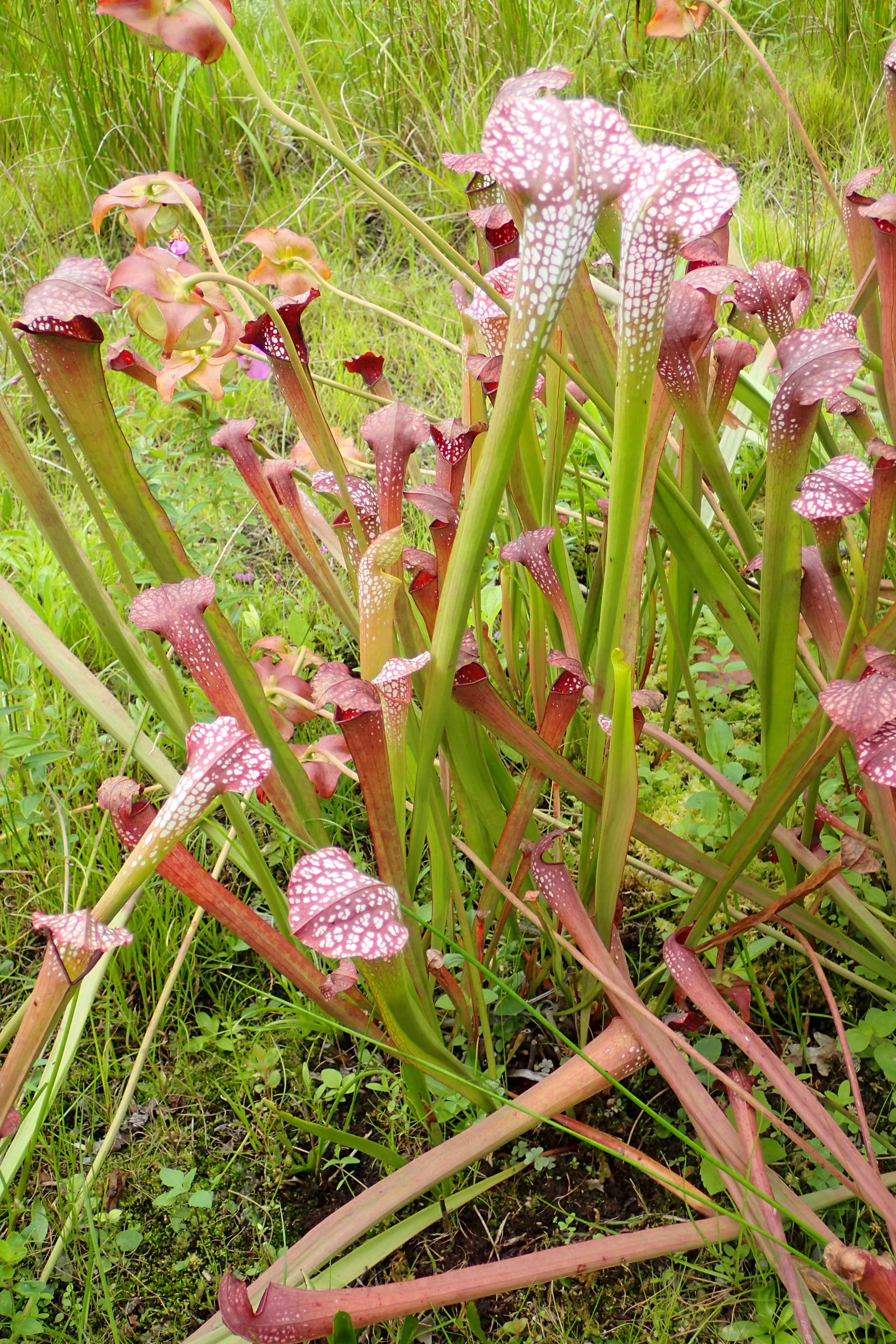
Source: Wikimedia Commons
Sarracenia × excellens
BeginnerSarracenia × excellens
The natural hybrid between white-topped S. leucophylla and hooded S. minor. White colouring and a frilly lid from S. leucophylla combine with an overhanging hood and white spots from S. minor.
About
Sarracenia × excellens is the natural hybrid between S. leucophylla and S. minor; the name was published by W. Bull. S. leucophylla has the upper third or so of each pitcher coloured white and a finely frilled lid margin, and its influence tends to show in hybrids as white colouring and that lid shape. The other parent, S. minor, has a lid bent forward over the mouth like a hood and white, light-transmitting spots (windows) on the upper pitcher. First-generation hybrids are usually intermediate, mixing these features of both parents. Sarracenia species hybridize readily and the hybrids are fertile, so in backcrossed plants the features of one parent may be almost invisible. Artificial crosses are also sold under this name, and colour and height vary widely with the parent plants used. In Japan it is sold online and at auctions, but some listings are merely hybrids that 'look like excellens', so choose plants whose parentage is certain. Care is the same as for other Sarracenia: full sun, tray watering, no fertilizer and a winter dormancy.
Source: Wikipedia (CC BY-SA 4.0)
Basic Info
Origin
Natural hybrid of the south-eastern USA (S. leucophylla × S. minor)
Lifespan
Perennial (can be kept for many years by division)
Size
Little published size data (intermediate between the parents)
Temperature
10〜30℃
Humidity
60〜90%
Watering & Fertilizer
No fertilizer (catches insects)
Growing Tips
Light & Placement
Grow outdoors in full sun; with too little light the colour is poor and the pitchers are weak.
Watering
Keep the pot standing in about 4-6 cm of water at all times and never let it dry out. Use rain water or other water low in dissolved minerals.
Soil & Repotting
A 1:1 peat and sand mix is the standard. Divide and repot well-grown plants every 3 or 4 years.
Temperature & Overwintering
Let it go dormant in winter. Fully dormant plants survive a few weeks frozen solid in their pots, but early and late frosts are the danger. Keep the winter spot cool, not warm.
Fertilizer
Do not fertilize the soil of mature plants; it can cause rhizome rot. Plenty of sun and access to prey are enough.
Pruning & Grooming
The plant recovers nutrients from old leaves, so cut off only the brown, dead parts.
Sarracenia × excellens FAQ
QWhat is the growing difficulty level for Sarracenia × excellens?
Beginner. A variety suitable for beginners. No special equipment or experience is required—you can grow it without problems by setting up a basic cultivation environment.
QHow should I water and fertilize Sarracenia × excellens?
Sarracenia × excellens: watering & fertilizer — No fertilizer (catches insects). Aim for appropriate frequency and amount.
QWhat is the typical price for Sarracenia × excellens?
The price of Sarracenia × excellens varies significantly by variety, characteristics, size, and lineage. Please check GrowerDirect's price guide for the latest market information.
Last updated: September 23, 2026
References & Sources
Edited & verified by: GrowerDirect Editorial Team
The classifications, regulations, and growing data on this page are created and verified based on the primary information database below.
Taxonomy & Authority
Accepted name: Sarracenia × excellens W.Bull
Authority databases: GBIF · GBIF Sarracenia × excellens W.Bull
Nomenclature follows global taxonomic authority databases.
Regulations & Conservation Status
The whole genus Sarracenia is listed in CITES Appendix II (apart from a few Appendix I species and subspecies), and this covers hybrids and cultivars too. Import and export across borders require CITES permits, but no registration is needed to buy, sell or give plants within Japan.
Sources: Species+ (CITES) Sarracenia × excellens
Regulations may change. Always verify the latest information with the relevant authorities.
Related Species
Find listings for this species
Related Articles
Complete Sarracenia Growing Guide | Variety Selection, Outdoor Cultivation, and Winter Dormancy
A complete guide to cultivating Sarracenia, a carnivorous plant native to North America. Learn the characteristics of major species and varieties, the advantages and environmental needs for outdoor cultivation in sunny locations, selection of soil and containers, watering and standing-water management techniques, winter dormancy care, and practical tips for growing healthy, thriving plants in Japan's climate.
Sarracenia Outdoor Cultivation Guide | Cold Hardiness and Year-Round Management
This guide explains the benefits of outdoor Sarracenia cultivation, cold hardiness, annual management schedules, and care for soil, watering, and light.
Sarracenia Trap Function and Diverse Morphology
A detailed explanation of the unique trap mechanisms of Sarracenia carnivorous plants and the varied morphology that differs by species.
How to Cultivate Sarracenia (Pitcher Plant) | Humidity Control and Maintaining Tubular Carnivorous Leaves
Methods for maintaining healthy tubular carnivorous leaves in Sarracenia. Detailed explanation of replicating native habitat conditions, optimal parameters for light, humidity, and growing media, seasonal management (the necessity of winter dormancy), and pest and disease management. A professional cultivation guide for experienced growers.
Can't find the plant you're looking for?
Post your wishes for free and growers with matching plants will contact you with introductions.