Source: Wikimedia Commons
Catopsis Berteroniana
IntermediateCatopsis berteroniana
A bromeliad carnivorous plant that traps insects with waxy leaf surfaces, drowning them in leaf-cup water for nutrients.
Overview
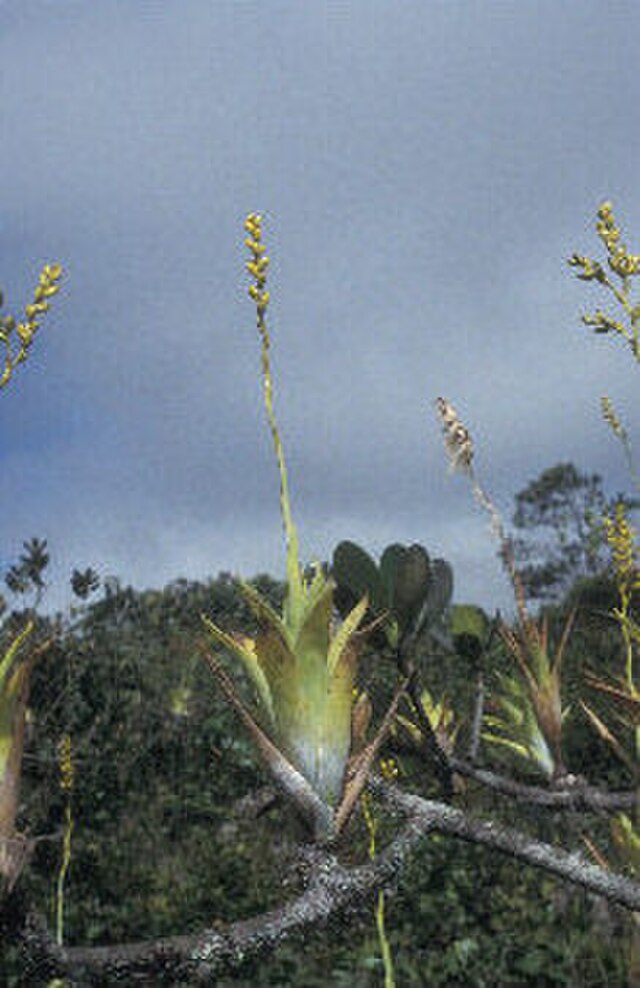
Catopsis berteroniana is a bromeliad (family Bromeliaceae) native to southern Florida, Central America, the Caribbean, and tropical South America, where it grows as an epiphyte in humid forests. It is considered the most carnivorous member of the Bromeliaceae, though it is debated as a true carnivore: the inner leaf surfaces are coated with ultraviolet-reflective white farina (waxy powder) that attracts and possibly disorients insects, causing them to fall into the central water-holding tank formed by the overlapping leaf bases. Trapped insects drown and are decomposed by microbial activity in the tank water, with the plant absorbing the released nutrients through specialized leaf trichomes. No digestive enzymes are produced by the plant itself.
Lifespan of the Catopsis Berteroniana
The Catopsis Berteroniana lives 5-10 years.
Size of the Catopsis Berteroniana
The Catopsis Berteroniana grows to 20-50cm.
Temperature & humidity for the Catopsis Berteroniana
Cultivation follows bromeliad culture: epiphytic well-draining media, pure or rainwater in the central tank, high humidity, and warm temperatures (20–35°C).
Basic Info
Origin
Southern Florida, Central America, Caribbean, and tropical South America, humid forest epiphytes
Lifespan
5-10 years
Size
20-50cm
Temperature
10〜30℃
Humidity
60〜90%
Watering & Fertilizer
Insects (auto-capture)
Growing Tips
Light & Placement
As an epiphyte, place it in bright partial shade with good airflow. Treat it much like an orchid or bromeliad.
Watering
Always keep the leaf tank filled with purified water or rainwater. Keep the medium well drained and never soggy.
Temperature & Overwintering
It prefers warm, humid conditions at 20-35°C. In winter move it to a warm spot indoors and avoid low temperatures.
Soil & Repotting
Plant in a well-drained epiphyte mix such as bark and sphagnum, or mount it on driftwood. Repot when the roots become crowded.
Fertilizer
It secretes no digestive fluid; microbes in the tank break down insects that fall in. Fertilizer is generally unnecessary.
Catopsis Berteroniana FAQ
QWhat is the growing difficulty level for Catopsis Berteroniana?
Intermediate. A variety suitable for intermediate growers. Requires some cultivation experience and knowledge of environment management. Pay careful attention to temperature and humidity control.
QWhat is the lifespan of Catopsis Berteroniana?
The average lifespan of Catopsis Berteroniana is 5-10 years. With proper cultivation environment and nutrient management, you can keep it healthy for a long time.
QHow large does Catopsis Berteroniana get?
The mature size of Catopsis Berteroniana is 20-50cm. This may vary slightly depending on cultivation environment and individual differences.
QHow should I water and fertilize Catopsis Berteroniana?
Catopsis Berteroniana: watering & fertilizer — Insects (auto-capture). Aim for appropriate frequency and amount.
QWhat is the typical price for Catopsis Berteroniana?
The price of Catopsis Berteroniana varies significantly by variety, characteristics, size, and lineage. Please check GrowerDirect's price guide for the latest market information.
Last updated: September 17, 2026
References & Sources
Edited & verified by: GrowerDirect Editorial Team
The classifications, regulations, and growing data on this page are created and verified based on the primary information database below.
Taxonomy & Authority
Accepted name: Catopsis berteroniana (Schult. & Schult.f.) Mez
Synonyms: Tillandsia berteroniana Schult. & Schult.f., Catopsis mosenii Mez, Tillandsia pendula Thunb. ex C.F.Gaertn., Renealmia pendula C.F.Gaertn., Pogospermum berteronianum (Schult. & Schult.f.) Brongn.
Authority databases: GBIF · POWO · ICPS cultivar registration (International Carnivorous Plant Society)
Nomenclature follows global taxonomic authority databases.
Regulations & Conservation Status
This genus is not listed in CITES Appendices (among carnivorous plants, only Nepenthes/Sarracenia/Dionaea are subject to CITES).
Sources: CITES Appendices (carnivorous plants) - ICPS/Barry Rice / CITES & Carnivorous Plant Checklist (RBG Kew)
Regulations may change. Always verify the latest information with the relevant authorities.
Related Species
Find listings for this species
Related Articles
Carnivorous Plant Dormancy Awakening Guide | Correct Timing for Resuming Feeding, Fertilizing, and Watering
A step-by-step guide to the correct timing for resuming watering, restoring humidity, feeding, and fertilizing as your carnivorous plants emerge from dormancy and enter spring growth.
Why Carnivorous Plant Traps Fail and How to Fix Them | Optimizing Humidity, Nutrition, and Prey-Capture Systems
Investigate why carnivorous plant traps fail to capture insects. From humidity management to nutrient balance, gland secretion function, and dormancy, a detailed scientific approach to restoring trap function.
A Guide to Giving Carnivorous Plants as Gifts | How to Choose Unique Presents and Tips for Long-Term Enjoyment
A guide to selecting carnivorous plants as gifts. Covers how to choose varieties based on the recipient's type, and important care tips to communicate before gifting, such as water quality and dormancy periods.
Developing Nepenthes Pitcher Traps Completely: Cultivation Secrets Through Environmental Management and Physiological Approaches
The carnivorous leaves of Nepenthes represent the masterpiece of an insect-trapping mechanism evolved over 200 million years. This article explains how to mature the carnivorous leaves completely and develop healthy plants with actual predatory function through humidity, light, and nutrient management.
Can't find the plant you're looking for?
Post your wishes for free and growers with matching plants will contact you with introductions.