Carnivorous Plant Dormancy Awakening Guide | Correct Timing for Resuming Feeding, Fertilizing, and Watering
A step-by-step guide to the correct timing for resuming watering, restoring humidity, feeding, and fertilizing as your carnivorous plants emerge from dormancy and enter spring growth.
Key Takeaways
A step-by-step guide to the correct timing for resuming watering, restoring humidity, feeding, and fertilizing as your carnivorous plants emerge from dormancy and enter spring growth.
Related Species
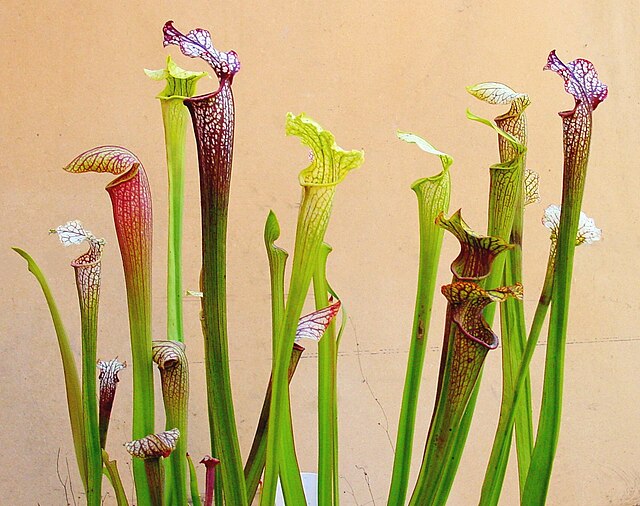
The transition of carnivorous plants from dormancy to spring growth is said to be more challenging in managing the "exit" than the "entrance" to dormancy. As temperatures begin to moderate, signs of activity appear in the plants, but this stage is not yet a complete growth period. If you switch immediately to normal care once dormancy ends, the still-inactive roots become stressed, and what should be vigorous spring growth may actually backfire. This article uses Sarracenia, which enters dormancy, and Nepenthes (pitcher plant), which doesn't enter dormancy but overwinters indoors, as examples to explain step-by-step the correct timing for resuming feeding, fertilizing, and watering.
Treat Dormancy Awakening as a "Transition Period"
Even when movement begins to appear in Sarracenia's rhizomes and dormant buds, root activity is not yet in full motion. This is a transition period in which everything—the roots' ability to absorb water, the expansion of leaves that carry out photosynthesis, and the secretion of digestive fluid within the pitcher leaves—gradually starts up.
The signs that mark this transition period can be summarized as follows.
- New buds in white to pale green appear at the tips of rhizomes or in the center of the plant
- The tips of new pitcher leaves begin to emerge from the soil surface
- The soil at the base becomes less likely to dry out when touched (a sign of roots resuming water uptake)
- In the case of Nepenthes, new leaves unfold noticeably faster than during winter
Once multiple signs are present, the basic approach is to gradually return each care item to normal.
How to Resume Watering and Raise Water Levels
For Sarracenia that was kept at a low water level during dormancy, gradually raise the water level once signs of awakening appear. Raise it a few centimeters per week, with the important thing being not to suddenly return to full water level. By giving the roots time to acclimate to the wet environment, you can reduce the risk of root rot.
For plants that overwinter indoors, including Nepenthes, the air in heated rooms tends to be dry, and the drying pattern of the growing medium may have changed over winter. Even when increasing watering frequency for spring, the principle of watering only after the soil surface dries remains unchanged. Rather than a gut-level switch based on rising temperatures, observe the condition of the growing medium and the plant's water absorption, and adjust accordingly.
How to Acclimate to Light and Clean Up Dead Leaves
Plants managed indoors by a window or in partial shade during winter will suffer leaf scorch if suddenly moved to strong direct sunlight in spring. Although most Sarracenia prefer bright light, new leaves shortly after dormancy awakening do not yet have sufficient UV resistance. For the first one to two weeks, place them in bright shade or a lightly shaded spot, then gradually extend the photoperiod every few days through an "acclimation" process. The same applies when moving Nepenthes to a balcony or outdoors.
Additionally, cleaning up pitcher leaves that died during dormancy or discolored leaves once new buds have begun to move improves air circulation. However, for leaves whose status is still unclear, it is safer to leave them rather than remove them hastily. Non-completely dead leaves may still retain stored nutrients, so target only obviously dead parts.
How to Determine When to Resume Feeding (Capturing Prey)
Carnivorous plant pitcher leaves do not have digestive and absorptive function as soon as they expand. For Sarracenia's tubular pitcher leaves, feeding can be resumed once digestive fluid begins to be secreted internally and the lid takes on bright color. Nepenthes pitchers (pouches) similarly begin to function only once the mouth opens and liquid begins to accumulate.
Forcing prey into non-functional old pitcher leaves shortly after dormancy awakening will only result in decay without digestion or absorption. If you transition to outdoor management where insects naturally enter, feeding is not particularly necessary, but when artificially feeding plants under indoor care, try feeding newly expanded pitcher leaves with small amounts first.
How to Begin Fertilizing and Important Considerations
Carnivorous plants are naturally adapted to nitrogen replenishment through prey capture in nutrient-poor growing media. For this reason, fertilizing is not essential, but in potted cultivation, supplementing with diluted liquid fertilizer applied as a foliar spray during the growth period is considered effective.
The appropriate timing to begin fertilizing is once the following conditions are met.
- New pitcher leaves have expanded to some degree
- Roots have returned to a state where they can absorb water (the growing medium dries quickly after watering)
- Two to three weeks have passed since new bud expansion was confirmed
Once you reach this stage, it is safe to begin applying liquid fertilizer even more diluted than the recommended concentration, about once a month, in the form of a light misting on the leaves. Avoid fertilizing shortly after dormancy awakening while roots are not yet fully active, as not only will nutrients be poorly absorbed, but it also places unnecessary stress on roots.
Smooth Transition into Spring Growth
What is common to all aspects—watering, light, feeding, and fertilizing—is the attitude of "gradually shifting while observing the plant's response during the transition period." Checking daily for signs such as the expansion rate of new leaves, their coloration, and the functional recovery of pitcher leaves is the most reliable method for determining the appropriate management timing.
Once the plant enters full growth mode, water consumption increases and new leaf expansion visibly accelerates. At that point, return the water level to normal management, ensure sufficient photoperiod, and get your feeding and fertilizing cycles on track. Adjusting your pace to match the plant's pace, without rushing, is the practical key to growing carnivorous plants healthily from spring through autumn.
At GrowerDirect, you can directly purchase Sarracenia and Nepenthes in excellent condition, managed by our growers. The ability to directly confirm plant condition and management history with the grower is an advantage unique to a direct-sales marketplace.