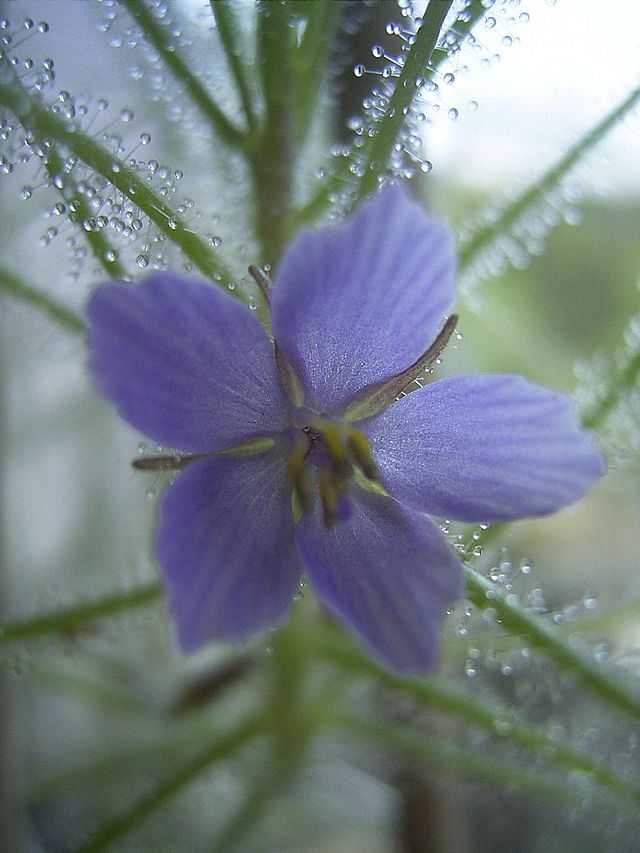
Source: Wikimedia Commons
Byblis Liniflora
IntermediateByblis liniflora
An Australian carnivorous plant with rainbow-glistening mucilage, called Rainbow Plant.
About
Byblis liniflora, the rainbow plant, is an annual carnivorous plant native to the tropical wetlands and grasslands of northern Australia (Northern Territory and northern Queensland) and Timor. Its common name refers to the spectacular iridescent shimmer produced by the dense, gland-tipped mucilaginous tentacles covering its thread-like leaves—a prismatic rainbow effect in sunlight. Like all Byblis, it captures insects passively by adhesion to this sticky surface but lacks the ability to move its tentacles or leaves. It is treated as an annual in cultivation, germinating in autumn to spring and completing its cycle the same season. Seed germination may benefit from smoke treatment (smoke water soaking) as in other Australian fire-adapted flora.
Lifespan of the Byblis Liniflora
The Byblis Liniflora lives 1-2 years (annual).
Size of the Byblis Liniflora
The Byblis Liniflora grows to 10-30cm.
Temperature & humidity for the Byblis Liniflora
The ideal temperature for the Byblis Liniflora is 20〜35℃.
Cultivation uses sphagnum or peat-perlite media, tray watering with pure or rainwater, and full sun with warm temperatures (20–35°C).
Basic Info
Origin
Northern Australia (Northern Territory and northern Queensland) and Timor, tropical grasslands and seasonal wetlands
Lifespan
1-2 years (annual)
Size
10-30cm
Temperature
20〜35℃
Humidity
60〜90%
Watering & Fertilizer
Insects (auto-capture)
Growing Tips
Light & Placement
It likes strong direct sun with warm, humid conditions, so grow it in a sunny spot. It stretches easily when light is insufficient.
Watering
Keep the medium constantly moist with tray watering, using purified water or rainwater. Avoid mineral-rich tap water.
Temperature & Overwintering
Ideal conditions are warm and humid at 20-35°C. As an annual it dies back, so overwinter it as seed rather than as a plant.
Soil & Repotting
Use moist sphagnum alone or a peat moss and perlite mix. As an annual it generally does not need repotting.
Propagation
Sow seed in autumn to winter, let it grow, flower and set seed in spring to summer, then collect seed. Soaking seed in smoke-treated water can improve germination.
Byblis Liniflora FAQ
QWhat is the growing difficulty level for Byblis Liniflora?
Intermediate. A variety suitable for intermediate growers. Requires some cultivation experience and knowledge of environment management. Pay careful attention to temperature and humidity control.
QWhat is the ideal temperature for Byblis Liniflora?
The ideal temperature for Byblis Liniflora is 20〜35℃. Avoid sudden temperature changes and maintain a stable environment.
QWhat is the lifespan of Byblis Liniflora?
The average lifespan of Byblis Liniflora is 1-2 years (annual). With proper cultivation environment and nutrient management, you can keep it healthy for a long time.
QHow large does Byblis Liniflora get?
The mature size of Byblis Liniflora is 10-30cm. This may vary slightly depending on cultivation environment and individual differences.
QHow should I water and fertilize Byblis Liniflora?
Byblis Liniflora: watering & fertilizer — Insects (auto-capture). Aim for appropriate frequency and amount.
QWhat is the typical price for Byblis Liniflora?
The price of Byblis Liniflora varies significantly by variety, characteristics, size, and lineage. Please check GrowerDirect's price guide for the latest market information.
Last updated: September 17, 2026
References & Sources
Edited & verified by: GrowerDirect Editorial Team
The classifications, regulations, and growing data on this page are created and verified based on the primary information database below.
Taxonomy & Authority
Accepted name: Byblis liniflora Salisb.
Synonyms: Byblis caerulea R.Br. ex Planch., Drosophorus caerulea R.Br. ex Planch.
Authority databases: GBIF · POWO · ICPS cultivar registration (International Carnivorous Plant Society)
Nomenclature follows global taxonomic authority databases.
Regulations & Conservation Status
This genus is not listed in CITES Appendices (among carnivorous plants, only Nepenthes/Sarracenia/Dionaea are subject to CITES).
Sources: CITES Appendices (carnivorous plants) - ICPS/Barry Rice / CITES & Carnivorous Plant Checklist (RBG Kew)
Regulations may change. Always verify the latest information with the relevant authorities.
Related Species
Find listings for this species
Related Articles
Rare Carnivorous Plants Guide | How to Grow Genlisea, Byblis, and Drosera
Detailed explanation of the characteristics and cultivation methods of rare carnivorous plants: Genlisea, Byblis, and Drosera. We introduce the insect-trapping mechanisms, cultivation conditions, and how to obtain them.
Byblis liniflora Cultivation Guide | Mucilage-Trap Carnivorous Plant
Byblis liniflora (Byblis genus) cultivation explained. From seed sowing to propagation methods for the beautiful "Rainbow plant" with luminous mucilage glands covering its entire body—a practical growing guide including substrate, water management, light, temperature conditions, and reproduction.
Carnivorous Plant Dormancy Awakening Guide | Correct Timing for Resuming Feeding, Fertilizing, and Watering
A step-by-step guide to the correct timing for resuming watering, restoring humidity, feeding, and fertilizing as your carnivorous plants emerge from dormancy and enter spring growth.
Why Carnivorous Plant Traps Fail and How to Fix Them | Optimizing Humidity, Nutrition, and Prey-Capture Systems
Investigate why carnivorous plant traps fail to capture insects. From humidity management to nutrient balance, gland secretion function, and dormancy, a detailed scientific approach to restoring trap function.
Can't find the plant you're looking for?
Post your wishes for free and growers with matching plants will contact you with introductions.