Byblis liniflora Cultivation Guide | Mucilage-Trap Carnivorous Plant
Byblis liniflora (Byblis genus) cultivation explained. From seed sowing to propagation methods for the beautiful "Rainbow plant" with luminous mucilage glands covering its entire body—a practical growing guide including substrate, water management, light, temperature conditions, and reproduction.
Key Takeaways
Byblis liniflora (Byblis genus) cultivation explained. From seed sowing to propagation methods for the beautiful "Rainbow plant" with luminous mucilage glands covering its entire body—a practical growing guide including substrate, water management, light, temperature conditions, and reproduction.
Related Species
The Byblis Genus
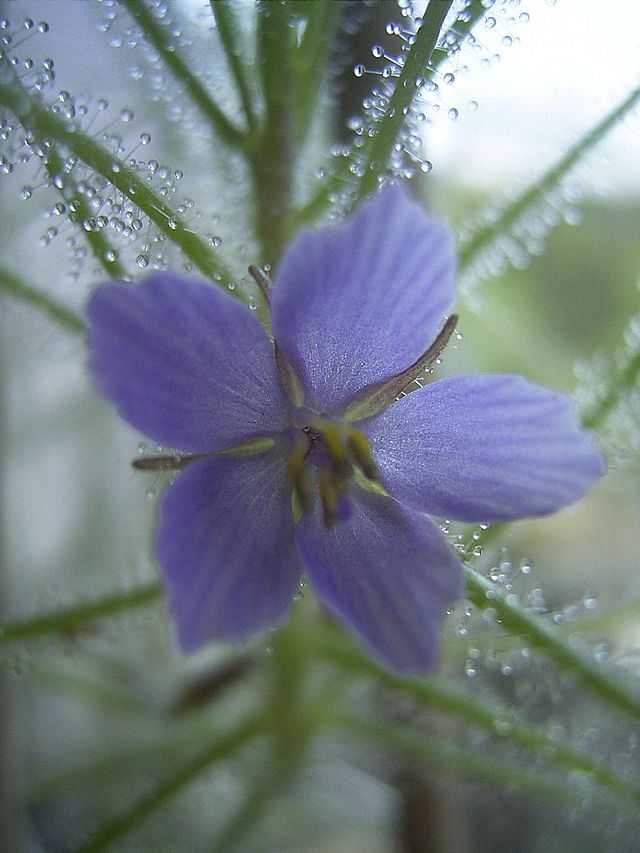
The genus Byblis (Byblidaceae family) is a carnivorous plant genus distributed across Australia and Papua New Guinea, with approximately 7 species. With luminous mucilage glands covering its entire body that shimmer like a rainbow when exposed to sunlight, it is also called "Rainbow plant".
Byblis liniflora, native to Papua New Guinea to northern Australia, is an annual species and the most widely cultivated in the genus.
Differences from Drosera (Sundew)
The genus Byblis is sometimes confused with Drosera (sundew), but they are systematically completely different.
| Characteristic | Byblis | Drosera (Sundew) |
|---|---|---|
| Classification | Byblidaceae (independent family) | Droseraceae |
| Leaf shape | Linear (thread-like, elongated) | Rounded to spoon-shaped and varied |
| Moving glandular hairs | None (passive mucilage trap) | Present (actively moving) |
| Flower characteristics | 5 petals, radially symmetric | Varied |
| Propagation method | Primarily seeds (annual) | Leaf cuttings, seedlings |
Basic Growing Environment
Light Intensity
B. liniflora is a plant that prefers strong light.
- Outdoor cultivation: Ideal with at least 6 hours of direct sunlight (30–50% shade in intense summer heat)
- Indoor cultivation: Full-spectrum LED, 14–16 hours of lighting, 20,000 lux or more
- Signs of insufficient light: Fewer mucilage glands, thin and etiolated stems
With sufficient light, the mucilage secreted by the glandular hairs shimmers with rainbow colors, displaying the beautiful appearance that gives the "Rainbow plant" its name.
Temperature
| Environment | Temperature Range |
|---|---|
| Optimal growth temperature | 20–30°C |
| Heat tolerance (max) | 35°C (short-term) |
| Cold tolerance (min) | 10°C |
| Overwintering | Annual, propagated via seeds for the following year |
Since B. liniflora is an annual, it dies in fall and winter. Seeds must be collected and stored to continue growing it the following year.
Seed Sowing
Growing Byblis from seed is the standard method.
Seed Germination Treatment
B. liniflora seeds have a hard seed coat (dormancy) and tend to have low germination rates as is. The following treatments are effective:
Smoke water treatment: Most effective for seeds from Australia. This treatment mimics natural bushfire smoke, stimulating the seed coat and promoting germination. Commercial products like "Smoke Water" and "Seed Primer" are available.
Warm water soaking: Soak in lukewarm water (40–50°C) for 12–24 hours. Less certain than smoke water treatment but more convenient.
GA3 treatment: Soak in gibberellin (GA3) solution (100–500 ppm) for 12–24 hours. Effective for improving germination rates.
Seed Sowing Steps
- Moisten substrate (peat moss : perlite = 3:1) and level it
- Scatter seeds on the surface (do not cover with soil)
- Cover with a lid or clear plastic to maintain high humidity
- Place in a bright location at 20–28°C
- Germination typically occurs in 2–4 weeks (1–2 weeks if smoke water treated)
Substrate Selection
Recommended Substrate
| Substrate | Ratio |
|---|---|
| Peat moss | 60–70% |
| Perlite | 20–30% |
| Silica sand (fine) | 10–20% |
Important: Never use standard potting soil, leaf mold, or compost. Excessive nutrients will cause it to die quickly.
pH
Ideal pH: 4.5–6.0 (slightly acidic)
Water Management
Water Type
Use rainwater, distilled water, or RO water. Tap water contains minerals and chlorine; continuous use raises substrate pH, causing the plant to die.
Water Tray Management
- Keep 1–2 cm of water continuously in the saucer (water tray method)
- In summer, evaporation is rapid, so check and refill daily
- Avoid excessive waterlogging, which causes root rot; maintain a moderate water level
Flowers and Pollination
B. liniflora produces pale purple flowers in spring through summer. It has 5 petals with yellow stamens clustered at the center.
Self-Pollination and Hand Pollination
B. liniflora has high self-compatibility and often self-pollinates as flowers close, setting fruit (unlike other perennial Byblis, hand pollination is rarely necessary).
- Collect pollen from the stamens using a cotton swab or fine brush
- Apply pollen to the stigma of the same or different flower
- If pollination succeeds, fruit containing seeds forms after several weeks
Seed Collection and Storage
Harvest when the fruit turns brown and dries.
- Store seeds in a dry, dark location at room temperature (viable for 1–2 years)
- Sow in spring the following year
- Storage in a refrigerator (4–8°C) extends viability longer
Propagation Methods
Seed Propagation (Primary Method)
See seed sowing steps above.
Stem Cuttings
Although it's an annual, stem cuttings are possible during the growing season. Cut stems to 3–5 cm and insert into moist sphagnum or substrate under high humidity. However, success rates are lower than seed propagation.
Common Problems and Solutions
Sudden Decline
→ The most common cause is mineral accumulation and pH rise from continuous tap water use. Switch to pure water immediately; if symptoms are mild, recovery is possible.
Few or Non-Luminous Mucilage Glands
→ Insufficient light. Strengthen the lighting.
Seeds Won't Germinate
→ Seeds have not broken dormancy. Apply smoke water or GA3 treatment.
No Flowers
→ Insufficient daylight or temperatures too low.
White Powdery Substance on Leaves
→ Powdery mildew (fungus). Improve airflow and lightly spray with a fungicide (diluted orthocide wettable powder, etc.).
Growing Notes for Japan
In Japan, B. liniflora is somewhat difficult to obtain. It may be available from carnivorous plant specialists, plant shows (such as events hosted by the Carnivorous Plant Research Society), and grower direct-sale sites.
Seeds are especially common; seeds can often be shared through domestic grower communities (social media and specialized forums).
Summary
Byblis liniflora is beautiful with mucilage glands that shimmer in sunlight, making it an especially ornamental carnivorous plant. Since it's an annual, seed management is necessary, but once that hurdle is cleared, it's relatively easy to grow.
By following the basic principles of carnivorous plant care—strong light, acidic low-nutrient substrate, and pure water tray method—and establishing a cycle of collecting seeds annually to propagate the following year, you can enjoy this plant for years to come.