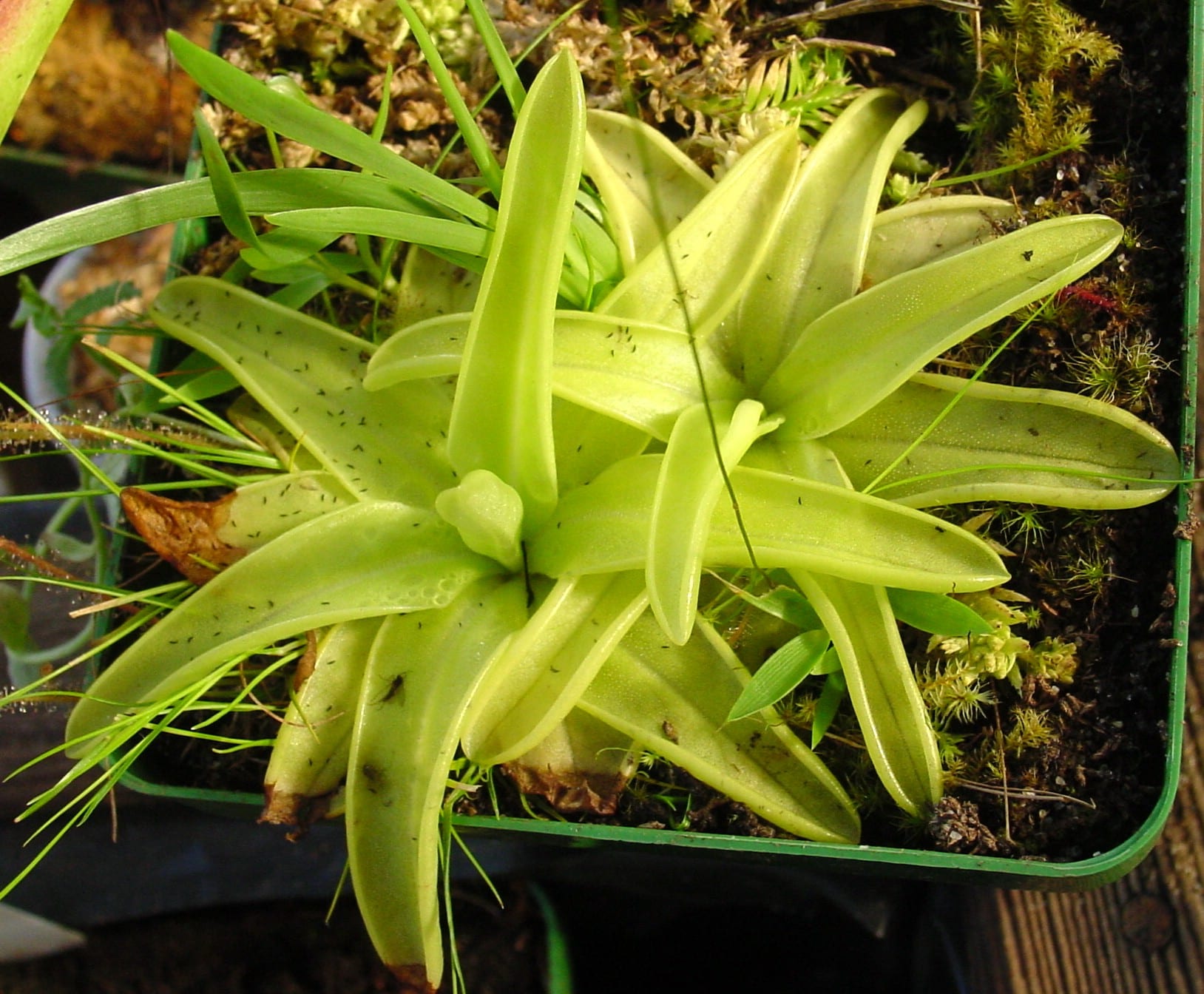
Source: Wikimedia Commons
Yellow butterwort
AdvancedPinguicula lutea
A butterwort of savannas and sandy bogs in the south-eastern United States. In spring it bears bright yellow flowers, unusual in the genus, above a yellow-green rosette up to about 15 cm across.
About
Pinguicula lutea, the yellow butterwort, is a species of the Gulf coastal plain of the south-eastern United States, found in Alabama, Georgia, Mississippi, North and South Carolina, Florida and south-eastern Louisiana. It grows in open pine woods, moist savannas and sandy bogs, in drier places than other southern butterworts, on nutrient-poor acidic soil of about pH 5-6. As a warm temperate species it keeps the same leaves all year and has no special adaptations to survive freezing. The leaves are yellow-green, about 5-7.5 cm long and 2.5 cm wide, pointed and inrolled, and the rosette can reach 15 cm across. It flowers from February to May; the flowers are bright yellow to straw-coloured (rarely white), 1-3 cm across, with a slender spur about 1 cm long, and the petals are often notched. Warm temperate butterworts are short-lived perennials that can flower themselves to death, so the usual approach is to collect seed and keep raising new plants. In Japan, flask-sown plants from Liberty County, Florida, and other sources appear at online auctions.
Source: Wikipedia (CC BY-SA 4.0)
Size of the Yellow butterwort
The Yellow butterwort grows to Rosette up to 15 cm across; flowers 1-3 cm across.
Basic Info
Origin
South-eastern USA (savannas and sandy bogs of the Gulf coastal plain)
Lifespan
Short-lived perennial
Size
Rosette up to 15 cm across; flowers 1-3 cm across
Temperature
10〜30℃
Humidity
60〜90%
Watering & Fertilizer
Little or no fertilizer needed (catches small insects on sticky leaves)
Growing Tips
Light & Placement
Wild plants grow in open pine woods and savannas. Give it a bright spot, with some shade in the height of summer.
Watering
Keep the mix damp at all times. It grows in drier spots than other southern butterworts, so do not keep it waterlogged.
Temperature & Overwintering
It keeps the same leaves all year and has no adaptations to freezing. Bring it in before frost, or protect it if grown outside.
Soil & Repotting
Grow in 3 parts peat, 1 part silica sand and 1 part perlite, or in pure peat. Replant into fresh mix if moss or cyanobacteria start to cover it.
Propagation
A short-lived perennial, so collecting seed is essential to keep it long term. It needs hand pollination with a small brush. Seed germinates in 2-4 weeks at above 15°C.
Yellow butterwort FAQ
QWhat is the growing difficulty level for Yellow butterwort?
Advanced. A variety suitable for advanced growers. Requires advanced cultivation techniques and specialized equipment, with careful environmental adjustments needed.
QHow large does Yellow butterwort get?
The mature size of Yellow butterwort is Rosette up to 15 cm across; flowers 1-3 cm across. This may vary slightly depending on cultivation environment and individual differences.
QHow should I water and fertilize Yellow butterwort?
Yellow butterwort: watering & fertilizer — Little or no fertilizer needed (catches small insects on sticky leaves). Aim for appropriate frequency and amount.
QWhat is the typical price for Yellow butterwort?
The price of Yellow butterwort varies significantly by variety, characteristics, size, and lineage. Please check GrowerDirect's price guide for the latest market information.
Last updated: September 23, 2026
References & Sources
Edited & verified by: GrowerDirect Editorial Team
The classifications, regulations, and growing data on this page are created and verified based on the primary information database below.
Taxonomy & Authority
Accepted name: Pinguicula lutea Walter
Authority databases: GBIF · GBIF Pinguicula lutea Walter
Nomenclature follows global taxonomic authority databases.
Regulations & Conservation Status
Not listed under CITES; no paperwork is needed to buy or grow it in Japan.
Sources: Species+ (CITES) search: Pinguicula lutea (no listing)
Regulations may change. Always verify the latest information with the relevant authorities.
Related Species
Find listings for this species
Related Articles
How to Grow Butterwort (Pinguicula) | Beautiful Flowers and the Charm of Sticky Traps
A beginner's guide to growing Butterwort (Pinguicula). Discover cute violet-like flowers, the sticky leaf insect-catching mechanism, differences in cultivation between Mexican and temperate species, and propagation methods.
Why Carnivorous Plant Traps Fail and How to Fix Them | Optimizing Humidity, Nutrition, and Prey-Capture Systems
Investigate why carnivorous plant traps fail to capture insects. From humidity management to nutrient balance, gland secretion function, and dormancy, a detailed scientific approach to restoring trap function.
A Guide to Giving Carnivorous Plants as Gifts | How to Choose Unique Presents and Tips for Long-Term Enjoyment
A guide to selecting carnivorous plants as gifts. Covers how to choose varieties based on the recipient's type, and important care tips to communicate before gifting, such as water quality and dormancy periods.
Developing Nepenthes Pitcher Traps Completely: Cultivation Secrets Through Environmental Management and Physiological Approaches
The carnivorous leaves of Nepenthes represent the masterpiece of an insect-trapping mechanism evolved over 200 million years. This article explains how to mature the carnivorous leaves completely and develop healthy plants with actual predatory function through humidity, light, and nutrient management.
Can't find the plant you're looking for?
Post your wishes for free and growers with matching plants will contact you with introductions.