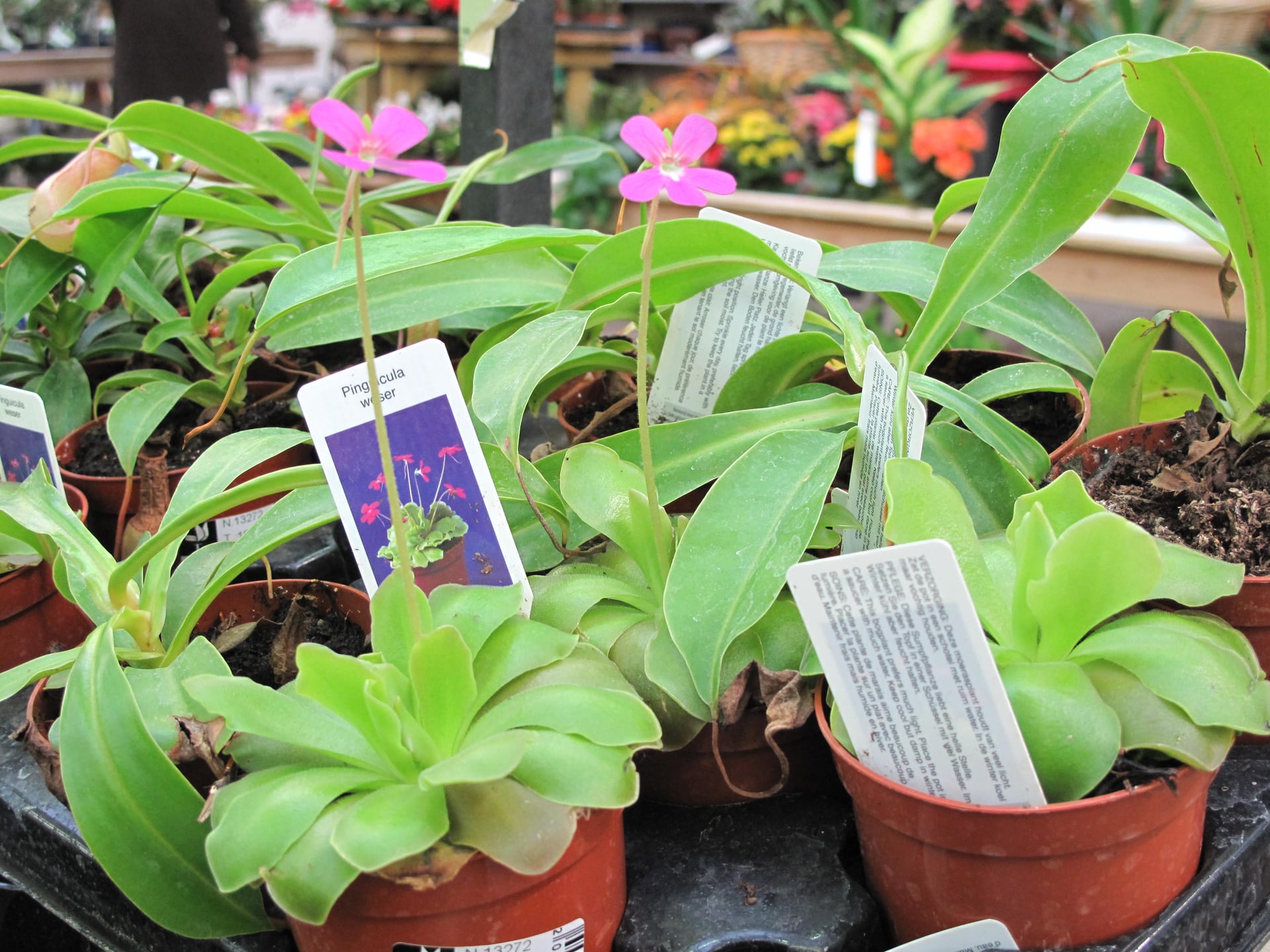
Source: Wikimedia Commons
Pinguicula 'Weser'
BeginnerPinguicula 'Weser'
A butterwort cultivar selected from the same P. moranensis × P. ehlersiae cross as 'Sethos'. The flowers resemble 'Sethos' but have a single white streak down the central lower lobe and dark veins.
About
'Weser' is a butterwort cultivar raised from the Mexican species P. moranensis and P. ehlersiae. Like 'Sethos', it was created by H. Weiner of Hameln, Germany, in 1981, introduced in Adrian Slack's 1986 book and entered in the International Carnivorous Plant Society (ICPS) register in 1998. It is named after the river Weser at the originator's home, and the ICPS register treats it as a sister cultivar published at the same time as 'Sethos'. Slack described its flowers as similar in colour to 'Sethos' but with a single white streak down the central lower lobe and conspicuous dark veins. 'Sethos' instead has a many-rayed white star at the throat, so the difference is clear when the flowers are side by side. The French cultivar 'L'Hautil' comes from the same cross, and the three are hard to tell apart by leaves alone; check the flower pattern on unlabelled plants. In Japan it is offered by specialist carnivorous plant nurseries. Care is the same as for its Mexican parents: carnivorous leaves in summer and a rosette of succulent leaves in winter.
Source: Wikipedia (CC BY-SA 4.0)
Basic Info
Origin
Horticultural hybrid raised in Germany in 1981 (parents are Mexican species)
Lifespan
Perennial (can be kept for years by division and leaf cuttings)
Size
Little published size data
Temperature
10〜30℃
Humidity
60〜90%
Watering & Fertilizer
Little or no fertilizer needed (catches small insects on sticky leaves)
Growing Tips
Temperature & Overwintering
In summer it makes carnivorous leaves in warm, humid conditions; in winter keep it cooler and drier and it rests as a rosette of succulent leaves. Typical indoor windowsill conditions suit it well.
Light & Placement
Grow on a bright windowsill or under lights. Many grow on cliffs with little direct sun in the wild, so avoid harsh midsummer sun.
Watering
In summer, when it has carnivorous leaves, the pot can stand in up to 2 cm of water. Once it switches to succulent winter leaves, let it dry for about a week between waterings.
Soil & Repotting
It is not a bog plant; a mix of equal parts peat, coarse sand and perlite with dolomitic lime added to make it alkaline suits it. Repot or divide in the winter resting phase.
Propagation
Keep the cultivar true by leaf cuttings or division; plants raised from seed will not be the same cultivar.
Pests & Cautions
Do not use fungicides on Pinguicula; they can kill the plants. Fungus gnat larvae eat the leaves, so a thin layer of coarse sand on the soil surface helps.
Pinguicula 'Weser' FAQ
QWhat is the growing difficulty level for Pinguicula 'Weser'?
Beginner. A variety suitable for beginners. No special equipment or experience is required—you can grow it without problems by setting up a basic cultivation environment.
QHow should I water and fertilize Pinguicula 'Weser'?
Pinguicula 'Weser': watering & fertilizer — Little or no fertilizer needed (catches small insects on sticky leaves). Aim for appropriate frequency and amount.
QWhat is the typical price for Pinguicula 'Weser'?
The price of Pinguicula 'Weser' varies significantly by variety, characteristics, size, and lineage. Please check GrowerDirect's price guide for the latest market information.
Last updated: September 23, 2026
References & Sources
Edited & verified by: GrowerDirect Editorial Team
The classifications, regulations, and growing data on this page are created and verified based on the primary information database below.
Taxonomy & Authority
Accepted name: Pinguicula 'Weser' Hort.Slack
Originator: H. Weiner
Authority databases: GBIF · GBIF Pinguicula L.(属) · ICPS 登録栽培品種 Pinguicula 'Weser'(1998年登録、P. moranensis × P. ehlersiae)
Nomenclature follows global taxonomic authority databases.
Regulations & Conservation Status
Not listed under CITES; no paperwork is needed to buy or grow it in Japan. It is not registered under Japan's Plant Variety Protection law.
Sources: Species+ (CITES) search: Pinguicula (no listing) / MAFF Plant Variety Protection database
Regulations may change. Always verify the latest information with the relevant authorities.
Related Species
Find listings for this species
Related Articles
How to Grow Butterwort (Pinguicula) | Beautiful Flowers and the Charm of Sticky Traps
A beginner's guide to growing Butterwort (Pinguicula). Discover cute violet-like flowers, the sticky leaf insect-catching mechanism, differences in cultivation between Mexican and temperate species, and propagation methods.
Why Carnivorous Plant Traps Fail and How to Fix Them | Optimizing Humidity, Nutrition, and Prey-Capture Systems
Investigate why carnivorous plant traps fail to capture insects. From humidity management to nutrient balance, gland secretion function, and dormancy, a detailed scientific approach to restoring trap function.
A Guide to Giving Carnivorous Plants as Gifts | How to Choose Unique Presents and Tips for Long-Term Enjoyment
A guide to selecting carnivorous plants as gifts. Covers how to choose varieties based on the recipient's type, and important care tips to communicate before gifting, such as water quality and dormancy periods.
Developing Nepenthes Pitcher Traps Completely: Cultivation Secrets Through Environmental Management and Physiological Approaches
The carnivorous leaves of Nepenthes represent the masterpiece of an insect-trapping mechanism evolved over 200 million years. This article explains how to mature the carnivorous leaves completely and develop healthy plants with actual predatory function through humidity, light, and nutrient management.
Can't find the plant you're looking for?
Post your wishes for free and growers with matching plants will contact you with introductions.