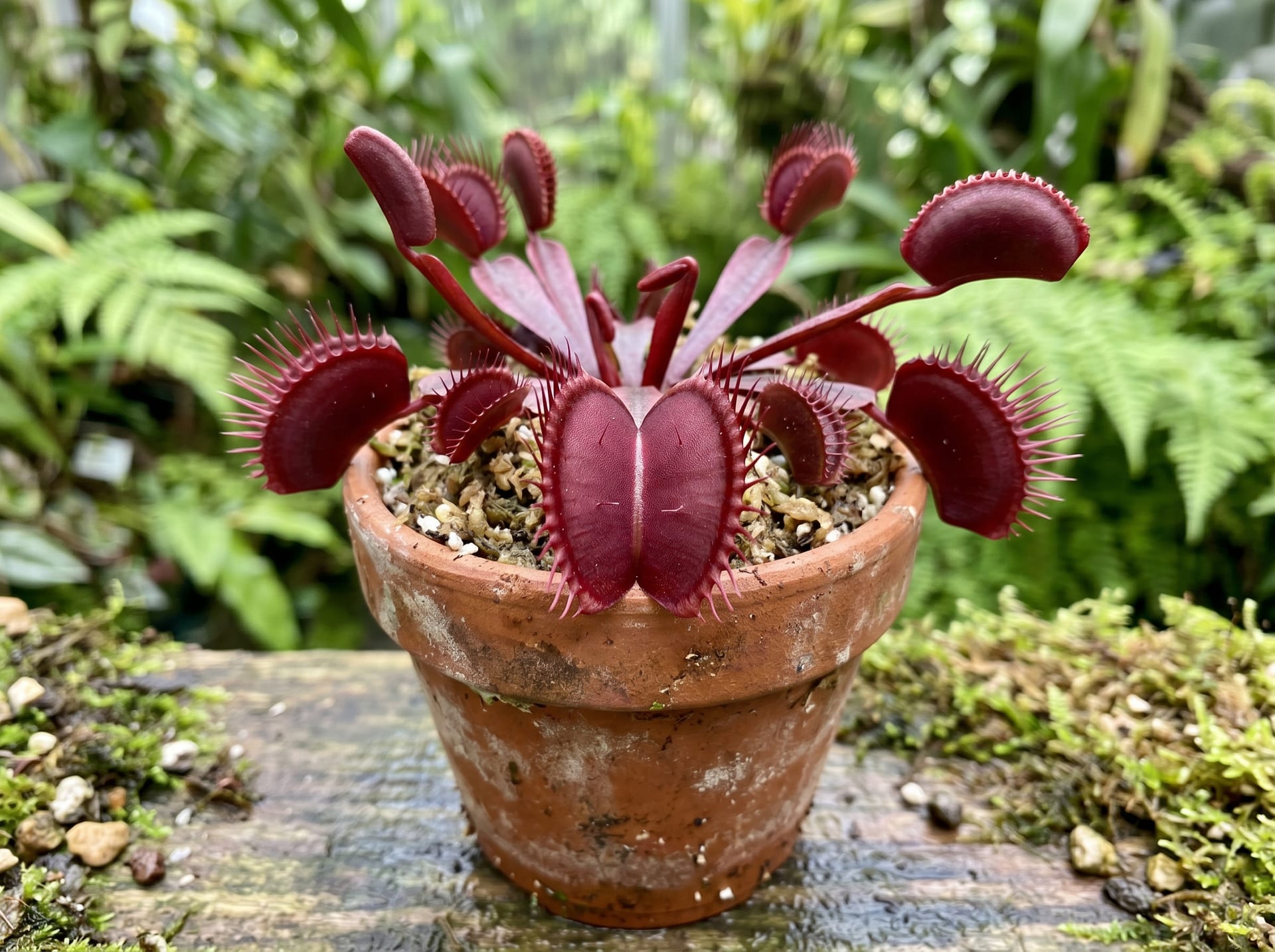
AI-generated image
Venus Flytrap Red Dragon
IntermediateDionaea muscipula 'Akai Ryu'
Most "it died right away" cases come from skipped winter dormancy, tap water, or fertiliser. Red Dragon is the popular cultivar that turns deep red all over.
About
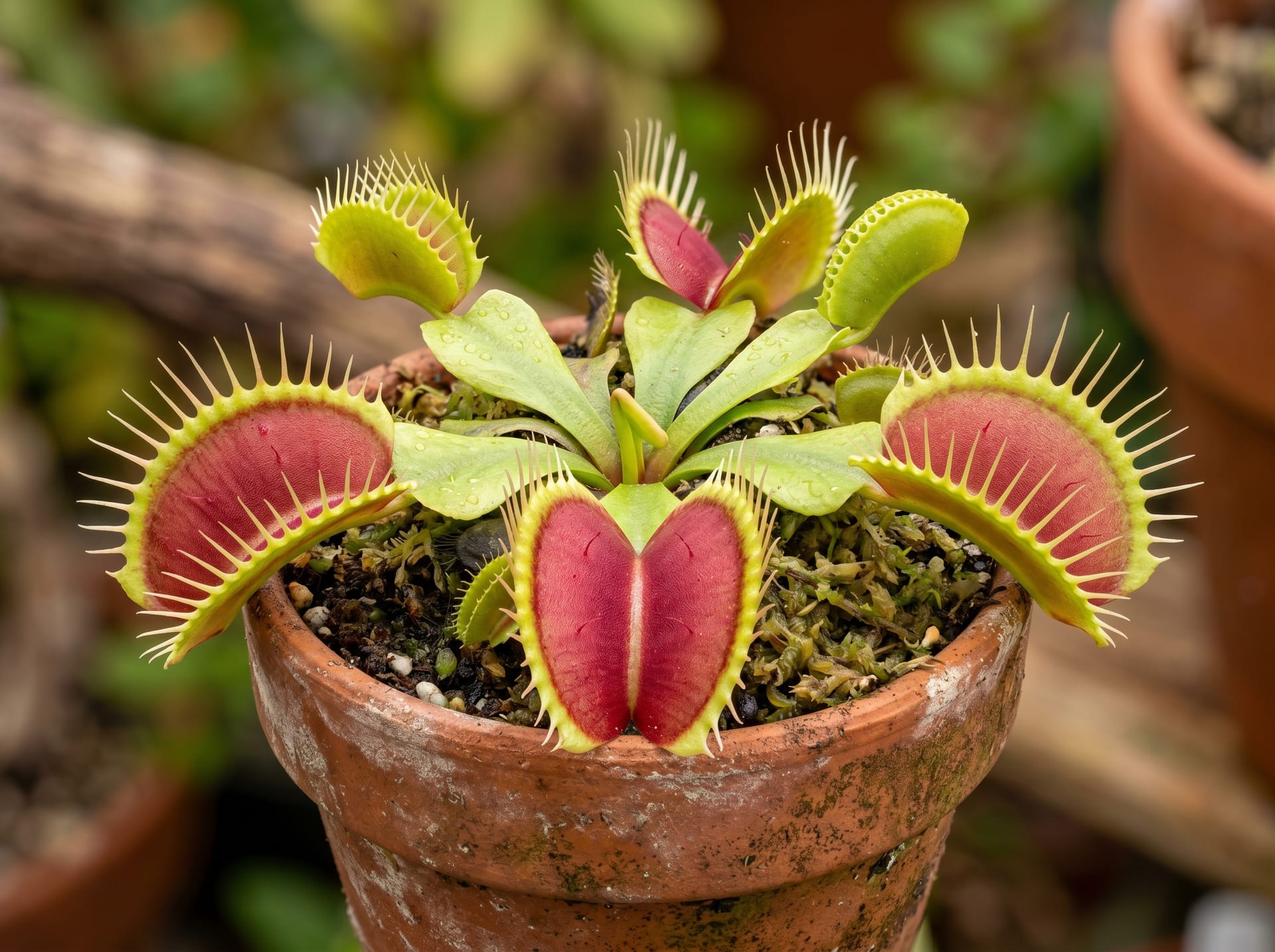
Red Dragon (Dionaea muscipula 'Akai Ryu') is one of the most widely cultivated red-pigmented cultivars of the Venus flytrap. Under strong direct sunlight, the entire plant—including traps, petioles, and even the trap interior—develops a deep crimson coloration that inspired its name. Its registered name in the International Carnivorous Plant Society (ICPS) cultivar register is the Japanese 'Akai Ryu' (red dragon), published by R. Gagliardo in 1996 and registered in 1998; 'Red Dragon' is the English translation under which it is widely sold. Like the wild-type species, it requires nutrient-poor, acidic media (sphagnum or peat-perlite), tray watering with pure or rainwater, and strong sunlight to maintain its vivid red color; insufficient light causes the plant to revert to greenish tones. Adult plants typically reach 5–10 cm in diameter. The cultivar's striking appearance makes it a perennial favorite among carnivorous plant collectors. Individual plants live roughly 10–20 years, but Venus flytraps are perennials that can be maintained across generations through continued division and repotting, so the common impression that they "die quickly" is mostly due to care mistakes. In particular, blackening and wilting of the above-ground parts in winter is normal dormancy, not death, so it's crucial not to discard them mistakenly. The bulbs (corms) underground remain alive during dormancy and will sprout new growth in spring. The three major causes of death are "heated environments that prevent dormancy," "mineral buildup from tap water," and "fertilizing." Following the same approach as the base species—pure water, tray watering, no fertilizer, and cool winter dormancy—ensures you can enjoy them for years.
Lifespan of the Venus Flytrap Red Dragon
The Venus Flytrap Red Dragon lives 10-20 years.
Size of the Venus Flytrap Red Dragon
The Venus Flytrap Red Dragon grows to 5-10cm.
Temperature & humidity for the Venus Flytrap Red Dragon
A mandatory winter dormancy at 5–10°C is essential.
Basic Info
Origin
Horticultural cultivar (wild species native to wetlands of North and South Carolina, USA)
Lifespan
10-20 years
Size
5-10cm
Temperature
10〜30℃
Humidity
60〜90%
Watering & Fertilizer
Insects (auto-capture)
Growing Tips
Light & Placement
Strong outdoor sun is the key to the deep red color. With too little light the red fades and the plant turns greenish.
Watering
Tray-water (bottom watering) to keep it constantly moist, using only pure or rain water. Tap-water mineral buildup is one of the three main killers.
Soil & Repotting
Use pure sphagnum or peat moss with perlite. With regular division and repotting it can be kept going for generations.
Fertilizer
Never fertilize; feeding fertilizer is one of the three main killers. Photosynthesis and caught insects provide all it needs.
Dormancy Care
Let it go dormant at 5-10°C in winter, never in a heated room. Blackened top growth is normal; the bulb underground lives and sprouts in spring.
Pests & Cautions
Do not mistake winter dieback for death and throw it out. The reputation for dying quickly mostly comes from errors in dormancy, water, or fertilizer.
Venus Flytrap Red Dragon FAQ
QWhat is the growing difficulty level for Venus Flytrap Red Dragon?
Intermediate. A variety suitable for intermediate growers. Requires some cultivation experience and knowledge of environment management. Pay careful attention to temperature and humidity control.
QWhat is the lifespan of Venus Flytrap Red Dragon?
The average lifespan of Venus Flytrap Red Dragon is 10-20 years. With proper cultivation environment and nutrient management, you can keep it healthy for a long time.
QHow large does Venus Flytrap Red Dragon get?
The mature size of Venus Flytrap Red Dragon is 5-10cm. This may vary slightly depending on cultivation environment and individual differences.
QHow should I water and fertilize Venus Flytrap Red Dragon?
Venus Flytrap Red Dragon: watering & fertilizer — Insects (auto-capture). Aim for appropriate frequency and amount.
QWhat is the typical price for Venus Flytrap Red Dragon?
The price of Venus Flytrap Red Dragon varies significantly by variety, characteristics, size, and lineage. Please check GrowerDirect's price guide for the latest market information.
Last updated: September 25, 2026
Growing Specifications
- USDA Zone
- 5–8
- Hardiness (RHS)
- H3
Sources: Missouri Botanical Garden - Dionaea muscipula (Zone 5-8) / RHS Find a Plant - Dionaea muscipula (H3)
References & Sources
Edited & verified by: GrowerDirect Editorial Team
The classifications, regulations, and growing data on this page are created and verified based on the primary information database below.
Taxonomy & Authority
Accepted name: Dionaea muscipula J.Ellis 'Akai Ryu'
Synonyms: Drosera sessiliflora Raf., Dionaea sessiliflora Raf., Dionaea sensitiva Salisb., Drosera uniflora Raf., Dionaea uniflora Raf., Dionaea corymbosa Raf.
Class: 栽培品種(cultivar)
Originator: Ron Gagliardo (1998)
Awards: ICPS登録栽培品種
Authority databases: GBIF · POWO · ICPS cultivar registration (International Carnivorous Plant Society)
Nomenclature follows global taxonomic authority databases.
Regulations & Conservation Status
Although a cultivated variety, it is listed as CITES Appendix II under the species Dionaea muscipula (trade regulations apply at the species level). IUCN designations do not apply to cultivated varieties.
Sources: CITES Appendices (carnivorous plants) - ICPS/Barry Rice / CITES & Carnivorous Plant Checklist (RBG Kew)
Regulations may change. Always verify the latest information with the relevant authorities.
Related Species
Find listings for this species
Related Articles
Venus Flytrap Variety Guide | Popular Red, Giant, and Unusual Leaf Varieties
A detailed introduction to popular Venus flytrap varieties. From the all-red Red Dragon to B52 with its giant traps, and Fang with its deformed teeth, we explain the characteristics of each variety and differences in cultivation methods.
Venus Flytrap Annual Growing Cycle | Spring-Summer-Fall-Winter Management and Feeding Frequency Adjustment
From the Venus flytrap's spring growing season through summer peak vigor, autumn dormancy preparation, to winter low-temperature dormancy. Explains the annual growing cycle and seasonal management methods, and proper adjustment of feeding frequency.
Venus Flytrap Trigger Management | How to Protect Your Plant by Avoiding Unnecessary Stimulation
Venus flytrap trap leaves have a limited number of open-close cycles. This article provides practical guidance on management methods to prevent trap depletion from unnecessary stimulation, proper feeding techniques, and the causes and countermeasures for trap blackening.
Complete Guide to Growing Venus Flytraps | Post-Purchase Care and Tips for Thriving Growth
The Venus flytrap is a popular carnivorous plant that captures insects with its traps. This guide covers everything from required light, water, and soil to dormancy management, and explains why traps fail to close.
Can't find the plant you're looking for?
Post your wishes for free and growers with matching plants will contact you with introductions.