Source: Wikimedia Commons
Venus Flytrap Alien
IntermediateDionaea muscipula 'Alien'
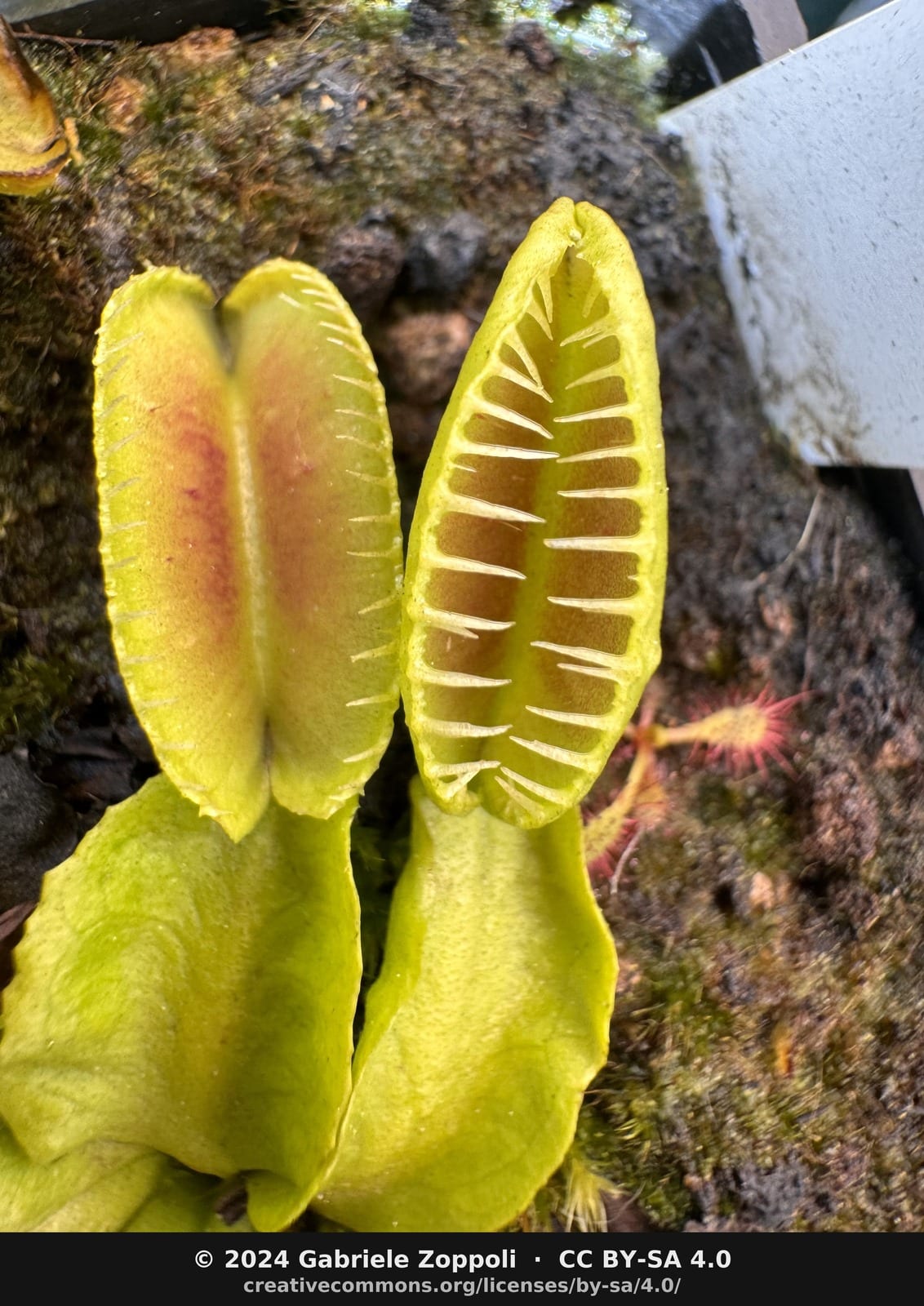
A mutant Venus flytrap whose traps are strongly arched and fused at the tip, so they never close fully. Its short teeth carry small wings. A French-registered cultivar named after the head of the creature in the film 'Alien'.
About
'Alien' is a Venus flytrap cultivar found by G. Bily in France in 2008 and registered with the International Carnivorous Plant Society (ICPS) in 2010. The parent species, Dionaea muscipula, is the single species of its genus and grows wild in wetlands of North and South Carolina, USA; many cultivars have been raised from it. According to the registration, mature traps are 4-5 cm long and all of them arch strongly, reminding the originator of the creature's head in Ridley Scott's 1979 film 'Alien'. The marginal teeth are a little shorter than usual and carry small wings along their length. Mature traps are fused at the tip and the basal lobes overlap. Because the lobes are thick and heavy the traps do not close well, and they often break if you try to close them by hand. There are many trigger hairs. Other mutant forms include 'Fused Tooth', with teeth joined together, and 'Jaws Smiley', with twisted traps, but the strongly arched trap is the mark of 'Alien'. It must be propagated vegetatively, by division or leaf pullings. In Japan it is sold under its cultivar name at online auctions; check photos for the arched traps when buying. Care is the same as for the species: sun, tray watering with pure water, no fertilizer and a cold winter dormancy.
Source: Wikipedia (CC BY-SA 4.0)
Size of the Venus Flytrap Alien
The Venus Flytrap Alien grows to Traps 4-5 cm long on mature plants.
Basic Info
Origin
Horticultural cultivar selected in France (species native to wetlands of North and South Carolina, USA)
Lifespan
Perennial (can be kept for many years by division)
Size
Traps 4-5 cm long on mature plants
Temperature
10〜30℃
Humidity
60〜90%
Watering & Fertilizer
No fertilizer (catches insects)
Growing Tips
Light & Placement
Full outdoor sun is best. A windowsill indoors is not bright enough; white LED lighting for about 14 hours a day works well.
Watering
Keep the pot standing in pure water at all times. Avoid tap water high in dissolved salts; use distilled, RO or rain water.
Soil & Repotting
Grows in pure sphagnum, sphagnum peat or a 1:1 peat-sand mix. Avoid perlite and other possibly salty materials. Divide and repot when the plant grows across the pot.
Fertilizer
Never add fertilizer to the soil. Feed insects or rehydrated dried bloodworms if growth slows. The traps of this cultivar do not close well, so do not force them shut.
Dormancy Care
Plants outdoors that experience freezing winters need dormancy. Blackened leaves in winter are normal; the plant underground is alive.
Propagation
Keep the cultivar true by division or leaf pullings; seedlings will not be 'Alien'.
Venus Flytrap Alien FAQ
QWhat is the growing difficulty level for Venus Flytrap Alien?
Intermediate. A variety suitable for intermediate growers. Requires some cultivation experience and knowledge of environment management. Pay careful attention to temperature and humidity control.
QHow large does Venus Flytrap Alien get?
The mature size of Venus Flytrap Alien is Traps 4-5 cm long on mature plants. This may vary slightly depending on cultivation environment and individual differences.
QHow should I water and fertilize Venus Flytrap Alien?
Venus Flytrap Alien: watering & fertilizer — No fertilizer (catches insects). Aim for appropriate frequency and amount.
QWhat is the typical price for Venus Flytrap Alien?
The price of Venus Flytrap Alien varies significantly by variety, characteristics, size, and lineage. Please check GrowerDirect's price guide for the latest market information.
Last updated: September 23, 2026
References & Sources
Edited & verified by: GrowerDirect Editorial Team
The classifications, regulations, and growing data on this page are created and verified based on the primary information database below.
Taxonomy & Authority
Accepted name: Dionaea muscipula 'Alien' Ellis
Originator: G. Bily
Authority databases: GBIF · GBIF Dionaea muscipula Ellis · ICPS 登録栽培品種 Dionaea 'Alien'(2010年登録)
Nomenclature follows global taxonomic authority databases.
Regulations & Conservation Status
The Venus flytrap (Dionaea muscipula) is listed in CITES Appendix II, and cultivars are treated as the species. International trade requires CITES permits, but buying and growing within Japan require no paperwork. The cultivar is not registered under Japan's Plant Variety Protection law.
Sources: Species+ (CITES) Dionaea muscipula / MAFF Plant Variety Protection database
Regulations may change. Always verify the latest information with the relevant authorities.
Related Species
Find listings for this species
Related Articles
Venus Flytrap Variety Guide | Popular Red, Giant, and Unusual Leaf Varieties
A detailed introduction to popular Venus flytrap varieties. From the all-red Akai Ryu to B52 with its giant traps, to unusual leaf varieties with deformed teeth, we explain the characteristics of each variety and differences in cultivation methods.
Venus Flytrap Annual Growing Cycle | Spring-Summer-Fall-Winter Management and Feeding Frequency Adjustment
From the Venus flytrap's spring growing season through summer peak vigor, autumn dormancy preparation, to winter low-temperature dormancy. Explains the annual growing cycle and seasonal management methods, and proper adjustment of feeding frequency.
Venus Flytrap Trigger Management | How to Protect Your Plant by Avoiding Unnecessary Stimulation
Venus flytrap trap leaves have a limited number of open-close cycles. This article provides practical guidance on management methods to prevent trap depletion from unnecessary stimulation, proper feeding techniques, and the causes and countermeasures for trap blackening.
Complete Guide to Growing Venus Flytraps | Post-Purchase Care and Tips for Thriving Growth
The Venus flytrap is a popular carnivorous plant that captures insects with its traps. This guide covers everything from required light, water, and soil to dormancy management, and explains why traps fail to close.
Can't find the plant you're looking for?
Post your wishes for free and growers with matching plants will contact you with introductions.