Venus Flytrap Variety Guide | Popular Red, Giant, and Unusual Leaf Varieties
A detailed introduction to popular Venus flytrap varieties. From the all-red Akai Ryu to B52 with its giant traps, to unusual leaf varieties with deformed teeth, we explain the characteristics of each variety and differences in cultivation methods.
Key Takeaways
A detailed introduction to popular Venus flytrap varieties. From the all-red Akai Ryu to B52 with its giant traps, to unusual leaf varieties with deformed teeth, we explain the characteristics of each variety and differences in cultivation methods.
Related Species
About Venus Flytrap — Before Learning About Variety Diversity
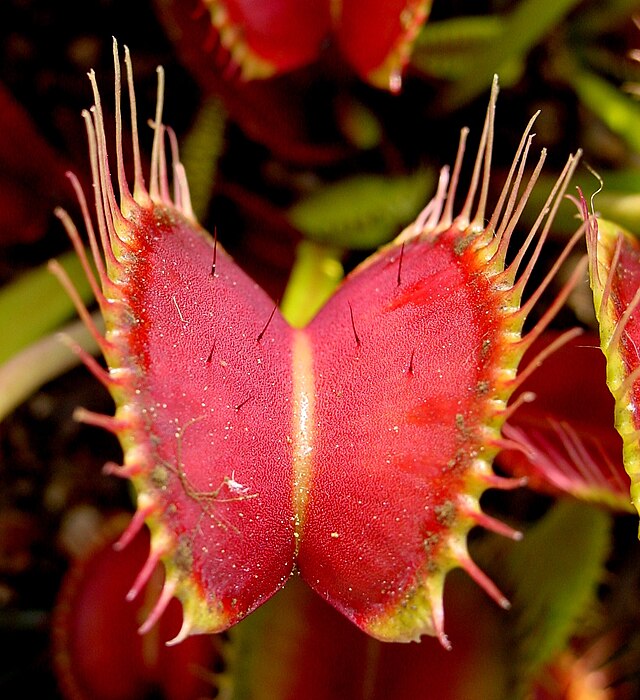
Venus flytrap (Dionaea muscipula) is a carnivorous plant native to the wetlands of North Carolina in North America, and is the only genus possessing its own unique trap mechanism. Although there is only one wild species, through years of selective cultivation and stabilization of mutations, breeders around the world have now registered hundreds of varieties or more. Red-colored traps, abnormally large leaves, traps that have transformed into strange shapes — each possesses its own distinct character and continues to captivate collectors.
When choosing a variety, it becomes easier to organize your thoughts by considering the axis of "ornamental purpose or cultivation difficulty." Generally, red varieties can be beautifully grown by anyone if sufficient light is provided, and giant varieties offer an easier way to enjoy the pleasure of feeding due to their larger trap openings. Unusual leaf varieties are rare, but some are sensitive to cultivation conditions. Accurately understanding the characteristics of each variety before bringing one home is the secret to enjoying them for the long term.
Red Varieties — Popular Group Where Vivid Colors Shine
Red varieties are types where the inside of the trap or the entire leaf turns red to deep purple, and they are popular from beginners to advanced cultivators. The expression of color requires strong light, low nitrogen, and a day-night temperature difference, and under appropriate conditions, the base becomes deep crimson.
'Royal Red' is one of the most popular red varieties. Under direct sunlight, the inside of the trap exhibits a vivid deep red color, and as light decreases, a greenish tint gradually increases. Maintaining strong light is key to good coloration. When grown outdoors in rain-exposed conditions or managed in a south-facing greenhouse, the coloration becomes distinctly superior to commercially available plants.
'Akai Ryu' (Red Dragon) is a popular variety widely distributed in Japan. A reddish tint spreads from the petiole to the edge of the trap, and the coloration around the trigger hairs is particularly beautiful. Growth is relatively vigorous, and when the plant fills a pot 10–12 cm in diameter, it develops an impressive appearance.
'SD Kronos' is a composite type where serrated long teeth develop at the edge of the trap and the interior becomes red. It is highly valued among breeders as a variety where both trap size and coloration can be enjoyed.
Giant Varieties and Large Trap Varieties — Types That Impress With Size
The opening of a typical Venus flytrap trap is about 1.5–2.5 cm, but large varieties can reach 3–5 cm. Larger traps can capture larger prey such as crickets or small cockroaches, making the pleasure of observing feeding dramatically greater.
'B52' is one of the most well-known giant varieties in the world. In mature plants, traps have been reported to exceed 4 cm, and it is said to originate from specimens selected and stabilized by Henning von Schmeling. If the cultivation environment is appropriate, growth proceeds smoothly, but because of its large size, care must be taken with oxygen supply to the roots and moisture management.
'Slack's Giant' is a variety named after Adrian Slack, a renowned carnivorous plant researcher from Britain. In addition to trap size, it features flat, wide petiolate leaves, forming a unique silhouette.
Many large strains with names like 'Jumbo' and 'Big Mouth' are also in circulation. Since variety names are not always standardized, it is safer to purchase from specialty nurseries and breeders with clear provenance.
Unusual Leaf and Deformed Varieties — Rare Types Where Trap Shape Has Changed
Some mutations of Venus flytrap change the very shape of the trap itself, and these are treated as special "unusual leaf varieties." They are rare and priced accordingly, but they have an irresistible appeal for collectors.
'Cudo' is a variety where the edge of the trap curves inward to form a cup-like shape. The normal bivalve-type trap has changed to a nearly spherical shape, and the trapping movement differs from that of typical varieties. While it is ornamentally valuable, trapping efficiency is somewhat reduced, so the management tip is to hand-feed dead prey rather than live insects.
The 'Dentate Traps' group consists of types where the teeth at the edge of the trap have changed from triangular to serrated or short-toothed forms, and multiple strains exist. The appearance is like delicate lace, and the form created when the teeth lock together upon closing is beautiful.
'Fused Tooth' is a mutation where adjacent teeth fuse together to form a spoon shape. The entire edge becomes smoothly wavy, giving it a completely different silhouette from typical varieties. Some individuals develop red coloration on the inside under adequate lighting, allowing you to enjoy both coloration and deformation.
Cultivation Tips by Variety
Although there are slight differences depending on the variety, the basic management common to all Venus flytraps is "strong light, low nutrients, moist conditions, and acidic." The standard substrate is either kamanuma soil alone or a 1:1 mix of peat moss and kamanuma soil, and fertilizer is generally not needed. Bottom watering (keeping 2–3 cm of water in a saucer at all times) is the most stable approach.
| Variety Group | Cultivation Tips |
|---|---|
| Red varieties | Direct sunlight is necessary for good coloration, so outdoor management or a greenhouse where adequate light can be secured is recommended. Coloration tends to be weaker near windows indoors, and using grow lights as supplementary lighting is also an option. |
| Giant varieties | They have vigorous root systems and are resistant to root rot, but because of their large trap size, keep the plant stationary during the 7–10 day digestion period after closure. Repeated stimulation will cause the plant to exhaust itself by continuously consuming traps. |
| Unusual leaf varieties | Growth is generally somewhat slow, and some are sensitive to environmental changes. Immediately after bringing home, the first hurdle is to keep it in the same location during the environmental transition period to stabilize it. |
Choosing Varieties and Benefits of Getting Plants from Growers
Most Venus flytraps sold at home centers and mass-market stores are seedlings without a variety name. To enjoy them as a collection, it is important to purchase specimens with clear variety names from specialty nurseries and growers.
When purchasing directly from a grower, check the following points.
- The condition of the parent plant and its growing environment
- The origin of the variety name and the reliability of its lineage
- The plant's condition at time of shipment (growth phase or dormant phase)
Growers specializing in carnivorous plants possess cultivation expertise for each variety, and can easily provide post-purchase support, which is also a major advantage.
The world of Venus flytrap varieties continues to expand, and new mutants are stabilized and released each year by breeders. A collection that begins with a single plant eventually grows into diverse specimens of red, giant, and deformed types — that is the profound appeal of this plant.