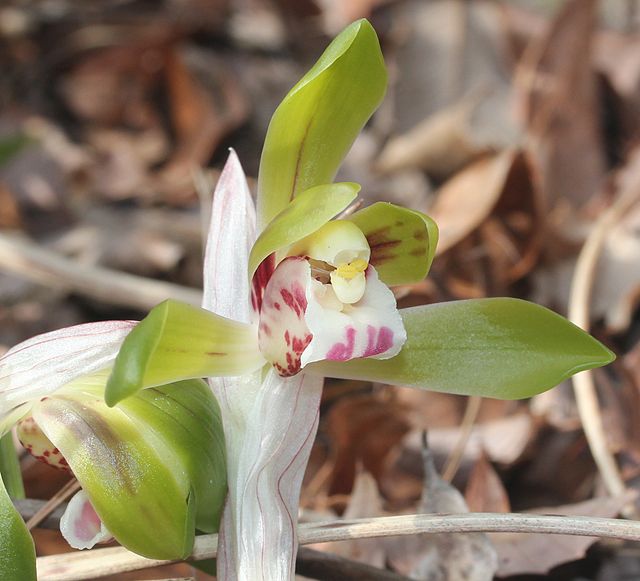
Source: Wikimedia Commons
Cymbidium Goeringii
BeginnerCymbidium goeringii
A wild Cymbidium species native to Japan, blooming with a single flower in early spring.
Overview
Cymbidium goeringii (shunran, spring orchid) is a terrestrial orchid native to deciduous forest floors in Japan, China, the Korean Peninsula, and parts of Southeast Asia. Plants grow 15–30 cm with narrow grass-like leaves in a dense tuft. In early spring (March–April), a single flowering stem bears one, rarely two, pale yellow-green flowers about 3–4 cm across with a subtle, refined fragrance. One of Japan's most familiar native orchids, it has been cultivated since ancient times with numerous named cultivars. Cold-hardy, tolerating outdoor winters in temperate Japan; bright dappled shade, humus-rich well-draining soil, and consistent moisture are recommended.
Lifespan of the Cymbidium Goeringii
The Cymbidium Goeringii lives 10+ years.
Size of the Cymbidium Goeringii
The Cymbidium Goeringii grows to 15-30cm.
Temperature & humidity for the Cymbidium Goeringii
The Cymbidium Goeringii tolerates temperatures of -5〜30℃.
Basic Info
Origin
Japan, China, Korean Peninsula, and Southeast Asia, deciduous forest floors
Lifespan
10+ years
Size
15-30cm
Temperature
-5〜30℃
Humidity
50〜70%
Growing Tips
Light & Placement
Outdoor growing in bright partial shade suits it. Its home is the deciduous forest floor, so avoid strong direct sun.
Watering
It dislikes drying out, so keep watering moderately. Water when the surface dries and never let it dry out completely.
Temperature & Overwintering
It is very cold hardy and can overwinter outdoors. It is a tough plant suited to Japan's mountain climate.
Soil & Repotting
Plant in humus-rich, well-drained soil such as a wildflower mix or akadama blend. Use a deep pot so the roots can extend.
Fertilizer
Feed with a small amount of slow-release fertilizer. Heavy feeding damages the roots, so keeping it modest is the rule.
Cymbidium Goeringii FAQ
QWhat is the growing difficulty level for Cymbidium Goeringii?
Beginner. A variety suitable for beginners. No special equipment or experience is required—you can grow it without problems by setting up a basic cultivation environment.
QWhat temperatures can Cymbidium Goeringii tolerate?
Cymbidium Goeringii tolerates temperatures of -5〜30℃. This is the tolerated range, not the ideal growing temperature. Keep conditions well inside it and avoid sudden temperature changes.
QWhat is the lifespan of Cymbidium Goeringii?
The average lifespan of Cymbidium Goeringii is 10+ years. With proper cultivation environment and nutrient management, you can keep it healthy for a long time.
QHow large does Cymbidium Goeringii get?
The mature size of Cymbidium Goeringii is 15-30cm. This may vary slightly depending on cultivation environment and individual differences.
QWhat is the typical price for Cymbidium Goeringii?
The price of Cymbidium Goeringii varies significantly by variety, characteristics, size, and lineage. Please check GrowerDirect's price guide for the latest market information.
Last updated: October 2, 2026
Growing Specifications
- Hardiness (RHS)
- H1c
References & Sources
Edited & verified by: GrowerDirect Editorial Team
The classifications, regulations, and growing data on this page are created and verified based on the primary information database below.
Taxonomy & Authority
Accepted name: Cymbidium goeringii (Rchb.f.) Rchb.f.
Synonyms: Cymbidium goeringii var. mackinnonii, Cymbidium pseudovirens, Cymbidium forrestii, Maxillaria goeringii, Cymbidium uniflorum, Cymbidium virens, Cymbidium mackinnonii, Cymbidium yunnanense
Authority databases: GBIF · POWO · RHS orchid hybrid registration (International Orchid Register) · AOS (American Orchid Society)
Nomenclature follows global taxonomic authority databases.
Regulations & Conservation Status
The family Orchidaceae is listed entirely in CITES Appendix II (except for the genera Paphiopedilum and Phragmipedium and certain species, which are in Appendix I). Cultivars and hybrids are subject to family-level regulation; however, artificially propagated specimens may benefit from simplified trading procedures under the Appendices.
Sources: CITES Appendices (Orchidaceae spp. = Appendix II) / CITES Appendix I Orchid Checklist (Kew/UNEP-WCMC 2019)
Regulations may change. Always verify the latest information with the relevant authorities.
Related Species
Find listings for this species
Related Articles
Complete Guide to Growing Cymbidiums | Tips for Blooming Gorgeous Flowers Every Year
Explains how to cultivate Cymbidiums suited to Japan's climate. This is a practical guide for enjoying gorgeous flower spikes every year, from fall outdoor care to flower bud formation through cold treatment and post-bloom care.
Cymbidium Outdoor Cultivation Guide | Enjoying Cold-Hardy Orchids in Your Garden
Explore outdoor cultivation methods for cymbidiums, which are relatively cold-hardy. This guide covers placement selection, summer shading and winter frost protection, autumn low-temperature management for flower bud formation, and division methods for large specimens.
Cymbidium Flower Bud Differentiation and Temperature | The Mechanism of Nighttime Low Temperature Inducing Flower Bud Formation and Winter Management Practices
Explaining the mechanism of nighttime low temperatures required for Cymbidium flower bud differentiation, and practical methods for autumn temperature management and winter care.
Airflow Management Guide for Bulbless Orchids | Understanding the Physiology of Non-Water-Storing Epiphytic Orchids and Their Differences from Dendrobium kingianum
This guide explains the physiology of bulbless epiphytic orchids and key points for airflow management, while comparing water management differences with pseudobulbed Dendrobium kingianum.
Can't find the plant you're looking for?
Post your wishes for free and growers with matching plants will contact you with introductions.