Source: Wikimedia Commons
Dendrobium Chrysotoxum
IntermediateDendrobium chrysotoxum
A Dendrobium with vivid golden flower clusters and sweet honey-like fragrance.
Overview
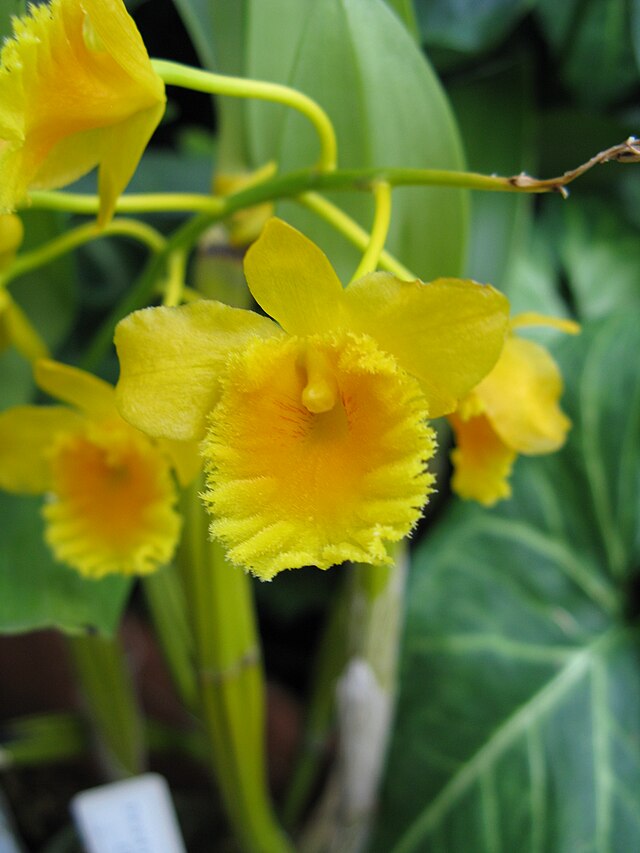
Dendrobium chrysotoxum is an epiphytic orchid native to montane forests at 300–1,500 m in northeastern India, Myanmar, Thailand, southern China, and Vietnam. Plants grow 20–40 cm with club-shaped pseudobulbs (swollen at the top) bearing leathery leaves. In spring (March–May), pendant inflorescences bear ten to twenty or more vivid golden-yellow flowers, 3–5 cm across, with a strongly fringed orange lip and a potent, sweet honey-like fragrance. A free-draining bark or pumice medium is standard.
Lifespan of the Dendrobium Chrysotoxum
The Dendrobium Chrysotoxum lives 10+ years.
Size of the Dendrobium Chrysotoxum
The Dendrobium Chrysotoxum grows to 20-40cm.
Temperature & humidity for the Dendrobium Chrysotoxum
The ideal temperature for the Dendrobium Chrysotoxum is 12〜30℃.
Cultivation requires a cool, dry winter dormancy (below 10°C with minimal watering) to initiate flowering, followed by strong light, ample water, and regular fertilization during the growing season.
Basic Info
Origin
northeastern India, Myanmar, Thailand, southern China, and Vietnam, at 300–1500 m elevation
Lifespan
10+ years
Size
20-40cm
Temperature
12〜30℃
Humidity
50〜70%
Growing Tips
Light & Placement
In the growing season (spring to autumn) it likes strong light and tolerates direct sun. Keep it bright to fatten the pseudobulbs.
Watering
Water generously in the growing season to fatten the pseudobulbs. In winter, withhold water and let it enter a dry rest.
Temperature & Overwintering
It grows at 12-30°C. In winter, withholding water and giving it cool conditions is the key to flower bud formation.
Soil & Repotting
Pot in bark and pumice for good drainage. Repot when the club-shaped pseudobulbs have multiplied and crowd the pot.
Fertilizer
Feed during the growing season to build up the pseudobulbs. Stop feeding during winter dormancy and let the plant rest.
Dormancy Care
It drops its leaves in winter and needs a cool, dry rest. Resume watering when new growth starts in spring.
Dendrobium Chrysotoxum FAQ
QWhat is the growing difficulty level for Dendrobium Chrysotoxum?
Intermediate. A variety suitable for intermediate growers. Requires some cultivation experience and knowledge of environment management. Pay careful attention to temperature and humidity control.
QWhat is the ideal temperature for Dendrobium Chrysotoxum?
The ideal temperature for Dendrobium Chrysotoxum is 12〜30℃. Avoid sudden temperature changes and maintain a stable environment.
QWhat is the lifespan of Dendrobium Chrysotoxum?
The average lifespan of Dendrobium Chrysotoxum is 10+ years. With proper cultivation environment and nutrient management, you can keep it healthy for a long time.
QHow large does Dendrobium Chrysotoxum get?
The mature size of Dendrobium Chrysotoxum is 20-40cm. This may vary slightly depending on cultivation environment and individual differences.
QWhat is the typical price for Dendrobium Chrysotoxum?
The price of Dendrobium Chrysotoxum varies significantly by variety, characteristics, size, and lineage. Please check GrowerDirect's price guide for the latest market information.
Last updated: August 31, 2026
References & Sources
Edited & verified by: GrowerDirect Editorial Team
The classifications, regulations, and growing data on this page are created and verified based on the primary information database below.
Taxonomy & Authority
Accepted name: Dendrobium chrysotoxum Lindl.
Synonyms: Dendrobium calothyrsos, Callista chrysotoxa, Callista suavissima, Dendrobium chrysotoxum var. suavissimum, Dendrobium suavissimum
Authority databases: GBIF · POWO · RHS orchid hybrid registration (International Orchid Register) · AOS (American Orchid Society)
Nomenclature follows global taxonomic authority databases.
Regulations & Conservation Status
The family Orchidaceae is listed entirely in CITES Appendix II (except for the genera Paphiopedilum and Phragmipedium and certain species, which are in Appendix I). Cultivars and hybrids are subject to family-level regulation; however, artificially propagated specimens may benefit from simplified trading procedures under the Appendices.
Sources: CITES Appendices (Orchidaceae spp. = Appendix II) / CITES Appendix I Orchid Checklist (Kew/UNEP-WCMC 2019)
Regulations may change. Always verify the latest information with the relevant authorities.
Related Species
Find listings for this species
Related Articles
Complete Guide to Growing Dendrobium | Autumn Management for Flowering and Year-Round Care
Explains autumn cold treatment, watering restrictions, fertilizer timing, and repotting cycles for year-round dendrobium blooms. Introduces management differences for both Nobile and Phalaenopsis types.
How to Grow Dendrobium nobile Orchids | Flower Bud Initiation Through Cold Treatment
Detailed guide to Dendrobium nobile characteristics, year-round care schedule, flower bud initiation through cold treatment, and management of unwanted shoots.
How to Grow Sekkoku (Chōsei Orchid) — Basics for Enjoying Japan's Traditional Oriental Orchids
A practical guide to the characteristics of Sekkoku (Dendrobium moniliforme, Chōsei Orchid), planting options using sphagnum moss, tree fern, and rock mounting, seasonal placement, watering and fertilizing, flowering tips, propagation methods including division and keiki (plantlets), and pest and disease management.
Denphale Care Guide: Tips for Enjoying Long-Lasting Cluster Flowers with Year-Round Warm Management
This guide explains the characteristics of Denphale, a warm-climate hybrid of Dendrobium, how it differs from Nobile types, temperature and watering management, and how to propagate using high growths.
Can't find the plant you're looking for?
Post your wishes for free and growers with matching plants will contact you with introductions.