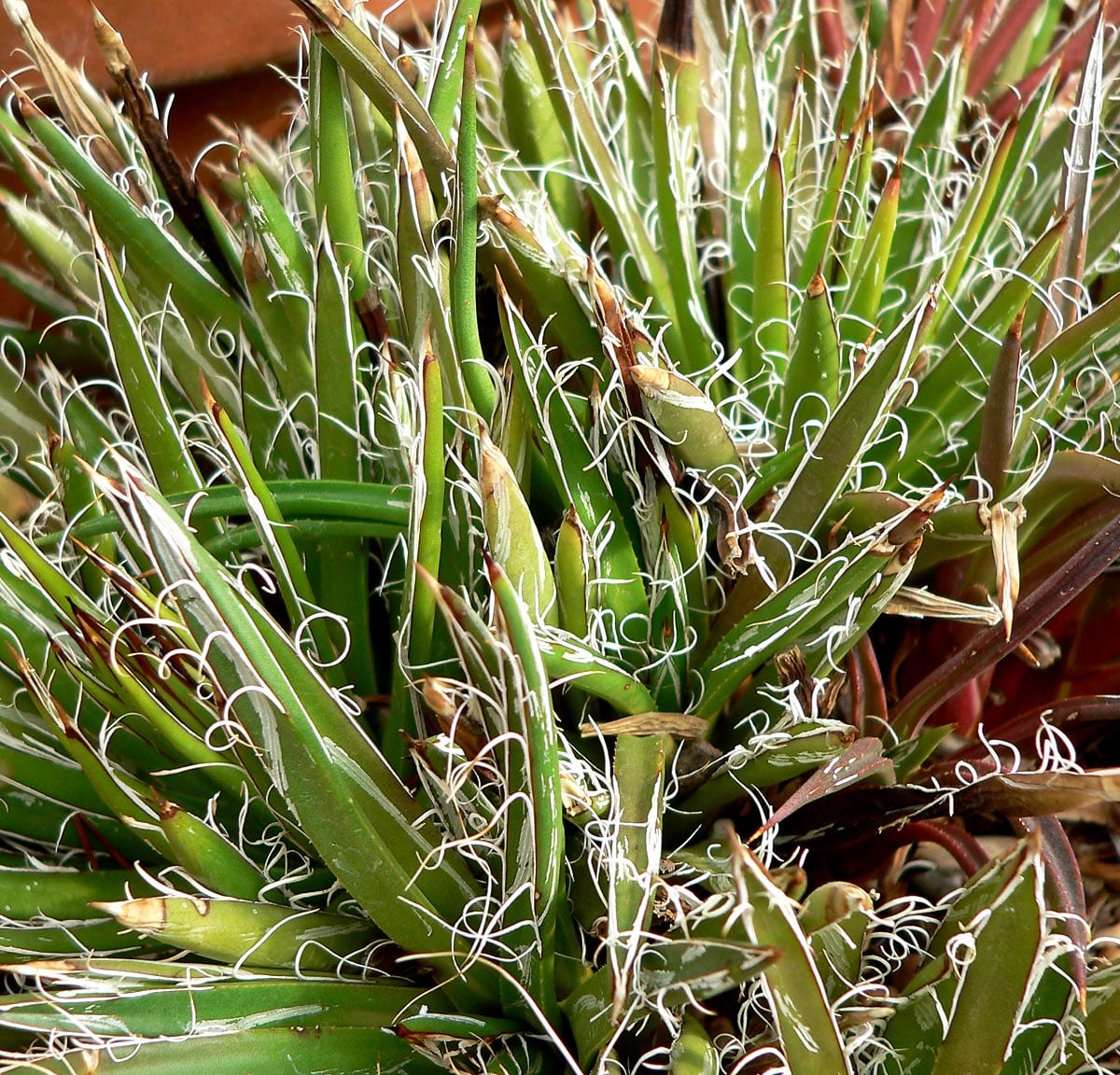
 © Stan Shebs / CC BY-SA 3.0
小花龍舌蘭(姫凌亂雪)
Agave parviflora, sometimes called Santa Cruz striped agave, is a compact species whose rosette tops out at around 25 cm tall and 20 cm wide. Its narrow, deep green leaves are etched with fine white lines, and curling white fibers that peel away from the leaf margins give the whole plant a softly frosted, thread-wrapped look. Like other agaves, it is a perennial that flowers only once — the flowering rosette dies back afterward, but offsets forming around its base carry the plant forward. This is considered an intermediate-level plant to grow, appreciated for its compact size and finely detailed rosette form.
View 小花龍舌蘭(姫凌亂雪) encyclopedia →成交手續費 0%!2026年9月30日前註冊,前 2 株免佣金!
生產者 招募中!
在 GrowerDirect 上架,直接銷售給全國的客戶吧!
GrowerDirect承諾的 6 項透明性重點
龍舌蘭出品中生產者將明示以下資訊。確保品種、產地、所需光量、栽培難度的透明度。
- 品種明示
- 實物照片
- 色澤
- 產地明示
- 所需光量
- 難度明示
查看全部141個品種
已註冊的生產者(搶先看)
小花龍舌蘭(姫凌亂雪)的基本資料
- 栽培難度
- 適合中級者
- 壽命
- 多年生植物。開花的蓮座形葉叢會枯萎,由子株更新。
- 體型
- 蓮座形葉叢高約25厘米、寬約20厘米。
- 澆水
- 不需要過度施肥(生長期間少量緩效肥料即可)。
- 光照與擺放位置
- 放在光線充足、通風良好的地方。光線不足會導致葉片徒長,白色圖案也會變得不明顯。
- 澆水
- 根部長期潮溼容易爛根。待土壤充分乾燥後再澆水。
- 溫度與越冬
- 耐寒溫度的具體資料較少。由於植株較小,冬季應避免凍結和過度潮溼,在明亮處乾燥管理。
- 介質與換盆
- 使用排水良好的介質。由於體型小,應使用較小的盆栽管理。
- 注意事項
- 《華盛頓公約》(CITES)附錄I・物種保護法國際稀有物種。轉讓原則上需要登記證,國內繁殖的植株亦需登記。購買時必須確認是否有登記證。
關於小花龍舌蘭(姫凌亂雪)
Agave parviflora (Santa Cruz striped agave) is a compact agave reaching about 25 cm tall and 20 cm wide, with narrow striped leaves and curling white marginal fibers. An intermediate-level species for growers.
開始照料小花龍舌蘭(姫凌亂雪)前需要了解的7件事
1Placement & Sunlight
This agave thrives in full sun with good air circulation. Without enough light, the leaves stretch out and the rosette loses its tight form, which also makes the white leaf markings and curling marginal fibers less defined. Keep it outdoors in a bright spot, or as close to a sunny window as possible if grown indoors.
2Watering Rhythm
Water thoroughly once the soil has dried out, then wait until it dries again before the next watering. Avoid letting water pool in the center of the rosette, since standing moisture between the leaves can lead to rot — direct water toward the base of the plant instead.
3Well-Draining Soil
Use a fast-draining mineral mix with a generous portion of akadama or pumice to prevent root rot. Soil that's too rich in organic matter stays wet longer, which is hard on this plant's relatively small root system.
4Repotting Timing
Repot in spring, during the growing season, once roots have filled the pot. Because this is a compact variety, avoid jumping to an oversized pot — excess soil volume stays damp longer and raises the risk of root rot.
5Humid-Season Care
During the rainy season and peak summer humidity, move the plant somewhere sheltered from direct rain with good airflow to prevent rot-related damage. It also helps to water less frequently during these humid stretches, since moisture tends to linger between the leaves and at the base.
6Winter Protection
This agave tolerates cool temperatures reasonably well but is sensitive to frost and freezing. Move it to a bright indoor spot or a covered area as temperatures drop, and cut back watering significantly during dormancy to keep the plant on the dry side.
7Check for the Registration Certificate First
Agave parviflora is listed in CITES Appendix I and designated an Internationally Endangered Species of Wild Fauna and Flora under Japan's Act on Conservation of Endangered Species. Transferring a plant within Japan generally requires a registration certificate under that act, and this applies to plants propagated in Japan as well. Whenever you buy or transfer one, always confirm that a registration certificate comes with the plant. Beyond that, look for deep green leaves, a tightly formed rosette, and intact white fibers along the leaf margins. Keep in mind that a rosette showing an emerging flower stalk is nearing the end of its life, since it dies after blooming.
小花龍舌蘭(姫凌亂雪)的常見問題
- Q.Is Agave parviflora difficult to grow?
- A.It's generally considered an intermediate-level plant. Avoiding excess moisture and insufficient light, along with fast-draining soil and measured watering, makes it manageable for most growers. If you're new to agaves, it can help to start with a hardier species before taking this one on.
- Q.How large does this agave get?
- A.The rosette typically reaches around 25 cm tall and 20 cm wide, making it one of the smaller agave species. Its compact size makes it well suited to long-term container growing.
- Q.Should I trim off the curling white fibers on the leaf edges?
- A.There's no need to remove them. These white fibers unraveling from the leaf margins are one of the plant's defining features, giving the whole rosette its frosted appearance — it's worth simply enjoying how they develop and fray naturally over time.
- Q.What happens to the rosette after it flowers?
- A.The rosette that flowers will die back afterward. However, since this is a perennial species, offsets that form around the base carry the plant forward as new rosettes.
- Q.Can it be grown indoors?
- A.Yes, as long as it's placed in a bright, well-ventilated spot such as a sunny windowsill. That said, insufficient light can cause the rosette to stretch out, so an outdoor spot or bright balcony is preferable whenever possible to maximize sun exposure.
小花龍舌蘭(姫凌亂雪)栽培的實用工具
在圖鑑中詳細了解小花龍舌蘭(姫凌亂雪)
查看小花龍舌蘭(姫凌亂雪)的圖鑑條目 →
收錄栽培難度、尺寸、原產地、日照等基礎資料。