Aquarium Water Quality Adjustment and CO2 Fertilization | How Hardness, pH, and CO2 Affect Aquatic Plant Color and Growth Rate
Explains the interactions between water hardness (GH and KH), pH, and CO2 addition in aquatic plant aquariums, and the specific effects these parameters have on aquatic plant coloration and growth rate.
Key Takeaways
Explains the interactions between water hardness (GH and KH), pH, and CO2 addition in aquatic plant aquariums, and the specific effects these parameters have on aquatic plant coloration and growth rate.
Related Species
Understanding the "Chemistry" of Water for Aquatic Plants
Aquatic plants are often discussed in terms of three essential elements: light, fertilizer, and CO2. However, in practice, water quality parameters such as hardness (GH and KH) and pH also play a significant role in aquatic plant coloration and growth rate. These factors are closely intertwined with CO2 solubility, and changing one element will have cascading effects on the others. By understanding the basics of water chemistry, you can more easily achieve vibrant, healthy aquatic plant growth while suppressing algae growth.
The Relationship Between Hardness (GH and KH) and Aquatic Plants
GH (General Hardness) indicates the total amount of calcium (Ca²⁺) and magnesium (Mg²⁺), while KH (Carbonate Hardness) indicates the amount of bicarbonate ions (HCO₃⁻).
For aquatic plants, hardness plays important roles in the following ways:
- Function as a nutrient: Calcium is essential as a structural component of cell walls, and magnesium is essential as the central element in chlorophyll. In environments where GH is extremely low (too soft), deficiency symptoms such as wavy leaf margins or whitening of leaf veins may occur.
- Connection with CO2: KH functions as a buffer that determines pH through chemical equilibrium with CO2. The higher the KH, the higher the pH, and the lower the CO2 solubility relatively. Conversely, when large amounts of CO2 are added, pH drops (described below).
The guideline hardness at which most aquatic plants grow best is GH 4–8°dH (70–140 mg/L) and KH around 3–6°dH. Softwater-loving aquatic plants such as Rotala, Glossostigma, and New Large Pearl Grass prefer low GH (2–4°dH), while Vallisneria and Aponogeton species tend to prefer slightly harder water.
The Effect of pH on Aquatic Plant Growth
pH is a measure of hydrogen ion concentration and directly relates to the photosynthetic efficiency of aquatic plants.
Optimal pH range for aquatic plants: Most common aquatic plants prefer pH 6.5–7.2, which is weakly acidic to neutral. In this range, the balance of inorganic carbon (CO2 and HCO₃⁻) is maintained in a form that aquatic plants can readily utilize.
What happens when pH is high (7.5 or above): As pH rises, most CO2 converts to bicarbonate ions (HCO₃⁻). Aquatic plants basically absorb dissolved CO2 (CO₂aq) more readily than HCO₃⁻, so even with the same KH and CO2 levels, the higher the pH, the less carbon is effectively available for the plants to use. Symptoms such as slowed growth, leaf reduction, and faded color tend to appear.
Risks of low pH (below 6.0): Weakly acidic conditions offer many advantages for aquatic plants, but when pH drops significantly below 6.0, bacterial activity in the water decreases and organic matter decomposition stalls. It also becomes excessive stress for shrimp and fish. Nutrient-rich substrate soil has the effect of shifting pH toward acidity, so it is important to prevent rapid pH drops through regular water changes.
Why CO2 Addition Changes Aquatic Plant Coloration and Growth Rate
CO2 (carbon dioxide) is the carbon source for photosynthesis and a critically important variable directly affecting aquatic plant growth.
Effect on growth rate: When CO2 is added appropriately (target dissolved CO2 concentration of 15–30 mg/L), the photosynthetic rate of aquatic plants increases significantly, and growth rate can accelerate 2–5 times. The effect is particularly pronounced in fast-growing species such as Rotala, Hair Grass, and New Large Pearl Grass.
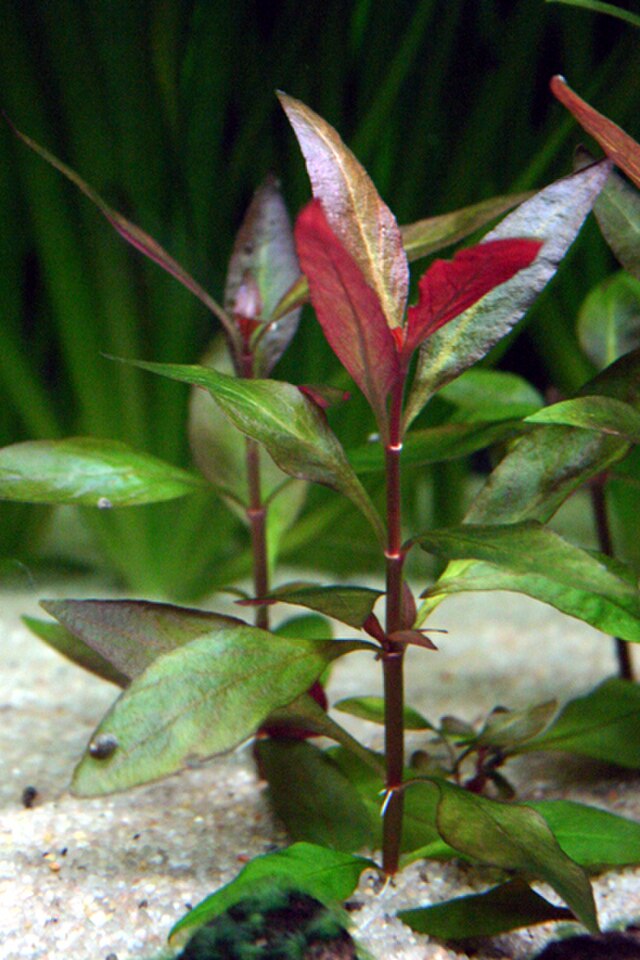
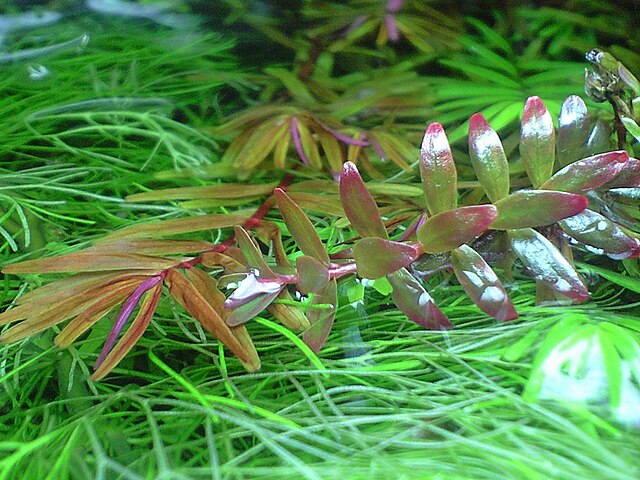
Effect on coloration: The red color in red-leaved aquatic plants (Rotala indica, Alternanthera reineckii, etc.) is produced by increased synthesis of anthocyanin (red pigment) as photosynthetic rate increases. If CO2 addition is insufficient, the red color will not develop well even with adequate light, remaining yellowish-green to pale green. Green aquatic plants also tend to develop a glossy deep green and achieve a tighter, more beautiful overall appearance.
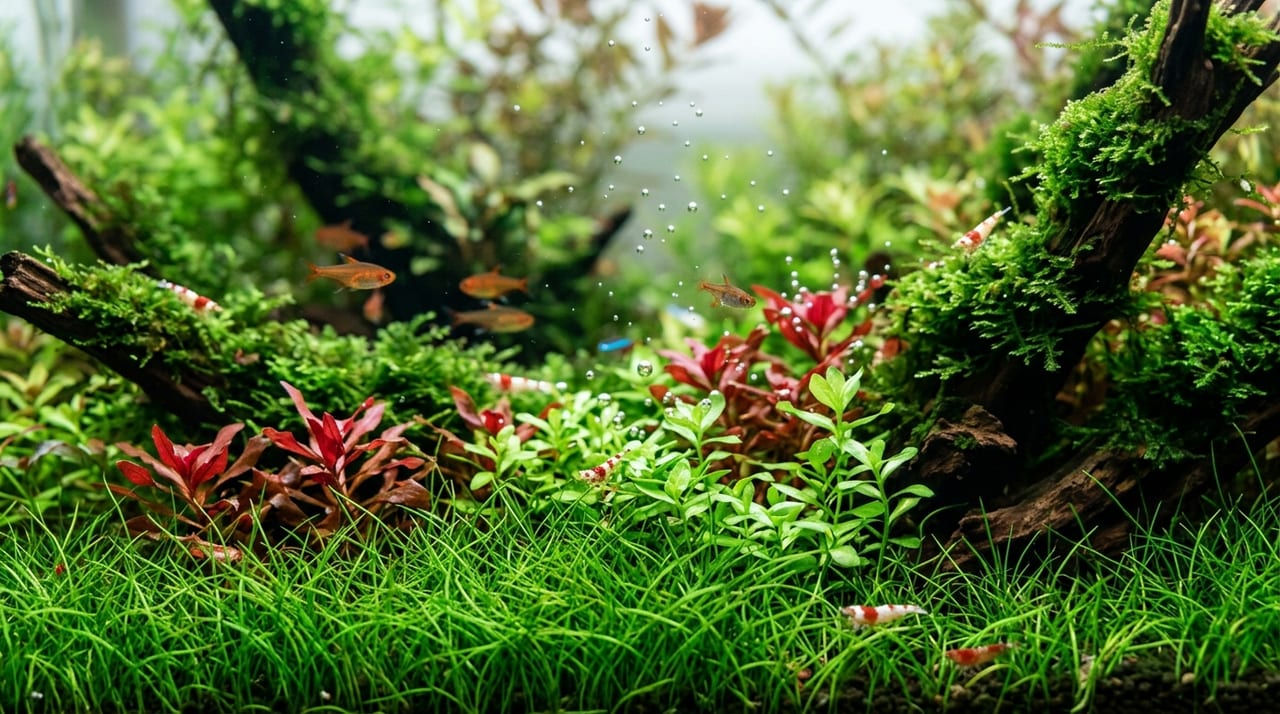
Pearling phenomenon: In environments abundant with CO2 where photosynthesis is vigorous, oxygen bubbles emerge from leaves in a phenomenon called "pearling." This is a visible signal of photosynthetic activity and also a sign that tank management is in good condition.
Practical Adjustment of Water Quality and CO2 Balance
Since these three elements (hardness, pH, and CO2) are interconnected, it is helpful to adjust them comprehensively following these steps:
- First, assess current water quality: Measure GH, KH, and pH using either reagent test kits or electronic devices. Japanese tap water varies by region from soft water (GH 1–4) to moderately hard water (GH 5–10), so checking your local tap water values once will make future adjustments easier.
- Adjust pH with substrate and substrate soil: Nutrient-rich substrate soil (such as ADA Aqua Soil Amazonia) stabilizes pH at 6–6.8. In hard water areas, it is also effective to lower hardness using reverse osmosis (RO) water before use.
- Increase CO2 addition gradually: When adding CO2, start with a low amount and increase it gradually while monitoring the appearance of livestock. A guideline is an amount that lowers pH by 0.5–1.0 (for KH 4°dH, approximately pH 7.0 → 6.5). Using a drop checker or pH monitor makes quantitative management easier.
- Maintain stability through water changes: A weekly water change of about one-third is the most reliable way to stabilize the balance of hardness, pH, and CO2.
Summary
In aquatic plant tank water quality management, it is important to view hardness, pH, and CO2 as three integrated elements. GH functions as a nutrient source for calcium and magnesium, KH functions as a pH buffer, and CO2 as a carbon source for photosynthesis, directly affecting growth rate and coloration. By understanding and adjusting the balance of these three elements, you can achieve an ideal tank environment where aquatic plants display their true beautiful colors and vigorous growth while suppressing algae. Start by measuring your home water quality and make adjustments one step at a time at a comfortable pace.