Tips for Beautiful Autumn Foliage on Deciduous Bonsai | Autumn Care for Japanese Maple
How to care for deciduous tree bonsai like Japanese maple to bring out vibrant autumn colors. This article covers using temperature differences, preventing leaf burn in summer, adjusting fertilizer, watering adjustments, and tips for achieving uniform leaf size.
Key Takeaways
How to care for deciduous tree bonsai like Japanese maple to bring out vibrant autumn colors. This article covers using temperature differences, preventing leaf burn in summer, adjusting fertilizer, watering adjustments, and tips for achieving uniform leaf size.
Related Species
The Essential Preparation Before Autumn: What Determines Beautiful Autumn Color
The moment when Japanese maple and maple bonsai turn vivid colors is one of the most eagerly anticipated moments of the year for bonsai enthusiasts. Yet there are many who say, "Even though I use the same management every year, somehow the colors never come out crisp." Beautiful autumn foliage is not determined by autumn management alone—it is crucial to begin preparing from the end of summer.
Between late August and early September, the first thing to check is the condition of the leaves. If there is significant damage from leaf burn or pests and disease, cut off the damaged leaves and tidy the tree. "Defoliation," in which all the leaves are removed, is an early-summer task; if done after late August, the new leaves will not have time to mature before autumn. In any case, defoliation on weakened trees is forbidden. Evaluate the health of the tree before deciding whether to proceed.
When it comes to fertilization, it is a rule to switch to fertilizer low in nitrogen from September onward. Excessive nitrogen will keep leaves green and cause them to drop prematurely. By applying "autumn fertilizer" rich in phosphorus and potassium, cell walls are strengthened and pigment production is promoted.
The Mechanism of Autumn Color and Temperature Management
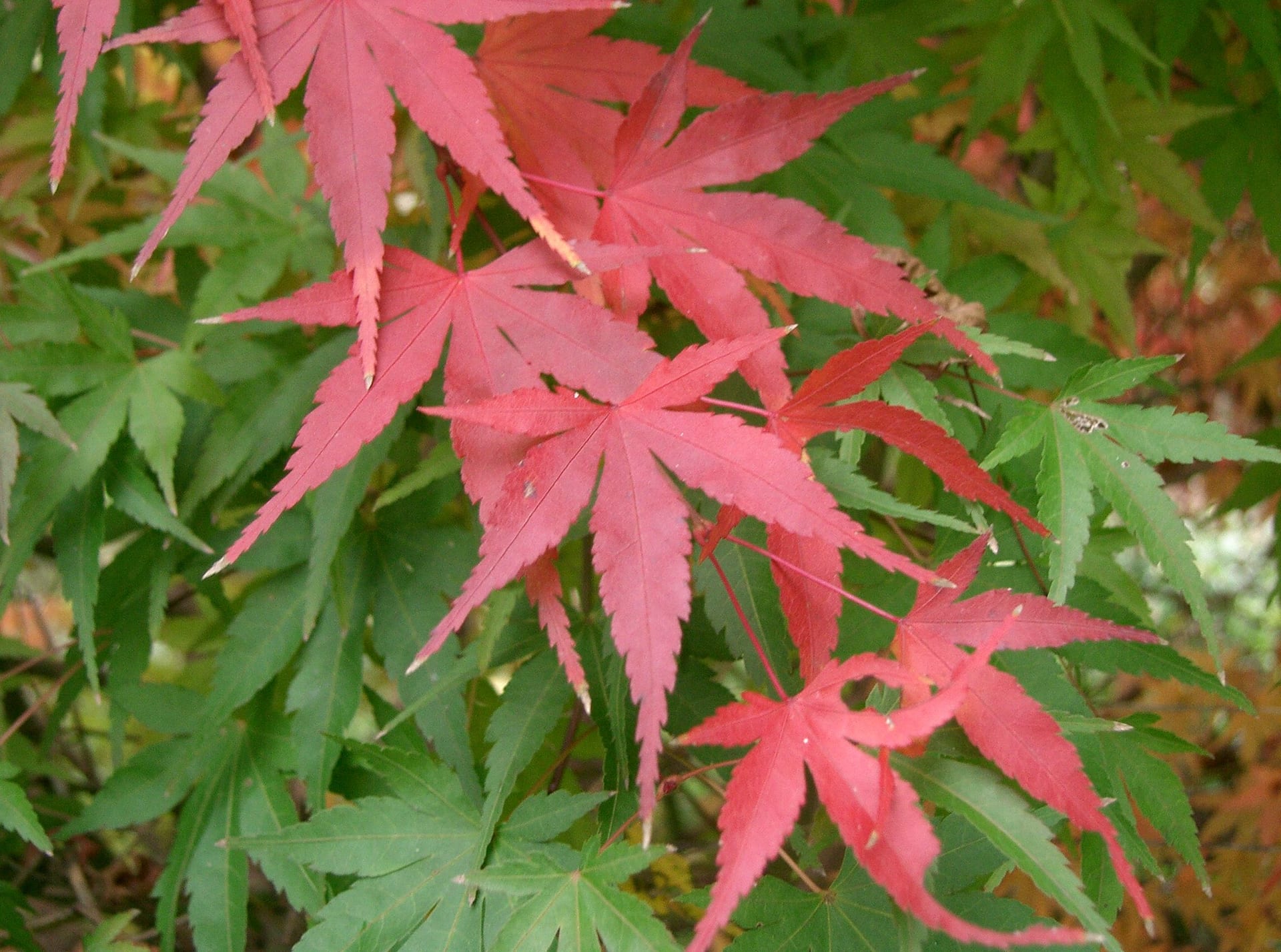
Why do leaves turn red in the first place? When temperatures drop in autumn, an "abscission layer" forms between the leaf and the branch, gradually cutting off the supply of nutrients and water to the leaf. Sugar remaining in the leaf is transformed into anthocyanin (red pigment) when exposed to ultraviolet rays, producing that vibrant red color.
Beautiful autumn foliage requires a significant "day-to-night temperature difference." Conditions with daytime temperatures around 20°C and nighttime temperatures below 10°C activate pigment production most effectively. In urban areas, nighttime temperatures often do not drop enough, causing autumn color to arrive later and appear duller than in natural settings.
An effective way to compensate for this is "strategically choosing the placement." During the day, place the tree in a sunny south-facing location to promote photosynthesis; at night, move it to a spot shaded by buildings or away from heat-absorbing concrete, thereby lowering the nighttime temperature slightly. Additionally, watering at night to cool through evaporation is also helpful as a supplementary method.
Watering and Soil Management
Autumn watering should follow the principle of "slightly less water." Excessive moisture dilutes the sugar concentration within cells, inhibiting pigment production. A good rule of thumb is to wait one to two hours after the soil surface dries before watering again.
However, be careful not to underwater. Japanese maple in particular will begin to die back from the leaf tips if underwatered, causing leaves to fall before autumn color appears. Make it a habit to check the soil dryness daily and judge by the weight of the pot for easier management.
The soil mixture should be free-draining—a mix like seven parts akadama, two parts leaf mold, and one part river sand is a good baseline. Poor drainage damages roots and leads to reduced tree vigor. Refreshing the soil through repotting every two to three years is the foundation for maintaining a healthy tree and enjoying beautiful autumn foliage year after year.
Characteristics of Autumn Color by Japanese Maple and Maple Variety
Even within the category of "Japanese maple and maple," autumn color and timing vary significantly by variety. Understanding these characteristics and managing accordingly leads to deeper appreciation.
- Yamamomiji (Mountain Japanese maple): Japan's representative autumn-coloring tree. Color variation from red through orange to yellow is large depending on the individual, and seedlings collected from natural mountain settings display especially rich color changes. Hardy to cold and easy for bonsai beginners to handle.
- Irohamomiji (Iroha maple): Features compact, beautiful leaves and is ideal for miniature bonsai. Many varieties turn a vivid red, and are popular with bonsai enthusiasts in urban areas. With sufficient sunlight and temperature difference, color is relatively stable.
- Hauchiwakaede (Fan maple): Large, rounded leaves; many varieties turn yellow to orange. The distinctive leaf shape has high ornamental value as bonsai, and is recommended for those wishing to enjoy yellow-toned autumn colors.
- Nomuramomiji (Nomura Japanese maple): A distinctive variety with red leaves from spring, turning deep crimson by autumn. Works well as a foil in displays when combined with other trees.
Pest and Disease Management During Autumn Color and Care After Leaf Drop
Once autumn color begins, complacency is not permitted. Aphids and scale insects continue to be active in autumn, so inspect the undersides of leaves and branch junctions regularly. When found, remove them physically with a cotton swab or toothbrush, or treat promptly with appropriate pesticide.
Additionally, powdery mildew and anthracnose on leaves can cause premature leaf drop before autumn color develops. Ensuring good air circulation and positioning the tree where leaves do not remain wet for long periods after rain is the foundation of prevention.
After leaf drop is an excellent opportunity to check the tree form and prune. Without leaves, any crowding or irregularities in the branch structure become immediately apparent. Remove unnecessary long shoots and crossing branches, and work toward shaping the tree for spring growth. After pruning, apply wound sealer to the cut surface to prevent pathogen entry.
For winter dormancy, both Japanese maple and maple have relatively good cold tolerance, but small-potted and ultra-miniature bonsai are prone to frozen roots; placing them in a polystyrene box or under a frost-protected shelf is recommended. Protecting the roots from freezing is the first step toward beautiful autumn foliage next year.
Summary: Beautiful Autumn Foliage Is Built on a Year of Care
The beauty of autumn foliage on deciduous bonsai arises not from short-term effort in autumn alone, but from the accumulation of effort across the entire year—spring growth, summer management, and autumn preparation.
The four most important points are:
- From September onward, reduce nitrogen and shift fertilization to phosphorus and potassium emphasis
- Choose placement that maximizes day-to-night temperature difference
- Keep watering slightly restrained to raise sugar concentration within cells
- Never neglect regular repotting and pest and disease management to maintain healthy tree vigor
The appeal of bonsai lies in the overlap of human care and the forces of nature. By spending time with your tree each day, enjoy even more vibrant autumn colors this year.