Rose Cutting Selection and Rooting Enhancement | Adjustment Techniques to Raise Success Rates Through Better Use of Rooting Hormone
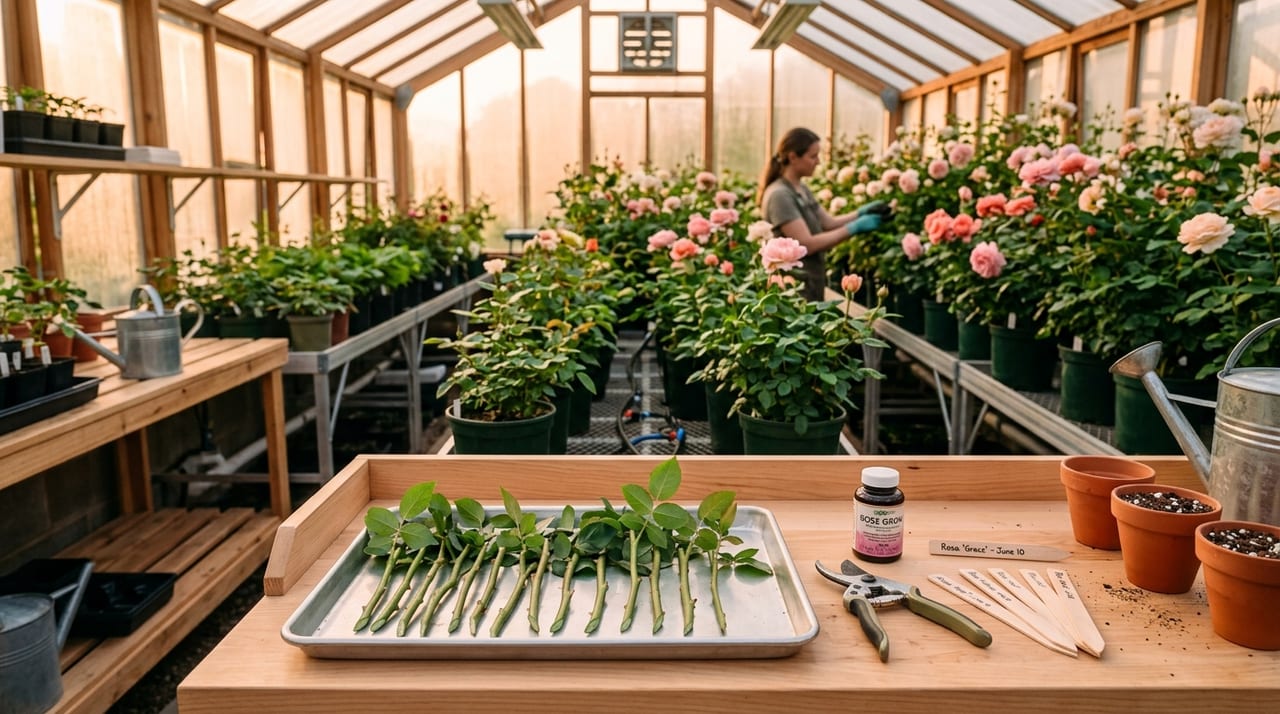
With rose cuttings, you can improve the success rate through careful cutting selection and strategic use of rooting promoters. This guide explains selection criteria, pre-treatment approaches, hormone agent selection, and staged root formation management.
Key Takeaways
With rose cuttings, you can improve the success rate through careful cutting selection and strategic use of rooting promoters. This guide explains selection criteria, pre-treatment approaches, hormone agent selection, and staged root formation management.
Propagating roses from cuttings appeals to many growers because it preserves the unique characteristics of a beloved variety in new plants. For discontinued cultivars or rare varieties grown only by specific local growers, cuttings become an important means of preservation. Note that for varieties registered under Japan's Plant Variety Protection and Seed Act (種苗法), you may propagate them to enjoy in your own garden, but you may not give the resulting plants to others (even free of charge) or sell them without the permission of the breeder's rights holder. Yet when attempting it, you may find the actual success rate falls short of expectations. By refining your cutting selection and rooting promoter technique, you can significantly improve outcomes. This article explains practical, scientifically grounded methods to achieve this.
Scientific Criteria for Rose Cutting Selection
The first key to successful rose propagation lies in selecting suitable cutting material. Vague judgments like "a healthy-looking branch" fall short. Ideal cuttings possess several specific physiological characteristics.
- Semi-hardened stem tissue: The ideal state lies between soft, green "greenwood cuttings" and fully hardened, brown "hardwood cuttings"—the intermediate stage. The benchmark: when bent, the stem should not snap sharply but should offer noticeable resistance. At this stage, the stem has accumulated adequate levels of plant hormones like auxin necessary for rooting. Fully hardened stems have depleted auxin concentrations, making rooting difficult. Conversely, fully soft new shoots have high auxin but fragile tissue that cannot withstand environmental stress and rots easily.
- New shoots following flowering: After a rose blooms, you will notice new lateral branches emerging below the spent flower. This new growth is at the transition from reproductive to vegetative growth, when cell division activity is highest. The same stem yields different rooting rates depending on whether cuttings are taken during this window or at other times.
- Internode length: The ideal length is 10–12 cm, containing 3–5 nodes counted from the top. Cuttings that are too short lack sufficient nutrients; those too long consume excess energy before rooting is complete.
- Diameter: Roughly pencil thickness is a good guide.
Pre-treatment of Cuttings and Selecting the Right Hormone Agent
After collection, cuttings should not be immediately soaked in rooting promoter. Proper pre-treatment first is essential.
- Cutting: Make a sharp angled cut (approximately 45 degrees) 3–4 cm from the base to maximize the exposed surface area.
- Sterilization: Disinfect the knife with alcohol before each cut to prevent bacterial infection.
- Timing of treatment: Fresh cuts are critical; soaking in rooting promoter within 30 minutes of collection is ideal. Over time, the cut oxidizes and water absorption decreases.
- Leaf removal: Remove all lower leaves, retaining only the upper 1–2 leaves. This minimizes water loss through transpiration while rooting occurs.
- Leaf trimming: The retained leaves can also be trimmed to half their size to further reduce transpiration.
Hormone agent selection significantly influences success rates. Three main types are commercially available.
| Type | Characteristics | Advantages |
|---|---|---|
| IBA (indole-3-butyric acid) liquid | Easy concentration adjustment. For the registered product Oxyberon liquid (IBA 0.4%), the base of the cutting is soaked for flowering plants including roses either in a 2× dilution for 5–10 seconds or in a 200–400× dilution for 12–24 hours | If you follow the label's dilution and soaking time, even a short treatment can be used |
| Hormone powder | Powder coating the cut provides sustained hormone action over time. The key is applying a thin layer—excess powder inhibits rooting | Portable, suited to outdoor work |
| Rooting aids marketed as natural-origin | Not registered as plant growth regulators (agricultural chemicals), and their rooting-promoting effect has not been confirmed for each product | If you use one, follow the product's label |
Rooting Environment and Staged Root Formation Management
After inserting cuttings into the growing medium, the first two weeks are critical. Key management parameters during this phase are:
| Parameter | Target | Notes |
|---|---|---|
| Relative humidity | 85–95% | Achieve through misting 2–3 times daily or using a small humidifier. Above 95%, fungal growth becomes likely; maintain adequate ventilation |
| Temperature | 20–25°C | Higher temperatures promote rot before rooting; lower temperatures slow hormone action. Above 25°C, microbial activity surges, sharply raising rot risk |
| Growing medium | Equal parts small-grain pumice and vermiculite | Excellent balance of water retention and drainage, ideal for rose cuttings. Sterilize (heat-treat) beforehand to reduce pathogenic risk |
From week three onward, gradually lower humidity while stepwise increasing oxygen supply to the root system until new leaves emerge from the new roots. Reduce misting frequency by one session per week, progressively lowering relative humidity from 95% to 70% over weeks three through five. Proper management of this transition significantly improves success rates.