Tosaminzuki Bonsai Training Guide | Spring Flowers and Tree Form
Tosaminzuki is a bonsai material with yellow spring flowers and four-season character. Pruning and winter cold exposure are keys to flowering.
Key Takeaways
Tosaminzuki is a bonsai material with yellow spring flowers and four-season character. Pruning and winter cold exposure are keys to flowering.
Tosaminzuki | Charm as a Bonsai Material
Tosaminzuki is a deciduous shrub native to Japan, belonging to the Hamamelidaceae (witch hazel) family. The name comes from the mountainous regions of Kochi Prefecture (former Tosa Province) where it grows wild naturally, with a natural tree height of approximately 3 to 4 meters. The branches contain abundant moisture and display a greenish-tinged color, which is said to be the origin of "mizuki" (water tree), and the trunk has a grayish-brown bark that develops a distinctive character as it ages.
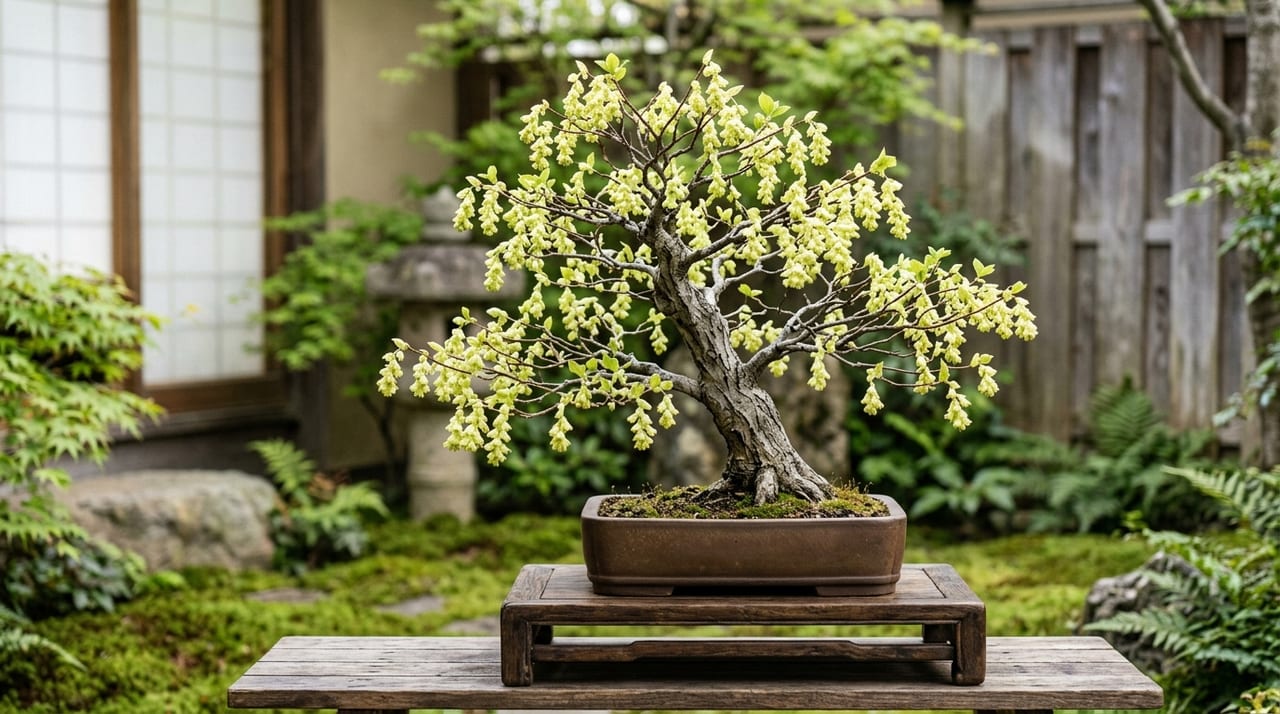
The greatest attraction of Tosaminzuki as a bonsai material is undoubtedly the delicate yellow flowers that hang in clusters in early spring. From mid-March through early April, the flowers bloom before the leaves emerge, so the spike-like flower clusters line the branch tips densely and stand out brilliantly in the clear spring light. The flowers have a subtle, refined fragrance, and each time you pass nearby, they remind you of the season's arrival, offering enjoyment beyond mere visual appreciation.
In early summer, soft new growth spreads across the tree, and in autumn the leaves turn yellow to orange. In winter, the tree sheds its leaves and becomes bare branches, yet the fine, branching structure of the twig tips is beautiful, and you can fully savor the four seasons' changes in a single pot. Compared to Hyūgamizuki (another member of the Hamamelidaceae), Tosaminzuki has longer flower clusters and a more showy impression. While it is popular as a garden tree, training it as a bonsai concentrates its charm even further.
Basic Care: Location, Watering, and Soil
Location Throughout the year, keep the tree outdoors in a bright, sunny spot as the basic rule. Insufficient light weakens the development of flower buds and reduces the number of flowers the following spring. A south- or east-facing location is ideal. However, direct afternoon sun during peak summer (July–August) can cause leaf scorch, so it is advisable to cut 30–50% of sunlight with a shade cloth or move the tree to a semi-shaded location.
In winter, maintain outdoor placement even after leaf drop. Cold exposure is essential for flower bud differentiation and development, so it is important to expose the tree to natural cold air while providing simple wind protection such as under eaves. Bring the tree indoors only minimally, such as when frost directly threatens it.
Watering This species develops fine roots, so both drought and overwatering cause damage. During the growing season (May–September), the basic rule is to water thoroughly when the soil surface becomes dry; on hot days, watering may be needed twice daily. From autumn through winter, water demand decreases, so switch to management that keeps the soil slightly dry while avoiding complete desiccation. Water in early morning or late morning for best results.
Soil A mix prioritizing drainage and aeration is best suited. A commonly used formula is 60% medium-grain akadama, 20% kanuma soil, and 20% leaf mold. If using commercially available bonsai soil, avoiding overly fine-grained products reduces root rot risk.
Repotting Timing and Procedure
The ideal time for repotting is in spring, immediately after flowering (late March through mid-April). At this time, new bud activity has begun, and the roots are in a highly recuperative state. Young trees (approximately five years old or less) should be repotted annually; more mature trees can be repotted every 2 to 3 years. Signs that repotting is needed include roots protruding from the pot drain holes or water running off the soil surface rather than soaking in.
The repotting procedure is as follows:
- Remove the tree from the pot and gently loosen the old soil around the outer edge of the root mass using your fingers or tweezers.
- Avoid injuring the fine roots; remove roots that have become compacted and blackened or are rotted using clean scissors. Aim to reduce the root mass by approximately one-third overall, but be cautious not to cut too much at once, which weakens the tree.
- Place drainage netting in a new pot, add a thin layer of stones at the bottom, then repot with fresh soil.
- After repotting, place the tree in shade or semi-shade for 1 to 2 weeks to allow recovery; return to normal care once the roots have settled.
Pruning and Wiring | Shaping the Tree Form
Pruning and wiring work can be organized by timing and key points as follows:
| Work | Timing | Points |
|---|---|---|
| Pinching new shoots | Around May–June | Pinch off the tips of excessively long new shoots. This suppresses apical dominance and encourages lateral branch development, building a finely branched structure. Rather than cutting heavily all at once, the key is to repeat pinching gradually while observing the tree's response. |
| Winter pruning | December–January (dormant season) | While preserving flower buds as much as possible (which are rounded, larger than leaf buds, and clustered toward branch tips), remove vigorous shoots, unnecessary upright branches, inward-facing branches, and crossing branches. When in doubt, it is better to be conservative and leave branches than to cut too heavily, allowing you to enjoy next spring's flowers. |
| Wiring | Growing season (when branches thicken rapidly) | When adjusting the angle of young branches, wrap with aluminum wire to guide them. Since Tosaminzuki's bark is relatively tender, wrapping a protective material (washi paper, raffia, etc.) under the wire before application prevents marks. Plan to remove the wire after 3 to 4 months and monitor carefully for wire marks. |
Fertilizing and Tips for Promoting Flowering
Fertilizer Application Tosaminzuki is sensitive to excess fertilizer; over-fertilizing causes vigorous, excessively long growth that disrupts tree form and can damage roots. From spring budbreak through early summer (March–June), apply slow-release solid fertilizer or liquid fertilizer with slightly higher nitrogen content 1 to 2 times monthly. During summer, reduce fertilizing; in autumn (September–October), switch to a formula emphasizing phosphorus and potassium to strengthen the tree. Stop fertilizing during winter dormancy.
Key Points for Promoting Full Flowering
First, cold exposure in winter is essential. Exposing the tree to temperatures below 5°C promotes flower bud differentiation and development. Mild winters often result in fewer flowers for this reason. Second, autumn and later pruning (October onward) easily damages flower buds, so aim to complete major structural adjustments after flowering. Additionally, slightly drier management during winter helps firm the roots and positively affects flower bud formation.
Regarding pests and disease, Tosaminzuki is relatively hardy, though scale insects occasionally develop in the crevices of bark. If found, gently scrub them away with an old toothbrush and spray with machine oil emulsion for control. In the humid conditions of the rainy season, powdery mildew may appear, so ensuring good air circulation and promptly removing infected leaves prevents problems.
Long-Term Tree Form Development and Enjoyment
One of the joys of Tosaminzuki bonsai is watching the trunk develop character over years and decades. The smooth bark of a young tree gradually becomes grayish-brown and takes on a settled character as 10 or 20 years pass, with fine vertical wrinkles gradually etched into the surface. An old specimen retains a distinctive presence even in winter when bare of leaves, displaying only the branch structure.
The tree form—such as a multi-trunk cluster, upright trunk, or informal style—is best chosen based on your preferences and the material's individual character. An informal style that takes advantage of the tree's naturally fine and branching character is relatively easy for beginners. Multi-trunk cluster forms create a spectacular scene when the flowers bloom abundantly in spring.
The essence of bonsai lies in enjoying the dialogue with the tree through the repetition of annual pinching, pruning, and fertilizing. Tosaminzuki is particularly rewarding because it responds with flowers in early spring, making you feel the rewards of patient winter care. As you care for it over the long term and gradually develop your ideal tree form—through that slow accumulation of time—you will discover that this gradual process itself is the greatest charm of Tosaminzuki bonsai.