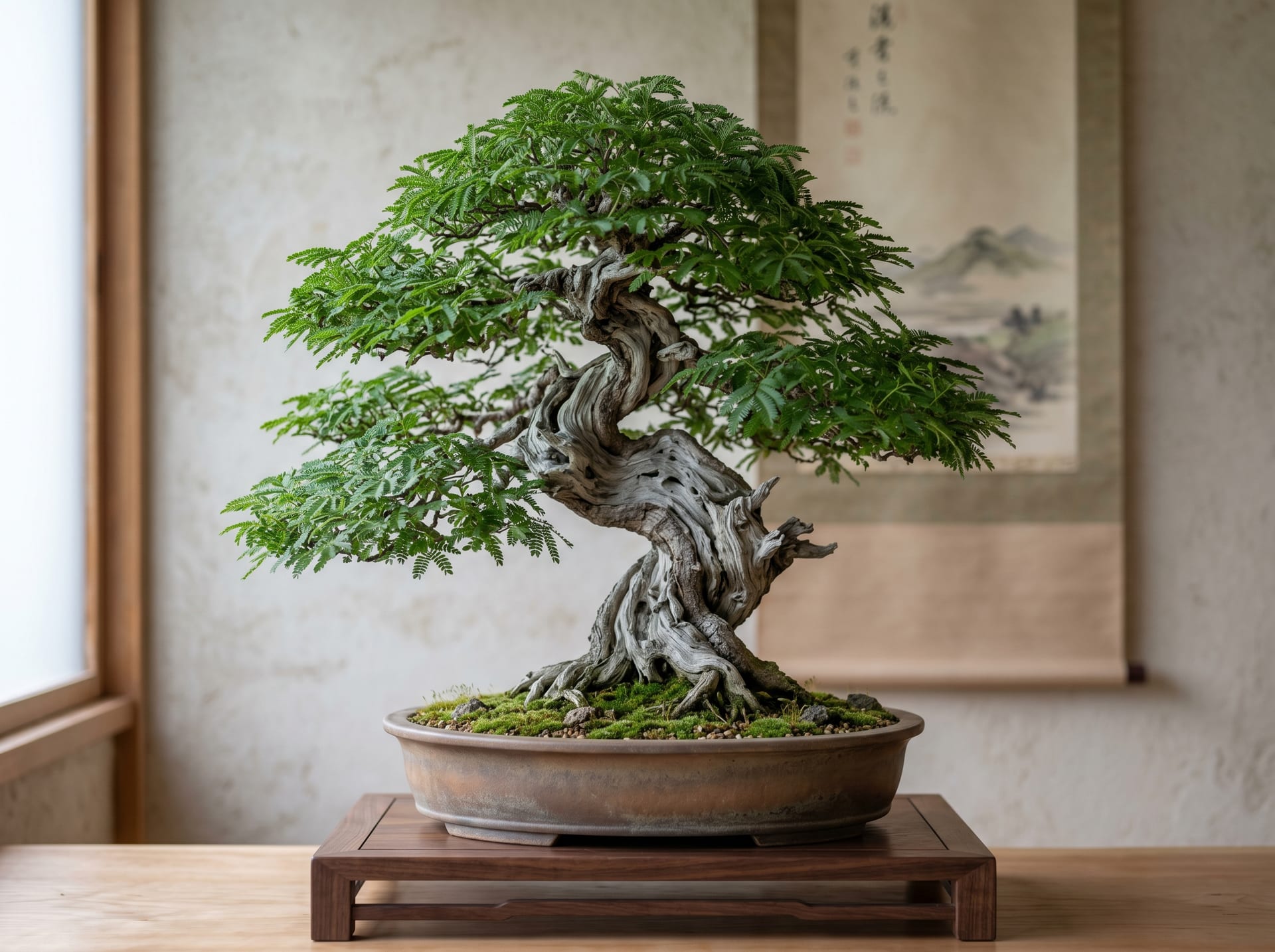
AI-generated image
Brazilian Rain Tree
IntermediateChloroleucon tortum
Tropical tree characterized by nyctinastic leaf movements, closing at night and in rain. Delicate pinnate leaves and white flowers. Peeling bark adds interest. Indoor management required.
About
Pithecellobium tortum, commonly known as the Brazilian rain tree, is a semi-evergreen shrub or small tree in the family Fabaceae, native to Brazil and other parts of South America. Its most distinctive and well-known characteristic is nyctinasty: the bipinnate leaves fold closed at night and on overcast or rainy days, opening again in sunlight — the behavior that gives the tree its common name. In bonsai, this leaf movement adds a dynamic, living quality rarely seen in other species. The delicate, finely divided pinnate leaves create a feathery texture, white flowers appear seasonally, and the trunk tends to develop a naturally twisted, tortuous form with attractive mottled bark. It is one of the most popular tropical bonsai species in Japan.
Lifespan of the Brazilian Rain Tree
The Brazilian Rain Tree lives 30+ years (as bonsai).
Size of the Brazilian Rain Tree
The Brazilian Rain Tree grows to 15-50cm (bonsai size).
Basic Info
Origin
South America (Brazil)
Lifespan
30+ years (as bonsai)
Size
15-50cm (bonsai size)
Temperature
-5〜35℃
Watering & Fertilizer
Fertilizer (regular)
Growing Tips
Placement
Bright indoor spot. Minimum 15°C
Watering
Loves water. Water before completely dry. Daily misting
Styling
Utilize delicate branching. Wire to direct branch angles
Notes
Very cold-sensitive. Air conditioning drafts damage leaves
Brazilian Rain Tree FAQ
QWhat is the growing difficulty level for Brazilian Rain Tree?
Intermediate. A variety suitable for intermediate growers. Requires some cultivation experience and knowledge of environment management. Pay careful attention to temperature and humidity control.
QWhat is the lifespan of Brazilian Rain Tree?
The average lifespan of Brazilian Rain Tree is 30+ years (as bonsai). With proper cultivation environment and nutrient management, you can keep it healthy for a long time.
QHow large does Brazilian Rain Tree get?
The mature size of Brazilian Rain Tree is 15-50cm (bonsai size). This may vary slightly depending on cultivation environment and individual differences.
QHow should I water and fertilize Brazilian Rain Tree?
Brazilian Rain Tree: watering & fertilizer — Fertilizer (regular). Aim for appropriate frequency and amount.
QWhat is the typical price for Brazilian Rain Tree?
The price of Brazilian Rain Tree varies significantly by variety, characteristics, size, and lineage. Please check GrowerDirect's price guide for the latest market information.
Last updated: June 24, 2026
Growing Specifications
- USDA Zone
- 10–11
References & Sources
Edited & verified by: GrowerDirect Editorial Team
The classifications, regulations, and growing data on this page are created and verified based on the primary information database below.
Taxonomy & Authority
Regulations & Conservation Status
Sources: CITES Checklist of CITES Species
Regulations may change. Always verify the latest information with the relevant authorities.
Related Species
Find listings for this species
Related Articles
10 Recommended Bonsai Species for Beginners | A Beginner's Guide: Choosing by Ease of Care and Appeal
A guide for beginners looking to start bonsai, introducing 10 carefully selected, easy-to-grow and attractive species. We explain in detail the characteristics, difficulty level of care, seasonal highlights, and price range for each species, helping you choose the right first tree for you.
Bonsai Wiring Guide | Fundamentals and Advanced Techniques for Shaping
A detailed guide to bonsai wiring techniques. Covers wire types and sizing, basic winding methods, shaping tips, timing for wire removal, and species-specific considerations—all the fundamentals of styling.
Guide to Growing Fruit-Bearing Bonsai | Enjoying the Fruit of Hime Apple, Rouyakaki, and Pyracantha
A comprehensive guide to growing fruit-bearing bonsai. Introduces how to select representative tree species such as hime apple, rouyakaki, and pyracantha, pruning and fertilization techniques for fruit bearing, pollination tips, and points for appreciation.
Agave Styling & Training Guide — Correcting Form, Adjusting Angles & Coordinated Presentation
How to style agave for maximum beauty: correcting distorted rosettes, adjusting planting angle, choosing coordinating pots, and practical techniques that highlight spines and elevate display value.
🩺 Common diseases
Can't find the plant you're looking for?
Post your wishes for free and growers with matching plants will contact you with introductions.