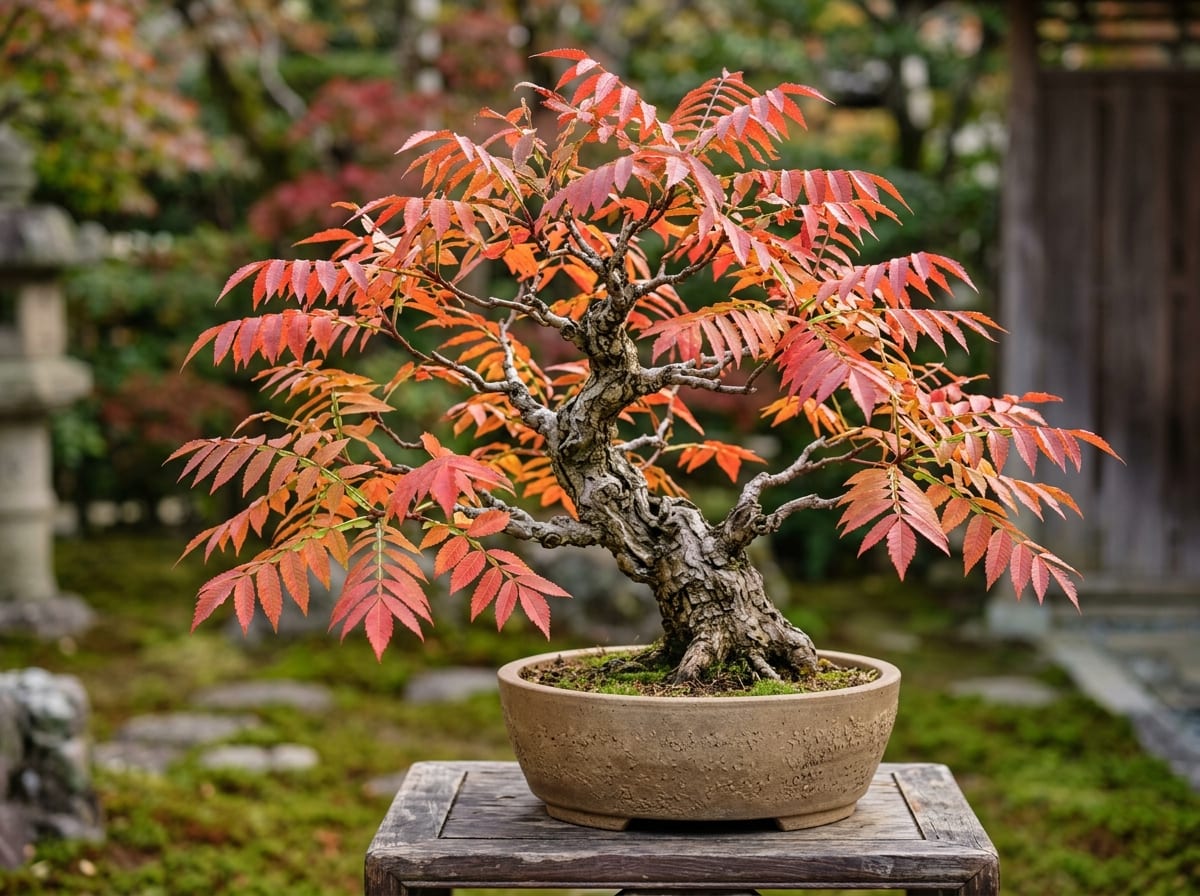
AI-generated image
Japanese Sumac
BeginnerRhus chinensis
A small deciduous tree of the cashew family, recognized by the winged axis of its pinnate leaves. Grown as small bonsai for its vivid red autumn color and natural form.
Overview
Rhus chinensis, known in Japanese as nurude (白膠木) and in English as Chinese sumac, is a small deciduous tree in the cashew family (Anacardiaceae). It grows wild throughout Japan from Hokkaido to Okinawa and ranges across the Korean Peninsula, China and Southeast Asia to the Himalayas. A hardy pioneer, it is quick to colonize clearings and forest edges. The leaves are odd-pinnate, and the leaf axis between the leaflets carries a narrow wing, which distinguishes it from the similar-looking lacquer tree and wax tree. Plants are either male or female, and creamy white flowers open in large panicles in late summer. In autumn the foliage turns a vivid red, making it one of the signature trees of Japan's mountain autumn color. Galls formed on the leaves by aphids, called gobaishi, are rich in tannin and were once used for teeth blackening and dyeing. The name nurude is said to come from the white sap from a wounded trunk, which was used as a coating. Although it is related to the lacquer tree, it is considered much less irritating; sensitive people can still develop a rash, so wear gloves when pruning or repotting. As bonsai it is valued for its autumn color and rustic, natural form. Give it full sun and a free-draining mix. It grows quickly, so cut back extended shoots regularly to keep the shape. Repot every two to three years in spring before the buds open.
Source: Wikipedia (CC BY-SA 4.0)
Lifespan of the Japanese Sumac
The Japanese Sumac lives 30-50 years (as bonsai).
Size of the Japanese Sumac
The Japanese Sumac grows to 10-50cm (bonsai size).
Temperature & humidity for the Japanese Sumac
The Japanese Sumac tolerates temperatures of ≥-15℃.
Basic Info
Origin
Japan (Hokkaido to Okinawa), the Korean Peninsula, China, and Southeast Asia to the Himalayas
Lifespan
30-50 years (as bonsai)
Size
10-50cm (bonsai size)
Temperature
≥-15℃
Watering & Fertilizer
Fertilizer (regular)
Growing Tips
Placement
Sun to semi-shade. Hardy and adaptable
Watering
Water thoroughly when topsoil dries. Standard watering is fine
Styling
Emphasize natural form. Clump style is also charming
Notes
Sap may cause rash. Gloves recommended
Japanese Sumac FAQ
QWhat is the growing difficulty level for Japanese Sumac?
Beginner. A variety suitable for beginners. No special equipment or experience is required—you can grow it without problems by setting up a basic cultivation environment.
QWhat temperatures can Japanese Sumac tolerate?
Japanese Sumac tolerates temperatures of ≥-15℃. This is the tolerated range, not the ideal growing temperature. Keep conditions well inside it and avoid sudden temperature changes.
QWhat is the lifespan of Japanese Sumac?
The average lifespan of Japanese Sumac is 30-50 years (as bonsai). With proper cultivation environment and nutrient management, you can keep it healthy for a long time.
QHow large does Japanese Sumac get?
The mature size of Japanese Sumac is 10-50cm (bonsai size). This may vary slightly depending on cultivation environment and individual differences.
QHow should I water and fertilize Japanese Sumac?
Japanese Sumac: watering & fertilizer — Fertilizer (regular). Aim for appropriate frequency and amount.
QWhat is the typical price for Japanese Sumac?
The price of Japanese Sumac varies significantly by variety, characteristics, size, and lineage. Please check GrowerDirect's price guide for the latest market information.
Last updated: October 2, 2026
References & Sources
Edited & verified by: GrowerDirect Editorial Team
The classifications, regulations, and growing data on this page are created and verified based on the primary information database below.
Primary sources
Taxonomy & Authority
Accepted name: Rhus chinensis Mill.
Synonyms: Rhus javanica var. chinensis
Authority databases: GBIF
Nomenclature follows global taxonomic authority databases.
Regulations & Conservation Status
Sources: CITES Checklist of CITES Species
Regulations may change. Always verify the latest information with the relevant authorities.
Related Species
Find listings for this species
Related Articles
Cherry Blossom Bonsai Care Guide | Complete Tips for Blooming
Detailed explanation of watering, pruning, and repotting timing for cherry blossom bonsai that blooms in full on a small pot.
Wisteria Bonsai: Cultivating Wisteria | Basics of Trellis Training and Pruning for Climbing Flowering Trees
An explanation of how to train wisteria, a climbing flowering tree, as bonsai. This guide covers the unique aspects of wisteria bonsai, from trellis construction and guiding the vine, to the timing of pruning to encourage blooming and watering and fertilizer management.
Complete Bonsai Tree Selection & Development Roadmap for Beginners | Phase-by-Phase Management Strategy from Year 1 to Year 5
Bonsai success for beginners depends on choosing the right tree species. This guide details the process of selecting beginner-friendly species like five-needle pine and shimpaku juniper, and developing them into refined bonsai through phased management over five years. We provide a five-year roadmap that advances through tree form foundation building, adjustment, and completion.
Bonsai Aged Wood Techniques | Creating Branch Aging Expression and Tree Age Aesthetics
Explains techniques for creating bonsai that appear aged from young stock. Introduces practical methods for expressing tree age aesthetics, from bark texture and branch structure to root development expression and changes over time.
🩺 Common diseases
Can't find the plant you're looking for?
Post your wishes for free and growers with matching plants will contact you with introductions.