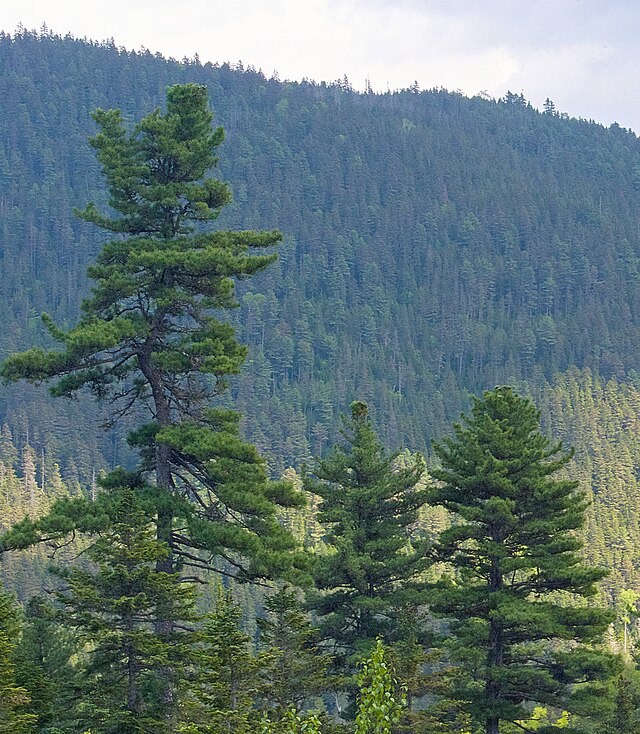
Source: Wikimedia Commons
Korean Pine
IntermediatePinus koraiensis
Close relative of Japanese white pine with larger cones and edible pine nuts. Native to Korea, China, and Russia. Very cold-hardy with powerful trunks and rich foliage.
About
Pinus koraiensis is a species of pine known commonly as the Korean pine. It is a relic species of the Tertiary, identified as a rare tree species by United Nations. It is native to eastern Asia, in Korea, northeastern China, the temperate rainforests of the Russian Far East, and central Japan. In the north of its range, it grows at moderate elevations, typically 600 to 900 metres, whereas further south, it is a mountain tree, growing at 2,000 to 2,600 m elevation in Japan. Other common names include "Chinese pinenut". The ancient woodland of P. koraiensis on the earth is about 50 million hectares, and China has about 30 million hectares, accounting for 60%. It is a second-class national key protected plant in China. P. koraiensis is a tree species with high economic and ecological value. The official name in Chinese is "红松 hóng sōng/red pine", because almost every part of it is related to red.
Source: Wikipedia (CC BY-SA 4.0)
Lifespan of the Korean Pine
The Korean Pine lives Centuries.
Size of the Korean Pine
The Korean Pine grows to 15-70cm (bonsai size).
Basic Info
Origin
East Asia (Korea, northeastern China, Russian Far East) and Japan
Lifespan
Centuries
Size
15-70cm (bonsai size)
Temperature
-5〜35℃
Watering & Fertilizer
Fertilizer (regular)
Growing Tips
Placement
Full sun outdoors. Tolerates extreme cold
Watering
Same as white pine. Water when topsoil dries
Styling
Informal upright and twin trunk suit well. Pinch for ramification
Notes
Needs heat protection in warm regions. Move to semi-shade
Korean Pine FAQ
QWhat is the growing difficulty level for Korean Pine?
Intermediate. A variety suitable for intermediate growers. Requires some cultivation experience and knowledge of environment management. Pay careful attention to temperature and humidity control.
QWhat is the lifespan of Korean Pine?
The average lifespan of Korean Pine is Centuries. With proper cultivation environment and nutrient management, you can keep it healthy for a long time.
QHow large does Korean Pine get?
The mature size of Korean Pine is 15-70cm (bonsai size). This may vary slightly depending on cultivation environment and individual differences.
QHow should I water and fertilize Korean Pine?
Korean Pine: watering & fertilizer — Fertilizer (regular). Aim for appropriate frequency and amount.
QWhat is the typical price for Korean Pine?
The price of Korean Pine varies significantly by variety, characteristics, size, and lineage. Please check GrowerDirect's price guide for the latest market information.
Last updated: June 24, 2026
Growing Specifications
- USDA Zone
- 3–7
References & Sources
Edited & verified by: GrowerDirect Editorial Team
The classifications, regulations, and growing data on this page are created and verified based on the primary information database below.
Taxonomy & Authority
Accepted name: Pinus koraiensis Siebold & Zucc.
Synonyms: Apinus koraiensis (Siebold & Zucc.) Moldenke, Pinus mandschurica Rupr., Strobus koraiensis (Siebold & Zucc.) Moldenke, Pinus strobus Thunb., Pinus prokoraiensis Y.T.Zhao, J.M.Lu & A.G.Gu
Authority databases: GBIF · POWO
Nomenclature follows global taxonomic authority databases.
Regulations & Conservation Status
The Russian population is listed in CITES Appendix III, but the listing covers only logs, sawn wood and veneer sheets; live plants (bonsai and seedlings) are not covered.
Sources: CITES Checklist of CITES Species / CITES Checklist (Pinus koraiensis)
Regulations may change. Always verify the latest information with the relevant authorities.
Related Species
Find listings for this species
Related Articles
Pine and Cypress Bonsai Care Calendar | Monthly Work Guide
Monthly management schedule for pine and cypress bonsai (black pine, five-needle pine, Shinpaku, etc.). Explains the annual plan for bud pinching, leaf thinning, wiring, and fertilization.
Complete Manual for Pine Bonsai Bud Removal (Green Pruning) — Care of Black Pine and Japanese Five-Needle Pine
A detailed explanation of the timing and methods for bud removal (green pruning) on pine bonsai. Introduces different bud-cutting schedules for black pine and Japanese five-needle pine, second-bud adjustment, old-leaf removal techniques, and short-leaf styling methods.
Black Pine Bud Pinching and Annual Canopy Management | Timing of Bud Pinching, Style-Specific Management (Formal Upright, Slanting, Cascade), and Tree Age & Cultivation Years
An explanation of the timing and technique for black pine bonsai bud pinching (green pinching), style-specific management for formal upright, slanting, and cascade forms, and cultivation principles according to tree age, all presented with an annual management schedule.
Agave Spine Terminology Explained | Differences Between Marginal Teeth, Terminal Spine, and Pencil
A detailed explanation of specialist terminology related to agave spines. This guide introduces the meanings and how to view marginal teeth, terminal spines, pencils, teeth, and other terms, as well as the differences by variety.
🩺 Common diseases
Can't find the plant you're looking for?
Post your wishes for free and growers with matching plants will contact you with introductions.