Agave Spine Terminology Explained | Differences Between Marginal Teeth, Terminal Spine, and Pencil
A detailed explanation of specialist terminology related to agave spines. This guide introduces the meanings and how to view marginal teeth, terminal spines, pencils, teeth, and other terms, as well as the differences by variety.
Key Takeaways
A detailed explanation of specialist terminology related to agave spines. This guide introduces the meanings and how to view marginal teeth, terminal spines, pencils, teeth, and other terms, as well as the differences by variety.
A significant portion of the charm of agave lies in the various forms of spines that grow on the edges and tips of the leaves. Among collectors, the shape, color, and arrangement of spines are important criteria for measuring the appeal of a variety. However, terminology related to spines is specialized and often difficult to understand for beginners. Here we will systematically explain the terminology related to agave spines to help guide your selection of varieties.
Marginal Teeth
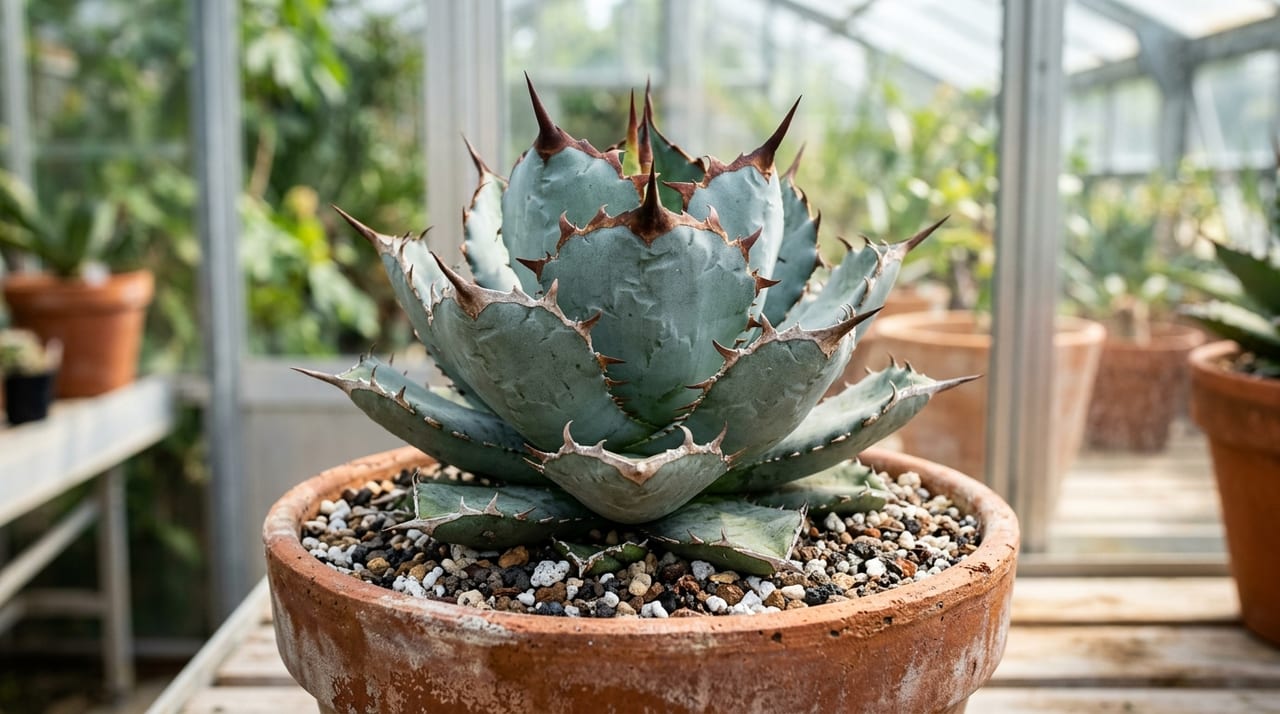
Marginal teeth (Marginal teeth / Marginal spines) are the spines that line the edges of agave leaves and are one of the most distinctive structures of agave. Also called "teeth," the shape, size, spacing, and color differ by variety.
Differences by variety are as follows:
| Variety | Characteristics of Marginal Teeth |
|---|---|
| Titanota | Large and sharp, with white to gray marginal teeth densely lined along the leaf edges. The size of the marginal teeth varies by variety and clone; the marginal teeth of "White Whale" are thick and rounded in shape, while those of "Caesar" are even larger and rugged in form. |
| Horrida | Wide spacing with each one being large. Gray-white to brown in color, with a strong angle protruding away from the leaf, characteristic of this variety. |
| Lophantha | Small and fine, densely arranged along the leaf edges. The overall impression is delicate, without the roughness seen in Titanota. |
The color of marginal teeth changes not only by variety but also by cultivation environment. When exposed to strong ultraviolet light, they tend to become white and hardened, and under indoor management, the color may fade. To produce well-developed marginal teeth, outdoor management in direct sunlight is ideal.
Collectors emphasize the following points as evaluation criteria for marginal teeth:
- Size
- Density
- Uniformity
- Whiteness of color
Because there is significant individual variation even within the same variety, the way marginal teeth develop on each individual plant affects the value of that plant.
Terminal Spine
The terminal spine (Terminal spine / End spine) is a single thick spine at the tip of the leaf. Also called "terminal spine," it is the sharpest weapon of an agave.
The length of the terminal spine varies widely by variety, ranging from 1 to over 10 cm, and the color varies—black, reddish-brown, gray, ivory, and so on. The ivory-colored terminal spines of Utahensis Evolispina are especially prized and are highly coveted by collectors.
The shape of the terminal spine is also a point of identification for varieties:
- Titanota: Thick and relatively short, mostly black to reddish-brown in color, with a sharp, pointed tip.
- Horrida: Has longer terminal spines with a beautiful gray to black coloration.
As a management note, terminal spines are extremely sharp and have enough strength to penetrate human skin. In environments with children or pets, options include cutting off the tip or protecting it with a cork stopper. However, since it does not regenerate when cut, this diminishes the ornamental value.
A structure that accompanies the terminal spine is the "decurrent spine." This is a spine that flows from the terminal spine along the leaf edge, with the base of the spine running along the leaf surface. Varieties with a clear manifestation of this structure have a particularly artistic appearance.
Pencil, Butt Teeth, and Cat's Claw
Let us also touch on spine descriptive expressions used among collectors.
- Pencil: Refers to when marginal teeth or terminal spines are shaped like a pencil—thin and elongated. This expression is seen in some Utahensis or specific clones of Titanota. Called "pencil spines," these unusually thin and long spines have a delicate beauty.
- Butt Teeth: Refers to a state where marginal teeth are irregularly arranged or abnormally enlarged. Many collectors prefer rugged butt teeth to orderly arranged marginal teeth, and they may be appreciated as individuality of the variety.
- Cat's Claw: Refers to when marginal teeth are curved like a cat's claw. Characterized by a curved shape that arcs outward from the leaf edge, this is seen in Agave of the Filifera group and some clones of Titanota.
- Water Mark: Although not a spine, it refers to patterns that appear on the leaf surface—marks left by the marginal teeth of the previous leaf being pressed against it. A neat water mark is evidence of dense and large marginal teeth, and it is evaluated as an indicator of the quality of the variety.
Spine Color and Factors in Color Change
Spine color is an important element in the ornamental value of agave. Let us understand the factors that influence color.
Spine color is determined mainly by the content of plant polymers such as lignin and suberin, as well as the amount of ultraviolet light exposure. Spines on newly developed leaves are often reddish-brown or yellow in color, and some varieties (such as White Whale Titanota) fade to white over time, while others turn black.
To produce white spines, strong ultraviolet light and a dry environment are effective. Plants grown in outdoor direct sunlight have noticeably whiter spines compared to indoor plants. Plants grown under LED grow lights tend to have somewhat weaker color development in their spines due to insufficient ultraviolet light. Some growers use UVB lighting as a supplement.
Many collectors also appreciate black spines, and the black terminal spines of Horrida and Utahensis are particularly popular. Black spines are seen more often on mature plants, while young plants generally remain reddish-brown.
Cultivation Techniques for Beautiful Spine Development
Here is a summary of key points in cultivation management to produce beautiful spines.
- Light: The most important factor. Exposing the plant to as much direct sunlight as possible throughout the year has a direct impact on spine development and color development. Ensure at least 6 hours of direct sunlight daily.
- Watering with Emphasis: Affects spine development. Providing adequate watering during the growth period to promote leaf expansion, followed by slightly drier management, allows spines to develop hard and firm. Constantly wet conditions tend to result in weak, soft spines.
- Fertilizer: Keep it minimal. Excessive nitrogen causes leaves to grow too soft, which can throw off the balance of spines. A formulation with slightly higher phosphorus and potassium is suitable for creating firm leaves and beautiful spines.
- Cold Stimulation: Said to be effective for spine development. Agave tends to harden spines as a stress response from experiencing temperature fluctuations. Having the plant spend the cool autumn and winter months outdoors results in well-developed spines on leaves that emerge the following spring.
If you want to obtain agave with beautiful spines, GrowerDirect is recommended, where you can check actual photos before purchasing. With photos of plants actually grown by growers, you can verify the condition of the spines, and you can also consult directly with the grower about spine development.
Appreciation Points for Spines and the Joy of Collecting
Agave spines are a deeply fascinating subject that offers increasingly rich appreciation as knowledge deepens.
Enjoying how its expression changes with the direction of light is also one of the delights of spine appreciation.
- When side lighting is applied, the irregularities of the marginal teeth are emphasized and three-dimensionality stands out.
- When photographed against the light, translucent spines transmit light and sometimes display a jewel-like beauty.