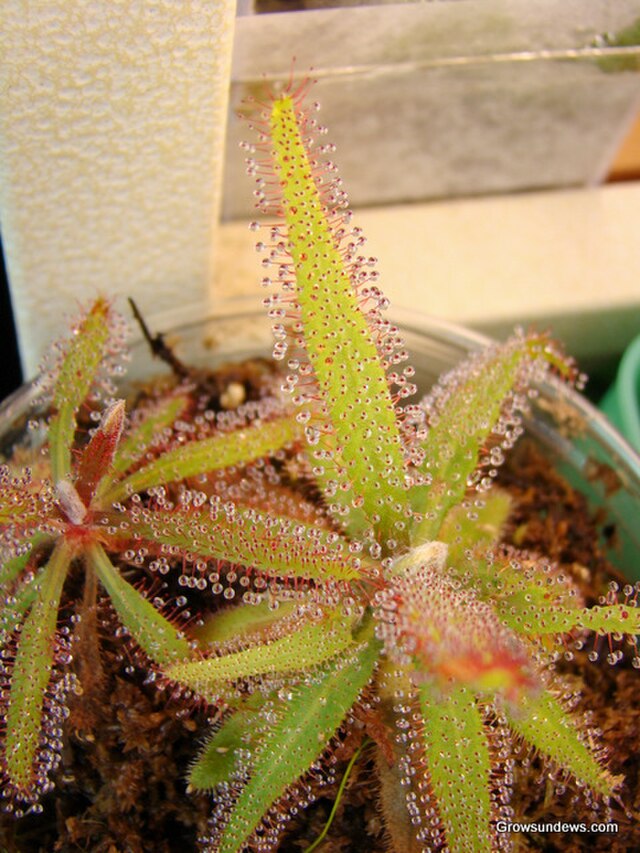
Source: Wikimedia Commons
Drosera Adelae
BeginnerDrosera adelae
An Australian sundew preferring partial shade with long lance-shaped leaves.
About
Drosera adelae, the lance-leaved sundew, is native to the humid tropical rainforest understory of northeastern Queensland, Australia, growing along shaded stream banks and on moist rock faces. Unlike the majority of sundews, which require intense sunlight, D. adelae is adapted to low-light conditions and thrives in bright indirect light or partial shade—making it unusual and valuable for indoor cultivation on windowsills. Its lance-shaped leaves bear mucilage-tipped tentacles that trap small insects, and the plant propagates readily from root cuttings and adventitious plantlets.
Lifespan of the Drosera Adelae
The Drosera Adelae lives 5+ years.
Size of the Drosera Adelae
The Drosera Adelae grows to 10-20cm.
Temperature & humidity for the Drosera Adelae
Cultivation requires consistently moist sphagnum media, tray watering with pure or rainwater, and warm temperatures of 20–30°C. It is intolerant of cold below about 5°C.
Basic Info
Origin
Northeastern Queensland, Australia, shaded tropical rainforest stream banks and moist rock faces
Lifespan
5+ years
Size
10-20cm
Temperature
10〜30℃
Humidity
60〜90%
Watering & Fertilizer
Insects (auto-capture)
Growing Tips
Light & Placement
Avoid direct sun and grow it in partial shade to bright indirect light. It also does well on a bright indoor windowsill.
Watering
Keep the sphagnum moist by tray watering or constant moisture, using purified water or rainwater. Never let it dry out.
Temperature & Overwintering
It likes warm, humid conditions at 20-30°C. It is not cold hardy and dies below 5°C, so keep it indoors in winter.
Soil & Repotting
Plant in moist sphagnum moss alone. It readily produces offsets from the roots, so divide and repot when crowded.
Propagation
It multiplies vigorously by sending up plantlets from the roots. Simply separate and pot the offsets.
Drosera Adelae FAQ
QWhat is the growing difficulty level for Drosera Adelae?
Beginner. A variety suitable for beginners. No special equipment or experience is required—you can grow it without problems by setting up a basic cultivation environment.
QWhat is the lifespan of Drosera Adelae?
The average lifespan of Drosera Adelae is 5+ years. With proper cultivation environment and nutrient management, you can keep it healthy for a long time.
QHow large does Drosera Adelae get?
The mature size of Drosera Adelae is 10-20cm. This may vary slightly depending on cultivation environment and individual differences.
QHow should I water and fertilize Drosera Adelae?
Drosera Adelae: watering & fertilizer — Insects (auto-capture). Aim for appropriate frequency and amount.
QWhat is the typical price for Drosera Adelae?
The price of Drosera Adelae varies significantly by variety, characteristics, size, and lineage. Please check GrowerDirect's price guide for the latest market information.
Last updated: August 31, 2026
References & Sources
Edited & verified by: GrowerDirect Editorial Team
The classifications, regulations, and growing data on this page are created and verified based on the primary information database below.
Taxonomy & Authority
Accepted name: Drosera adelae F.Muell.
Authority databases: GBIF · POWO · ICPS cultivar registration (International Carnivorous Plant Society)
Nomenclature follows global taxonomic authority databases.
Regulations & Conservation Status
This genus is not listed in CITES Appendices (among carnivorous plants, only Nepenthes/Sarracenia/Dionaea are subject to CITES).
Sources: CITES Appendices (carnivorous plants) - ICPS/Barry Rice / CITES & Carnivorous Plant Checklist (RBG Kew)
Regulations may change. Always verify the latest information with the relevant authorities.
Related Species
Find listings for this species
Related Articles
Drosera (Sundew) Care Guide | Diverse Carnivorous Plants That Trap Insects with Sticky Secretions
Explanation of how to grow carnivorous Drosera (Sundew). We introduce the characteristics of beginner-friendly varieties such as Spatulata, Capensis, and Adelae, methods for water tray watering, light conditions, overwintering, and propagation through leaf cuttings.
Drosera Propagation Guide — Leaf Cuttings, Division & Seeds
Propagating sundews: leaf cutting technique, division method, seed sowing, and species-specific propagation recommendations.
Complete Guide to Sundew (Drosera) Cultivation | How to Bring Out the Beauty of Its Sticky Secretions
Explains varieties such as D. adelae and D. capensis, water-tray management, light requirements, and differences between temperate and tropical species.
Sundew Species and Cultivation Techniques | Bringing Out the Beauty of Mucilage
This article explains the characteristics of major sundew species and cultivation techniques (light, humidity, soil) for making mucilage shine beautifully.
Can't find the plant you're looking for?
Post your wishes for free and growers with matching plants will contact you with introductions.